Comprehensive Analysis of Electric Damper: Structure, Principle, Application and Selection Guide
Release time:2025-12-08 Visits:14
Electric damper is a core actuating component in building automation, HVAC, and industrial ventilation systems, primarily used for precise control of air flow, pressure, and direction. It drives the valve blades to rotate or open/close through an electric actuator, enabling intelligent regulation of ventilation systems. This article will detailedly analyze the structure, working principle, application scenarios, and selection key points of electric dampers.
1. Basic Structure and Composition
An
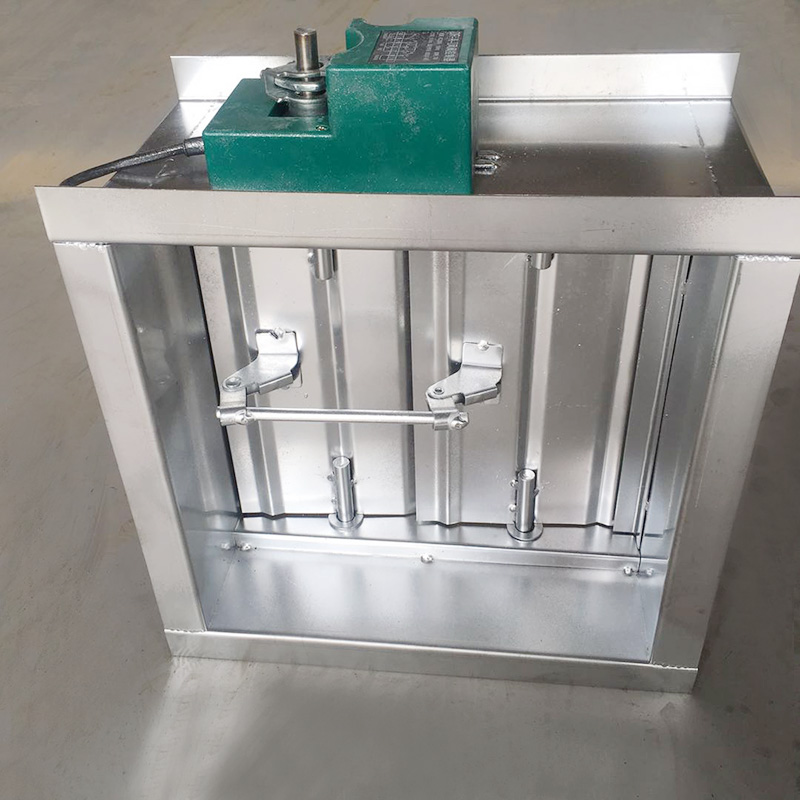
electric damper mainly consists of two parts: the valve body and the electric actuator.
The valve body is typically made of galvanized steel sheet, aluminum alloy, or stainless steel, with internal designs such as multi-leaf opposed, parallel blade, or louvered structures to ensure tightness and durability under different working conditions. Among them, the opposed multi-leaf damper has the best tightness and is suitable for high-precision air volume adjustment; the parallel blade damper has low resistance and is suitable for large flow scenarios; the louvered damper is often used in fresh air inlets or exhaust outlets, with rainproof and insect-proof functions.
The electric actuator is the driving core of the damper, divided into on-off type and regulating type according to the control signal type. The on-off actuator receives on-off signals to fully open or close the valve; the regulating actuator controls the valve for stepless adjustment within the range of 0°~90° through 0-10V or 4-20mA analog signals. In addition, the actuator can be equipped with a spring return function, which automatically returns to a safe position (such as fully open or fully closed) when power is off, suitable for safety-critical scenarios such as fire smoke exhaust. Some high-end actuators support communication protocols such as Modbus and BACnet, and can be directly connected to intelligent building systems.
2. Working Principle
Electric dampers achieve precise adjustment through closed-loop control. The control system calculates the required air volume based on sensor data (such as temperature, humidity, and pressure sensors) and sends control signals to the actuator. The internal circuit of the actuator drives the motor to rotate, and the gear set amplifies the torque to drive the valve blades to rotate, changing the cross-sectional area of the air duct. At the same time, the potentiometer or encoder in the actuator real-time monitors the valve position and sends feedback signals back to the control system to ensure that the valve opening is consistent with the command.
3. Main Application Scenarios
1. HVAC systems: Used to adjust the mixing ratio of fresh air and return air, improving indoor air quality and achieving energy saving.
2. Variable Air Volume (VAV) systems: Dynamically adjust air supply volume according to regional requirements in terminal devices.
3. Fire smoke exhaust systems: Used as smoke exhaust valves or air supply valves, which automatically open in case of fire and can fuse and close at high temperatures.
4. Industrial ventilation: Control the flow and cutoff of dust-containing gas or hot air pipelines in chemical, metallurgical and other industries.
5. Clean rooms and laboratories: Ensure environmental pressure and air flow stability through high-tightness design.
4. Selection Guide
1. Valve body selection: Determine the valve type and diameter according to duct size, air volume requirements, and allowable pressure drop. Low leakage rate dampers are suitable for clean rooms or VAV system shutdown scenarios.
2. Actuator matching:
- Clarify control requirements: Select analog actuators for adjustment scenarios and two-position actuators for on-off scenarios.
- Evaluate safety requirements: Spring return type is required for fire protection scenarios.
- Calculate torque: The output torque of the actuator must be higher than the torque required by the wind pressure with a margin reserved.
- Signal and protocol compatibility: Ensure that the actuator matches the control system's signal type (such as 0-10V) and communication protocol.
3. Environmental adaptability: For high-temperature and corrosive environments, select stainless steel valve bodies and actuators with high protection levels (IP rating).
5. Advantages and Features
Electric dampers have the advantages of precise control, fast response, and high degree of automation. Its compact structure and light weight support multi-station installation, and can improve system reliability through additional functions (such as manual emergency operation, signal feedback). With the increasing requirements for energy saving and safety, electric dampers have become an indispensable key equipment in modern ventilation systems.
 +85247166614