Detailed Explanation of Air Dampers: Types, Functions, and Selection Guide
Release time:2025-12-08 Visits:0
Air dampers, fully known as air volume control dampers, are core control components in ventilation, air conditioning, and air purification systems. They are mainly used to regulate, open/close, or isolate air flow and pressure in ducts. Their function is similar to that of faucets on water pipes, but the controlled object is air flow. The following is a comprehensive analysis of air dampers in terms of functions, types, composition, and selection.
1. Functions and Roles
The core functions of air dampers include:
1. Air Volume Regulation: Precisely control air volume by changing the opening angle of the damper blades to meet the needs of different areas.
2. Air Flow Interception: When fully closed, it can isolate the system for maintenance or fire prevention purposes.
3. Air Flow Distribution: Realize on-demand air flow distribution in complex pipelines.
4. System Balancing: Adjust air dampers during the commissioning phase to achieve the designed balance of system air volume.
2. Main Types
Air dampers can be divided into multiple categories by function:
1. Control Dampers: The most common type, which adjusts air volume through synchronous rotation of multiple blades, featuring low resistance and high precision.
2. Fire Dampers: Safety-critical equipment installed in fire compartments or machine rooms. They automatically close when the ambient temperature reaches 70°C (280°C for smoke prevention) to prevent the spread of fire.
3. Smoke and Fire Dampers: Integrate both regulation and fire prevention functions. They adjust air volume normally and close via temperature control or electrical signals in case of fire.
4. Smoke Exhaust Dampers: Normally closed, they open for smoke exhaust during a fire; they automatically close when the smoke temperature reaches 280°C.
5. Check Dampers: Allow only one-way air flow to prevent backflow, commonly used at fan outlets or kitchen ducts.
6. Pressure Relief Dampers: Maintain a specific positive pressure difference in a space (e.g., 25-30Pa) to prevent smoke intrusion and ensure normal door opening.
7. Airtight Dampers: Have extremely high sealing performance and are used to completely cut off air flow, suitable for clean rooms or laboratories.
Classification by drive mode:
- Manual Air Dampers: Adjusted by handles or worm gears, with simple structure and low cost, suitable for occasions that do not require frequent operation.
- Electric Air Dampers: Connected to electric actuators and receive electrical signals (such as 0-10V) to achieve remote automatic control, which is a standard configuration in modern building automation systems.
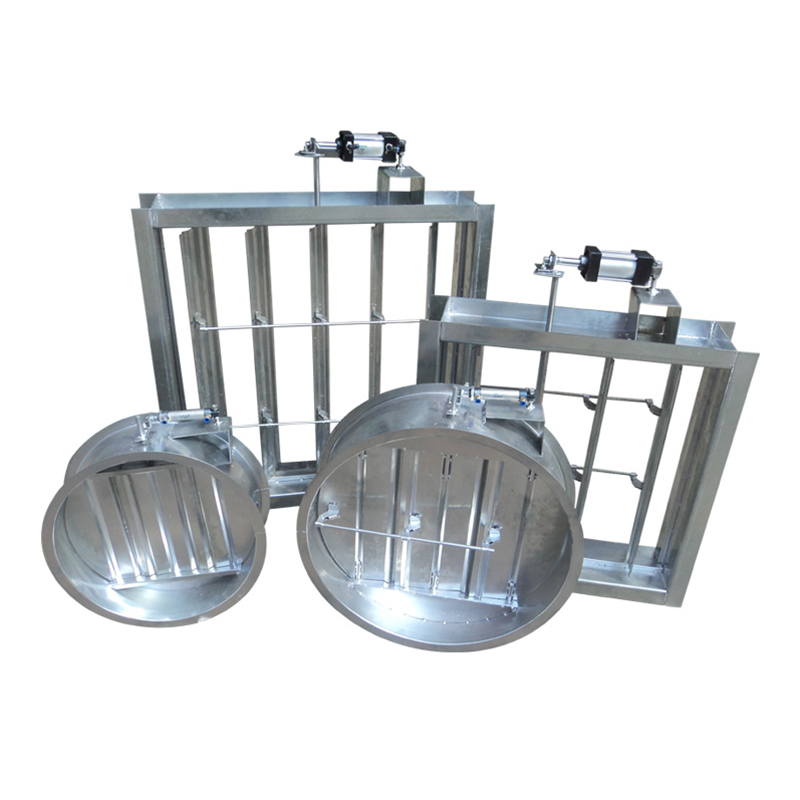
- Pneumatic Air Dampers: Driven by compressed air, mostly used in special industrial environments.
3. Key Components
Air dampers usually consist of a valve body frame, blades, shafts, bearings/bushings, seals, and actuators (manual, electric, or pneumatic). Common materials include galvanized steel sheets, aluminum alloys, or stainless steel (for anti-corrosion and explosion-proof requirements). Selection should be based on parameters such as working pressure and leakage rate.
4. Selection Points
When selecting air dampers, the following factors should be considered:
1. Functional Requirements: Clearly define the purpose such as regulation, fire prevention, or smoke exhaust.
2. Size Matching: The size of the air damper should be consistent with the air duct.
3. Leakage Rate: Airtight dampers require the minimum air leakage.
4. Drive Mode: Choose manual or electric based on the frequency of operation.
5. Material and Environmental Adaptation: Stainless steel and other materials should be selected for corrosive environments.
6. Working Pressure: Air dampers need to withstand the pressure of the pipeline system.
 +85247166614