Comprehensive Analysis of Angle Steel Flanges: Definition, Advantages, Types, and Application Guide
Release time:2025-12-08 Visits:0
Angle steel flange is a ring-shaped connector made from equilateral hot-rolled angle steel through mechanical rolling or bending, followed by welding, drilling, and other processes. It is widely used in ventilation, air conditioning, and fire smoke exhaust duct systems, primarily for connecting duct sections or ducts with equipment components to form a detachable connection system, ensuring sealing performance and structural strength.
The core advantages of angle steel flanges include high structural strength and durability, capable of withstanding large pressure and tension to ensure the stability of the duct system under positive and negative pressure conditions. The vertical surface of the angle steel provides a vertical force-bearing surface for bolt connection, and when combined with a sealing gasket, it can effectively prevent gas leakage, with better connection stability and sealing performance than flat steel flanges. In addition, angle steel flanges are suitable for ducts with various cross-sectional shapes such as rectangular, circular, and elliptical, and are particularly widely used in large-sized rectangular ducts. The raw material cost is low, the production process is mature, and the overall economy is better than that of common plate flanges, aluminum alloy flanges, and other types. The manufacturing and installation follow standards such as "Code for Construction Quality Acceptance of Ventilation and Air Conditioning Engineering" (GB50243), with strong universality.
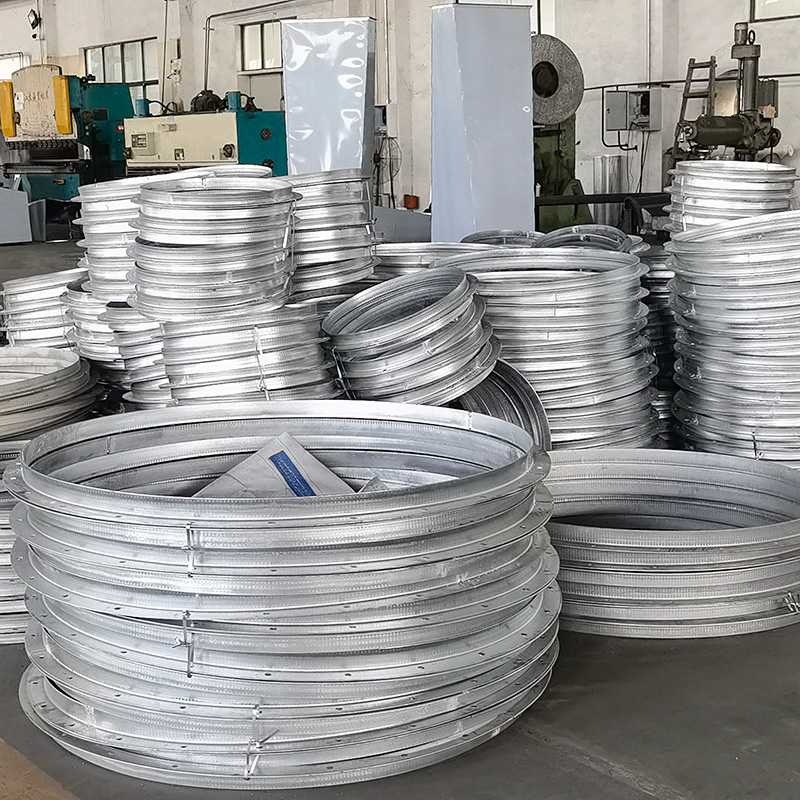
Angle steel flanges can be divided into rectangular and circular types according to the duct shape. According to the manufacturing process, they are divided into inward crimping (vertical surface facing the inside of the duct, which is the standard practice) and outward crimping (vertical surface facing outward, used for special requirements). According to the connection method, they are connected with matching flanges or with air valves and equipment interfaces. Common specifications range from 150mm to 8000mm in diameter and 3mm to 80mm in thickness, supporting customized processing of materials such as carbon steel and stainless steel.
The production process of angle steel flanges includes cold rolling and hot rolling methods. After being processed into rings, further treatments such as waterlines, spigots, and bolt holes are carried out. Its applications are not limited to duct connection but also widely used in industries such as fans, bridge formwork, chemical equipment, cable racks, and centrifuges as connecting or supporting components, featuring convenient use and low price.
Overall, with its excellent performance, economy, and adaptability, angle steel flanges have become indispensable key components in duct systems, suitable for various industrial scenarios and needs.
 +85247166614