Comprehensive Analysis of Design Specifications and Selection & Installation Key Points for Rectangular Air Ducts
Release time:2025-12-08 Visits:0
Rectangular air ducts, i.e., air ducts with rectangular cross-sections, are core components of ventilation and air conditioning systems. Their design must strictly comply with national specifications to ensure efficiency, safety, and economy. The following are the key points for design and implementation based on current standards.
1. Cross-Section Specifications and Aspect Ratio Control
Rectangular air ducts are widely used in civil buildings and low-velocity systems due to their ease of matching building spaces. The ratio of the long side to the short side (aspect ratio) should not exceed 4:1, and the maximum shall not be greater than 10:1. From a fluid mechanics perspective, a cross-section close to 1:1 has the smallest resistance and optimal economy, and it is recommended to control it within 3.0 in actual engineering. Air ducts are identified by their outer side lengths, and common standard sizes include series such as 120×120, 200×200, 400×200, 630×400, 1000×500, etc. Priority should be given to standard specifications to simplify production and installation.
2. Plate Thickness and Material Requirements
The thickness of steel plate or galvanized steel plate air ducts is determined by the length of the long side:
- When ≤320mm, the thickness is ≥0.5mm
- When 320–450mm, ≥0.6mm
- When 450–630mm, ≥0.6mm
- When 630–1000mm, ≥0.75mm
- When 1000–1250mm, ≥1.0mm
- When 1250–2000mm, ≥1.0mm
- When >2000mm, special design is required and the thickness is ≥1.2mm
Requirements for stainless steel air ducts:
- When ≤500mm, the thickness is ≥0.5mm
- When 500–1120mm, ≥0.75mm
- When 1120–2000mm, ≥1.0mm
- When 2000–4000mm, ≥1.2mm
All materials must be non-combustible, and anti-corrosion treatment or flame-retardant materials should be used in corrosive environments.
3. Air Velocity and System Balance
The recommended air velocity for main ducts is 6–14m/s, and for branch ducts is 2–8m/s. Excessively high air velocity may lead to excessive noise (e.g., noise may exceed 65dB when >15m/s), while excessively low velocity wastes space. The system needs to conduct pressure balance calculations, and the pressure loss difference between parallel loops should be controlled within 15%; otherwise, regulating devices must be installed.
4. Manufacturing and Installation Accuracy
The allowable deviation for air duct processing is strict:
- When the side length is ≤300mm, the deviation is 0 to -1mm
- When >300mm, the deviation is 0 to -2mm
The difference between the lengths of the two diagonals of a rectangular flange must be ≤3mm to ensure installation airtightness. The distance from the bottom of the air duct to the finished ceiling surface should be ≥100mm, and ≥50mm from the bottom of the beam. When passing through fire compartments, 70℃ or 280℃ fire dampers must be installed.
5. Economy and Space Adaptation
Circular air ducts are suitable for scenarios with large air volume and low resistance (such as industrial workshops), and their resistance is 20%–30% lower than that of rectangular air ducts under the same air volume. Rectangular air ducts are more suitable for narrow spaces in suspended ceilings, but the aspect ratio needs to be controlled to avoid excessive resistance. Special-shaped air ducts (such as oblate ones) are suitable for areas with limited height, but their resistance needs to be calculated separately.
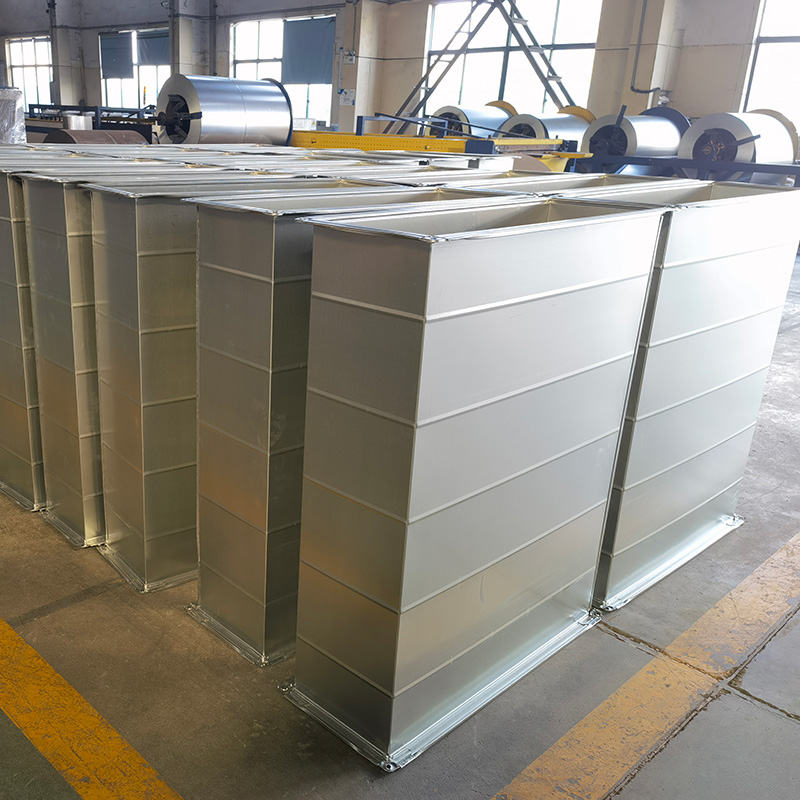
In summary, the design of
rectangular air ducts needs to comprehensively consider fluid performance, structural strength, material characteristics, and building coordination, and strictly follow national standards such as GB50019 and GB50243 to ensure efficient and reliable systems.
 +85247166614