Complete Guide to Selection and Installation of Galvanized Air Ducts: Thickness Selection and Specification Adaptation Guidelines
Release time:2025-12-08 Visits:0
As a core component of building ventilation systems, the selection, production, and installation of galvanized air ducts directly affect the safety, efficiency, and lifespan of the system. Correctly selecting duct thickness, specifications, and installation methods requires comprehensive consideration of system pressure, dimensions, installation environment, and functional requirements.
1. Scientific Selection of Duct Thickness
The selection of duct thickness is mainly determined by the system operating pressure and duct dimensions. For rectangular ducts, the long side dimension is used as the reference, while for circular ducts, the diameter is the reference.
For ordinary low-pressure ventilation systems (pressure ≤ 500Pa), when the duct side length does not exceed 320mm, the steel plate thickness should be no less than 0.5mm. For side lengths between 321mm and 630mm, the thickness needs to reach 0.6mm. When the side length is between 631mm and 1000mm, the thickness should be no less than 0.75mm. When the side length exceeds 1000mm, 1.0mm or thicker plates should be selected.
Medium-pressure air conditioning and ventilation systems (pressure 500-1500Pa) have stricter requirements. Corresponding to the above size ranges, the thickness requirements are increased to 0.6mm, 0.75mm, 1.0mm, and 1.2mm respectively.
Fire smoke exhaust systems (pressure ≤ 1500Pa) and industrial high-pressure ventilation systems (pressure 1500-3000Pa) have the highest standards. The thickness requirements for fire smoke exhaust ducts are 0.75mm, 1.0mm, 1.2mm, and 1.5mm respectively. For industrial high-pressure systems, when the duct side length is greater than 1000mm, the thickness needs to reach 1.5mm to 2.0mm.
It should be noted that circular ducts have stronger pressure resistance due to their structural advantages. Under the same pressure conditions, their required thickness can be 0.1 to 0.2mm less than that of rectangular ducts. For special environments such as concealed installation in ceilings or high-altitude installation, it is recommended to increase the thickness by 0.1 to 0.2mm on the basis of all recommended thicknesses to enhance deformation resistance. The咬口 and flange connections of the duct are weak links, and thickened steel strips can be used for local reinforcement to prevent cracking at the connection parts.
2. Specification Selection and Scene Adaptation
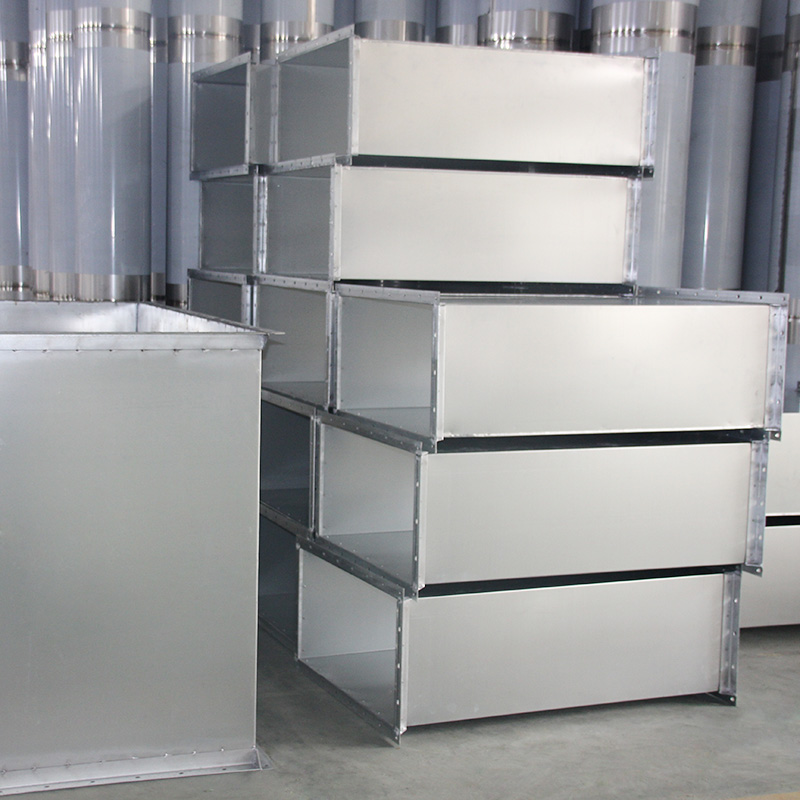
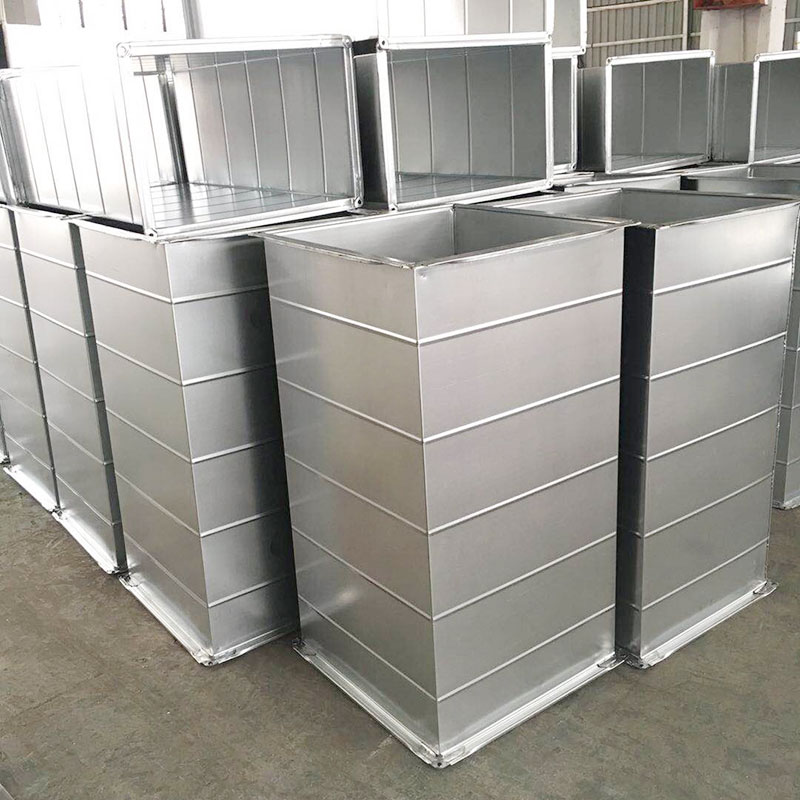
Galvanized air ducts mainly have two cross-sectional forms: circular and rectangular. Circular ducts have the advantages of low wind resistance and high strength, but they occupy a large space height and have a relatively complex production process. Rectangular ducts have more advantages in space utilization, so they have become the mainstream choice in building ventilation systems.
Duct specifications range widely. The diameter of circular ducts can be from 80mm to 2000mm, and the standard length is usually 4 meters per section, which can also be customized according to engineering needs. Galvanized air ducts are suitable for various civil and industrial building scenarios, including shopping malls, hotels, hospitals, office buildings, underground garages, factory workshops, and subways, meeting multiple functional requirements such as air supply, exhaust, and smoke exhaust.
When selecting duct specifications, comprehensive consideration should be given to the installation space, system functions, and construction environment to achieve the best balance between adaptability and economy.
3. Key Points of Production and Installation
Duct production requires multiple precise processes, including steel plate cutting,咬口 making, bending forming, flange welding, and riveting, to ensure the airtightness and structural strength of the duct.
Strict specification requirements must be followed during the installation process. For horizontal installation, when the duct diameter or long side dimension does not exceed 400mm, the distance between supports and hangers should not be greater than 4 meters; when the dimension exceeds 400mm, the distance should not be greater than 3 meters. For vertical installation, the distance should not be greater than 4 meters, and each straight pipe should be provided with at least two fixed points. The selection of supports and hangers should ensure that the strength and stiffness are appropriate. For special ducts that are ultra-wide or overweight, they should be implemented according to the design requirements.
In summary, the selection and installation of
galvanized air ducts is a systematic project. The material thickness, cross-sectional shape, and installation process need to be comprehensively determined according to the specific system pressure, duct size, installation location, and functional use to ensure the safety, economy, and reliability of the ventilation system.
 +85247166614