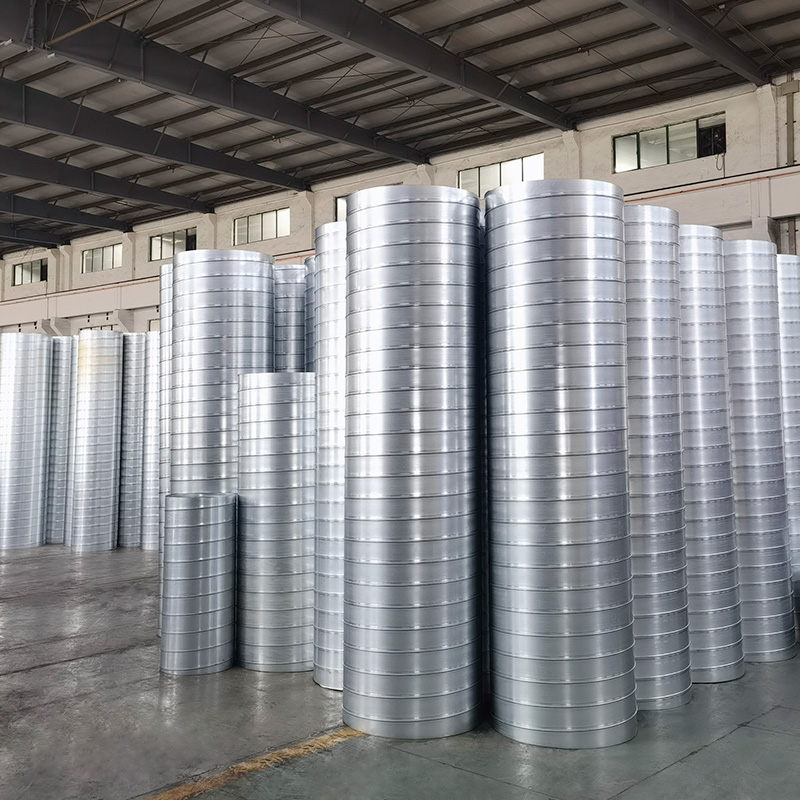
Comprehensive Analysis of Duct Processing Technology and Installation Specifications: Building Efficient and Reliable Ventilation Systems
Release time:2025-12-08 Visits:0
Duct processing is a core of HVAC engineering, and its quality directly determines the performance, energy consumption, and reliability of ventilation systems. This article systematically introduces the production standards, installation specifications, and quality control points of metal and non-metallic ducts, providing clear guidance for engineering practice.
1. Metal Duct Production Technology and Standards
Metal ducts undergo strict processes such as blanking, locking, folding, crimping forming, flange processing, welding, drilling, painting, and riveting flanging. The sheet thickness must match the system pressure and dimensions: in medium and low-pressure systems, when the long side is ≤320mm, the thickness is ≥0.5mm; ≤630mm, ≥0.6mm; ≤1000mm, ≥0.75mm; larger sizes require increasing to 1.0mm or 1.2mm.
Flange and bolt specifications must correspond to duct dimensions:
- Circular ducts: diameter ≤630mm use 25×25×3 angle steel and M6 bolts; ≤1250mm use 30×30×4 angle steel and M8 bolts.
- Rectangular ducts: long side ≤630mm use 25×25×3 angle steel and M6 bolts; ≤1500mm use 30×30×3 angle steel and M8 bolts; ≤2500mm require 40×40×4 angle steel.
Rectangular flange corners must have bolt holes with uniform spacing: 120mm for air conditioning and supply/exhaust systems, and 80mm for smoke control systems.
Reinforcement conditions must be strictly implemented:
- Circular ducts: diameter ≥800mm and length >1250mm or total area >4㎡ require reinforcement.
- Rectangular ducts: side length >630mm (insulated ducts >800mm), length >1250mm, or single-side flat area >1.2㎡ require reinforcement.
Production accuracy requirements: duct size deviation ≤2mm when ≤300mm, ≤3mm when >300mm; diagonal deviation ≤3mm; flange width uniform and ≥6mm.
2. Key Points for Non-Metallic Duct Production
Non-metallic ducts (such as fiberglass boards) involve processes including marking and cutting, sheet beveling, gluing and folding, and joint sealing. The sheet thickness is typically 25–30mm, ensuring firm adhesion between the aluminum foil layer and internal fibers. Dimensional deviation standards are consistent with metal ducts: side length deviation ≤2mm when ≤300mm, ≤3mm when >300mm, and diagonal deviation ≤3mm.
Seams must use fire-resistant adhesive materials, with external aluminum foil tape sealing width ≥25mm. Finished ducts should have a flat surface without deformation or blistering, and intact aluminum foil. Reinforcement must be implemented according to system working pressure and product standards, focusing on ensuring seam gluing and structural reliability.
3. Key Specifications for Duct Installation
Pre-layout and numbering are required before installation, with rational planning of air outlet, tee, and support positions. Hanger spacing requirements:
- For horizontal installation, spacing ≤4m when side length ≤400mm, and ≤3m when >400mm.
- The distance from the end hanger to the duct end ≤1m, preferably controlled within 200mm.
Horizontal main ducts exceeding 20m in length require anti-sway fixed points.
When passing through firewalls, a steel sleeve with thickness ≥1.6mm must be installed, internally sealed with non-combustible materials, and externally coated with fireproof mud. Fire dampers should be installed on the air flow direction side, ≤200mm from the wall; fire dampers with side length >630mm require independent hangers and must not affect the actuator operation.
4. Quality Inspection and Finished Product Protection
Ducts require light leakage detection: in a dark environment, use a low-voltage light source to move along joints to check for light leakage. Medium-pressure systems also require air leakage testing to ensure air leakage rate ≤5% of total air volume. Finished products should be stacked vertically to avoid extrusion deformation, and the integrity of surface or aluminum foil must be strictly protected during processing.
Through standardized processes, material optimization, and strict quality control, duct processing can significantly improve system energy efficiency, safety, and service life, providing reliable for the building environment.
 +85247166614