Manufacturing, Installation Process and Quality Control Standards for Collar Plate Flange Air Ducts
Release time:2025-12-08 Visits:0
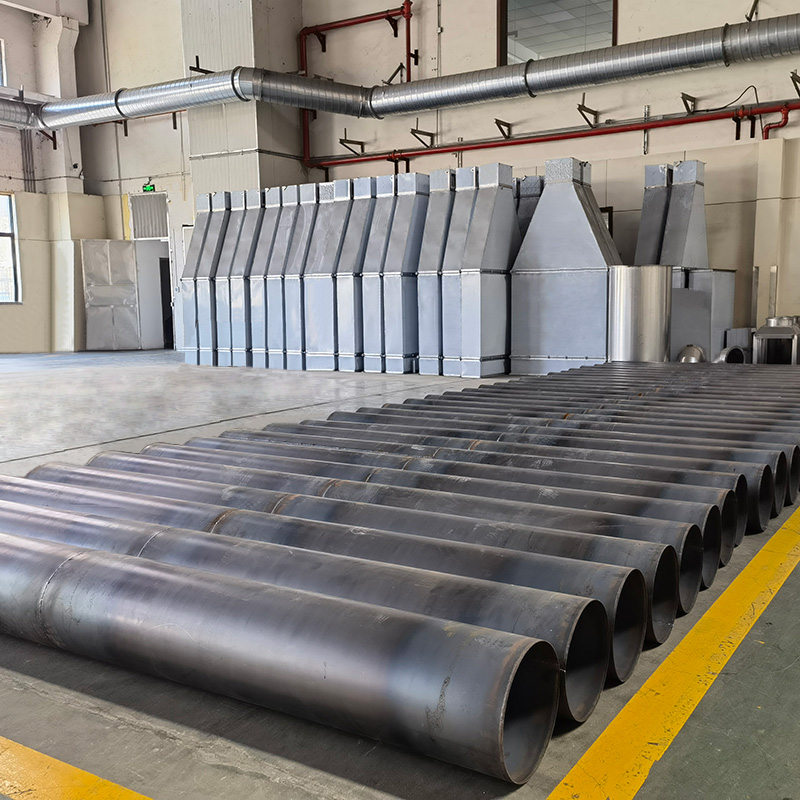
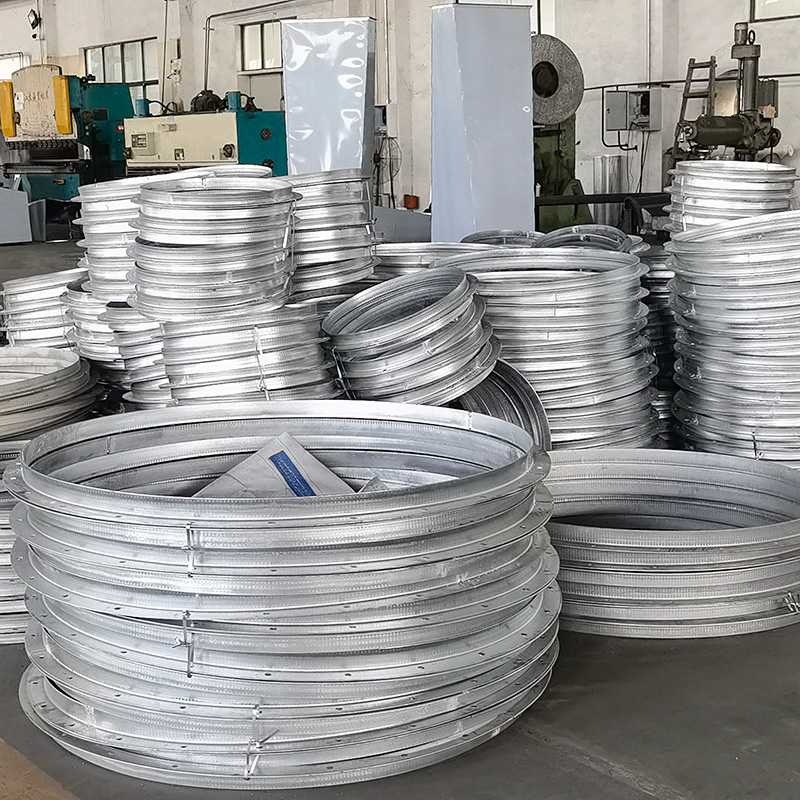
Collar plate flange air duct is a type of rectangular air duct that uses galvanized steel sheets, with flanges formed by rolling both ends of the duct itself through special equipment, and connected with components such as flange angle clips, sealing strips, and flange clamps. Its design and construction strictly comply with national standards such as "Code for Construction Quality Acceptance of Ventilation and Air Conditioning Engineering" (GB 50243) and "Technical Specification for Ventilation Ducts" (JGJ/T 141-2017).
1. Process Characteristics and Advantages
The core advantages of collar plate
flange air ducts lie in efficient production and economy. Through automated production lines, rapid cutting, ribbing, and flange forming can be achieved, with work efficiency approximately 3 times that of traditional angle steel flange air ducts. The duct surface has high strength due to ribbing treatment, with precise forming dimensions and good airtightness. In addition, this process reduces the use of profiles such as
angle steel, lowers material costs, and reduces environmental pollution from anti-corrosion engineering.
2. Manufacturing Technical Requirements
Before manufacturing the air duct, numbering and pre-arrangement are required to reasonably plan the positions of air outlets, tees, and supports. Plate splicing should adopt single-lock or double-lock seaming, using a wooden hammer to protect the galvanized layer. The flange flange turning amount should be controlled between 6mm and 9mm, and the flange should be flat, well-fitted, and free from warping. The overlapping parts at the four corners of the air duct need to be shoveled flat and tightly filled with sealant to avoid gaps.
Flange connection requires the use of special flange clamps with no burrs and uniform specifications. During installation, they should be arranged alternately (one front, one back) to ensure uniform force. The edge spacing between adjacent flange clamps should not exceed 100mm, and the four corners must be fastened with bolts. For bolt hole spacing, it should not exceed 150mm for air ducts of ordinary supply and exhaust and air conditioning systems, and not exceed 100mm for air ducts of smoke prevention and exhaust systems. All bolt holes should face the same direction.
3. Installation and Quality Control
When installing air ducts horizontally, the hanger spacing for ducts with side length ≤ 400mm should not exceed 4m, and for those with side length > 400mm, it should not exceed 3m. When the length of horizontally suspended main and trunk air ducts exceeds 20m, additional anti-sway fixing points should be added. Flange gasket materials should be selected according to the system type: ordinary air conditioning ducts can use sealing strips, while smoke prevention and exhaust ducts must use non-combustible materials such as asbestos boards. Gasket joints should adopt stepped or tongue-and-groove splicing and be coated with sealant.
4. Application Scope and Development
This connection process has been widely used in developed countries in Europe and America since the 1990s, and Chinese national standards also explicitly support the use of flangeless connection technology. It is suitable for general air conditioning and supply and exhaust systems, but for air ducts with side length exceeding 2000mm or smoke prevention and exhaust systems, angle steel flange connection is usually still required to ensure structural strength and fire protection requirements. Due to its economy and efficiency, collar plate flange air ducts have become one of the mainstream choices in modern ventilation engineering.
 +85247166614