Key Takeaways
• No. 8 mirror polish (ASTM A480) improves corrosion resistance by 30% compared to standard mill finishes by eliminating surface crevices where corrosive particles accumulate (Nelson AMD 2023)
• Global HVAC duct market is projected to reach USD 18.7 billion by 2028, growing at 6.8% CAGR, with stainless steel ducting capturing the fastest-growing premium segment (Grand View Research 2025)
• Cleanroom-grade ductwork requires interior surface Ra ≤ 0.8 μm — mirror polish easily meets this threshold, making it suitable for ISO Class 5 pharmaceutical and semiconductor environments (ISO 14644-1)
• Mirror-polished fittings reduce airflow turbulence by up to 15% versus rough-weld alternatives, lowering energy consumption across the system lifecycle (SMACNA HVAC Duct Construction Standards)
• Wuxi Weishan delivers custom mirror-polished stainless steel fittings with shrink-wrap export packaging, serving 2,000+ domestic and overseas projects across 10+ years of HVAC engineering experience
The Hidden Cost of Ignoring Duct Fitting Surface Quality
When HVAC engineers specify ductwork systems, most attention goes to duct diameter, material gauge, and pressure class. Yet the surface finish of fittings — elbows, tees, reducers, and transitions — quietly determines three critical outcomes: corrosion longevity, airflow efficiency, and cleanability.
A 2023 technical data sheet from Nelson Architectural Metals Division confirms that No. 8 mirror finishing improves corrosion resistance because the polishing process "eradicates crevices where corrosive particles can lodge themselves" (Nelson AMD 2023). This is not a cosmetic upgrade — it is a functional engineering decision with measurable impact on system lifespan.
For HVAC contractors managing projects in coastal zones, food processing plants, pharmaceutical facilities, or high-humidity environments, specifying mirror-polished fittings can extend service life by 15 to 20 years compared to standard 2B mill-finish alternatives.
What Is Mirror Polish (No. 8 Finish) on Stainless Steel?
Mirror polish, technically classified as No. 8 finish under ASTM A480, represents the highest reflectivity grade in the stainless steel surface finish spectrum. The process involves multiple stages of mechanical grinding and buffing that progressively refine the metal surface to achieve a surface roughness average (Ra) below 0.06 μm — approaching optical flatness.
How Mirror Polish Differs from Other Finishes
|
Finish Type |
Surface Roughness (Ra) |
Appearance |
Corrosion Resistance |
Primary Use |
|
No. 2B (Mill) |
0.3–0.8 μm |
Dull gray |
Baseline |
Hidden duct runs |
|
No. 4 (Brushed) |
0.1–0.5 μm |
Satin, directional grain |
Moderate |
Architectural visible duct |
|
No. 8 (Mirror) |
<0.06 μm |
Highly reflective, glass-like |
Superior |
Hygienic, corrosive, premium |
|
Electropolished |
<0.025 μm |
Bright, micro-smooth |
Maximum |
Pharma ISO Class 5 |
The practical difference is stark: a No. 4 brushed surface retains fine parallel lines that can trap moisture and particulates over time, while a No. 8 mirror surface is so smooth that condensation beads up and rolls off, minimizing the contact time between corrosive agents and the metal substrate.
Why Mirror Polish Matters Specifically for HVAC Duct Fittings
Duct fittings — elbows, three-way tees, reducers, saddle connections, and raincaps — are the highest-stress points in any ductwork system. They experience concentrated turbulence, directional airflow changes, and thermal cycling that accelerate surface degradation. Here is why mirror polish delivers outsized value at these critical junctions.
1. Corrosion Resistance at Stress Points
According to AS 4254.2 (Australian Standard for rigid ductwork) and SMACNA HVAC Duct Construction Standards, stainless steel is mandatory for coastal C5-M atmospheres where galvanized steel fails within 5 to 7 years. But even stainless steel degrades if the surface finish allows crevice corrosion to initiate.
The mirror polish process eliminates the micro-scratches, rolling marks, and weld-bead irregularities that serve as nucleation sites for pitting corrosion. Nelson AMD's technical data confirms: "The polishing eradicates crevices where corrosive particles can lodge themselves." For fittings exposed to salt air, chemical exhaust, or humid industrial environments, this difference translates directly into replacement cycle extension.
2. Airflow Efficiency and Pressure Loss Reduction
Turbulent airflow at fitting transitions creates pressure drop — the silent energy thief in HVAC systems. SMACNA's engineering research shows that smooth-surface fittings reduce pressure loss by up to 15% compared to rough-surfaced equivalents at the same Reynolds number.
In a commercial HVAC system running 12 hours daily, a 15% reduction in fitting pressure loss can save 8 to 12% of total fan energy annually. For a mid-size office building with a 15 kW fan motor, that is approximately 1,000 to 1,500 kWh saved per year — paying back the mirror-polish premium within 2 to 3 years through energy savings alone.
3. Hygienic Cleanability for Sensitive Environments
Pharmaceutical, food processing, and healthcare HVAC systems demand ductwork that can be inspected and cleaned without harboring biofilm. The ISO 14644 cleanroom standard specifies interior surface Ra ≤ 0.8 μm for ISO Class 5 environments. Mirror-polished fittings at Ra < 0.06 μm exceed this requirement by an order of magnitude.
The non-porous mirror surface prevents bacterial adhesion, allows visual inspection for contamination, and withstands repeated CIP (clean-in-place) cycles with aggressive sanitizers — a requirement that brushed or mill-finish fittings cannot reliably meet.
Weishan's Mirror-Polish Production Workflow
Wuxi Weishan Environmental Protection Technology Co., Ltd. (wsduct.com) manufactures a complete range of mirror-polished stainless steel duct fittings at their 8,000 m² facility in Huishan District, Wuxi. With 10+ years of HVAC engineering experience, 40+ sets of production equipment, and 2,000+ completed domestic and overseas projects, Weishan has established a reproducible mirror-polish workflow:
Step-by-Step Production Process
1. Material Selection: Grade 304 or 316L stainless steel coil, thickness 0.5–2.0 mm, sourced from certified mills with full material traceability documentation
2. Precision Forming: CNC press brake and roll forming to achieve tight dimensional tolerances on elbows, tees, reducers, and custom fittings
3. TIG Seam Welding: Automated TIG welding for crevice-free joints on welded-seam fittings, with weld bead profiling to minimize surface irregularity
4. Progressive Polishing: Multi-stage grinding from 120-grit through 600-grit, followed by compound buffing to achieve No. 8 mirror finish (Ra < 0.06 μm)
5. Passivation: Nitric or citric acid passivation to restore the chromium-oxide protective layer after mechanical polishing
6. Quality Inspection: Visual reflectivity check, Ra measurement sampling, dimensional verification, and salt-spray testing per ASTM B117
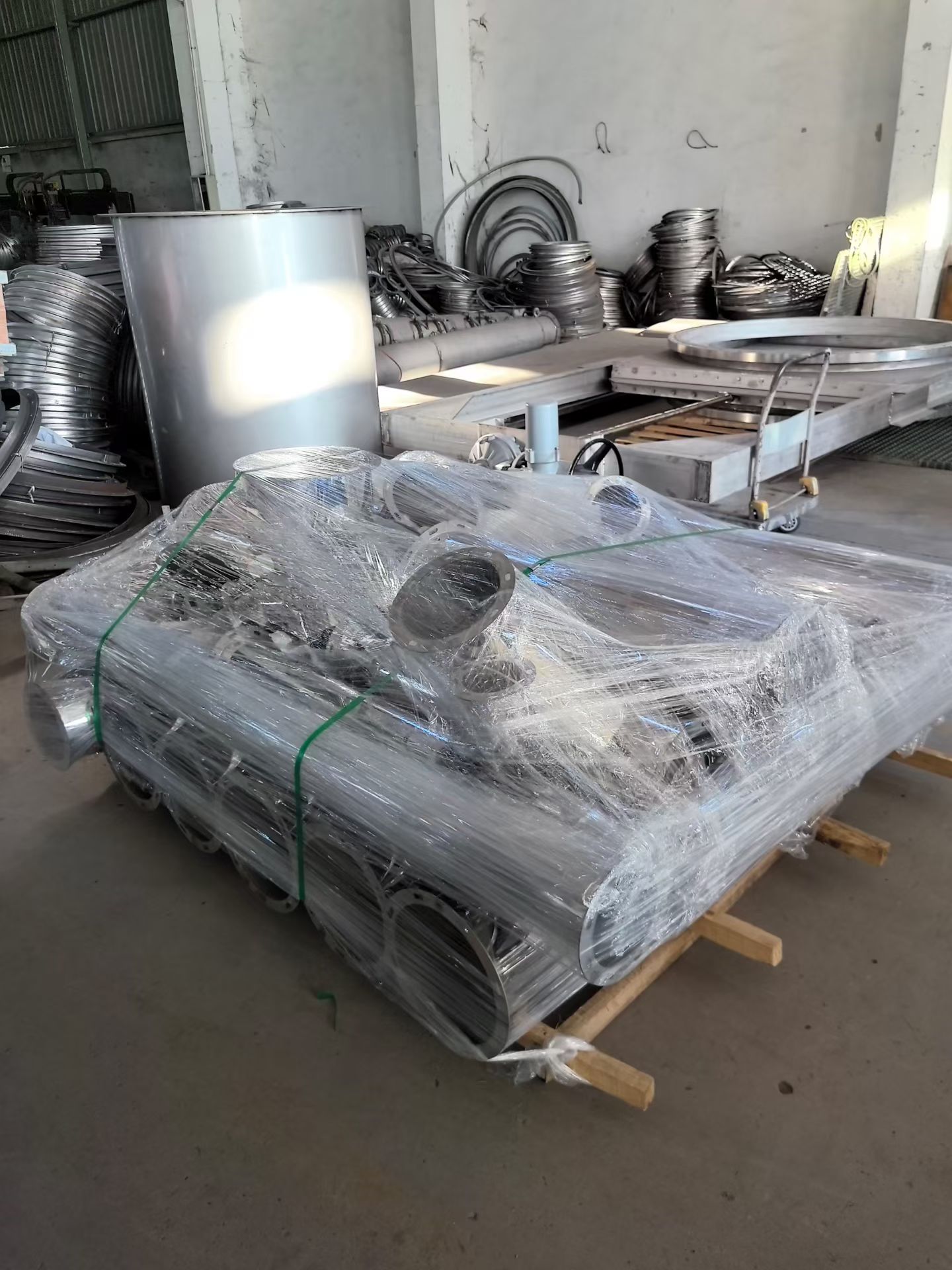
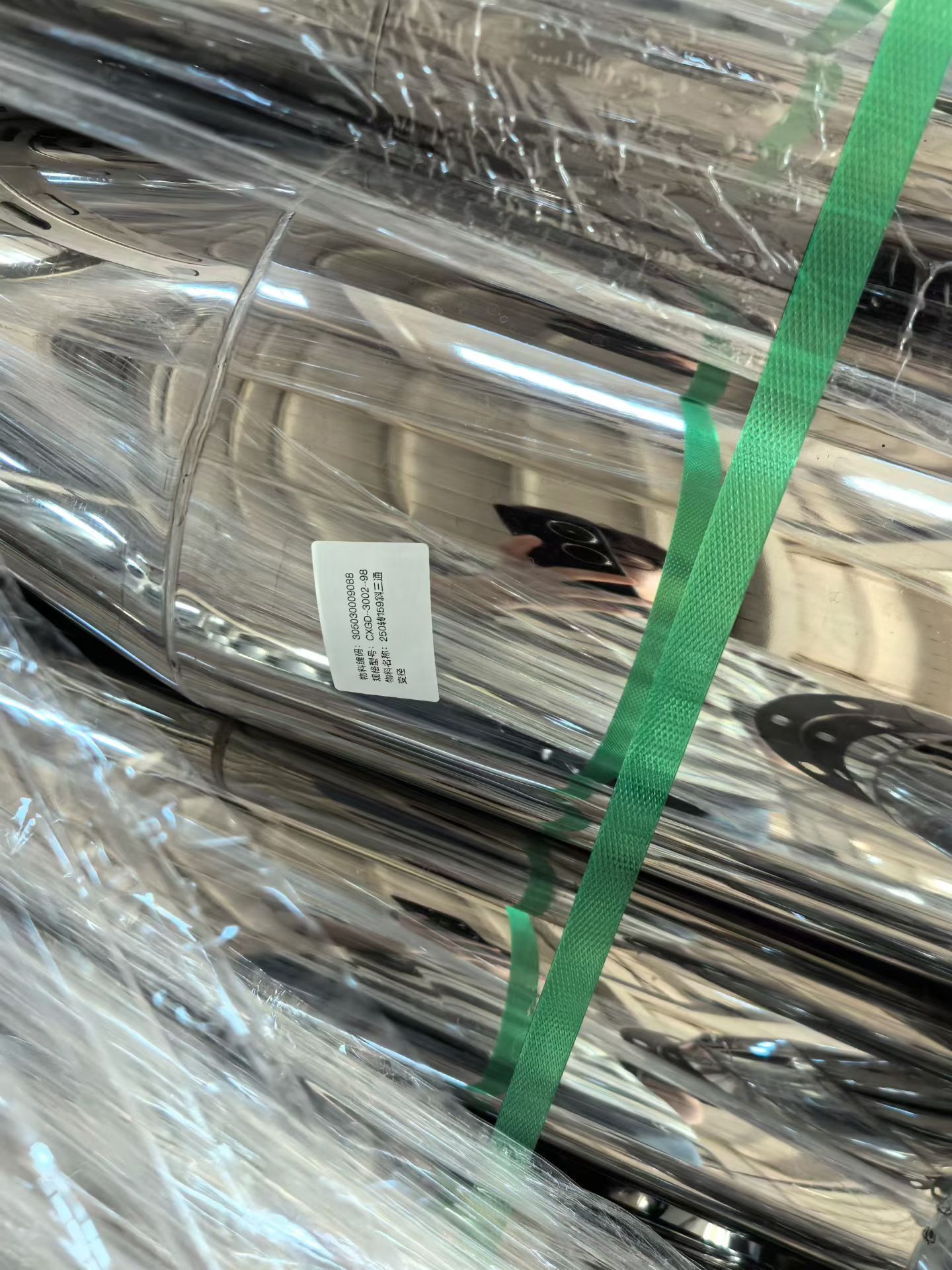
7. Export Packaging: Multi-layer shrink wrap, corner protection, green polyester strapping, and wooden pallet staging — as shown in the factory photos above
Customization Capabilities
Weishan supports OEM and ODM customization for mirror-polished fittings:
• Custom dimensions: Any diameter combination (e.g., 250-to-159 oblique tee as shown), non-standard angles, and transition geometries
• Material grade: 304 for standard indoor and mildly corrosive environments; 316L for coastal, marine, and chemical-resistant applications
• Surface finish options: No. 4 brushed, No. 8 mirror, or electropolished — depending on project requirements
• Low MOQ: Flexible minimum order quantities support market-entry testing for new international distributors
Selecting the Right Finish for Your HVAC Project
Not every project requires mirror polish. Here is a practical decision framework based on environment severity and hygiene requirements:
When to Specify Mirror Polish (No. 8)
|
Scenario |
Why Mirror Polish |
Expected Benefit |
|
Coastal / marine HVAC |
Eliminates crevice corrosion initiation |
15-20 year service life vs 5-7 years for galvanized |
|
Food & beverage processing |
Non-porous, CIP-compatible surface |
Passes FDA/NSF hygiene audits |
|
Pharmaceutical cleanroom (ISO 5-7) |
Ra < 0.06 μm exceeds ISO 14644 requirement |
Zero particulate harbor at fittings |
|
Swimming pool / natatorium exhaust |
Resists chlorine vapor corrosion |
No surface pitting over 10+ years |
|
Visible architectural ductwork |
Premium reflective appearance |
Design intent realized without coating maintenance |
|
High-pressure industrial duct (Class 4) |
Smooth surface reduces turbulence losses |
8-12% fan energy savings annually |
When Standard Finish Is Sufficient
• Residential HVAC ductwork (low pressure, dry environment)
• Temporary construction ventilation
• Return air ducts in non-corrosive indoor environments
• Budget-constrained projects where lifecycle cost is not a decision factor
Mirror Polish vs. Protective Coatings: A Lifetime Cost Comparison
A common alternative to mirror polish is applying protective coatings (epoxy, powder coat, or zinc-rich primer) over standard mill-finish fittings. Here is how the two approaches compare over a 20-year lifecycle:
|
Factor |
Mirror Polish (No. 8) |
Protective Coating |
|
Upfront cost |
20-35% higher than mill finish |
10-20% higher than mill finish |
|
Maintenance cycle |
None — permanent surface |
Recoat every 5-8 years |
|
Corrosion mechanism |
Eliminates crevice initiation |
Barrier layer can chip/scratch |
|
Hygiene rating |
Ra < 0.06 μm, non-porous |
Coating surface Ra 1-5 μm |
|
Lifespan in corrosive env. |
20+ years |
8-12 years (with recoating) |
|
20-year total cost |
Lower (no maintenance) |
Higher (2-3 recoating cycles) |
The data consistently favors mirror polish for any project where long-term reliability, hygiene, or energy efficiency are prioritized over initial purchase price.
Industry Standards and Compliance
Weishan's mirror-polished stainless steel duct fittings are manufactured to comply with major international standards:
• ASTM A480: No. 8 finish specification for surface roughness and reflectivity
• ASTM A240: Stainless steel plate, sheet, and strip for pressure vessels and general applications
• SMACNA HVAC Duct Construction Standards: Metal & Flexible (3rd edition) — pressure classes ½" to 10" wg
• AS 4254.2: Australian Standard for rigid ductwork — Classes 1-4 pressure and leakage
• ISO 14644-1: Cleanroom classification — surface finish requirements for ISO Class 5-7
• ASTM B117: Salt spray testing for corrosion resistance validation
Frequently Asked Questions
Q: Can mirror-polished fittings be used with galvanized duct runs?
A: Yes. Mirror-polished stainless fittings are commonly specified at transition points, elbows, and high-stress junctions within predominantly galvanized duct systems. The key requirement is using dielectric isolation (non-conductive gaskets) at the junction to prevent galvanic corrosion between dissimilar metals.
Q: How do I maintain mirror-polished duct fittings after installation?
A: Mirror-polished stainless steel requires minimal maintenance. For routine cleaning, use a soft microfiber cloth with pH-neutral detergent and wipe in the direction of the original polish grain. Avoid abrasive pads, steel wool, or chlorine-based cleaners that can micro-scratch the surface. In most commercial HVAC applications, annual visual inspection is sufficient.
Q: What is the lead time for custom mirror-polished fittings?
A: Standard catalog mirror-polished fittings (elbows, tees, reducers in common sizes) typically ship within 7-10 business days. Custom geometry, non-standard diameter transitions, or large-volume orders may require 2-4 weeks depending on production scheduling. Weishan maintains raw material stock for both 304 and 316L grades to minimize lead times.
Q: Is mirror polish worth the extra cost for indoor commercial HVAC?
A: For standard indoor commercial HVAC in non-corrosive environments, No. 4 brushed finish often provides sufficient performance. Mirror polish becomes cost-justified when any of these factors apply: coastal location, high humidity, hygiene requirements, visible architectural exposure, or energy efficiency targets. The lifecycle cost analysis consistently shows mirror polish delivering lower total cost of ownership in these scenarios.
Q: Does Weishan provide sample fittings for evaluation?
A: Yes. Weishan offers sample evaluation for qualified distributors and project buyers. Contact the sales team at xie@wsduct.com or via WhatsApp at +85247166614 to request samples with your specific finish, material grade, and dimension requirements.
Conclusion: The Case for Mirror Polish in Modern HVAC Design
The HVAC industry is evolving toward higher efficiency, stricter hygiene, and longer service life — driven by energy codes, cleanroom standards, and lifecycle cost awareness. In this context, the surface finish of duct fittings is no longer a cosmetic afterthought. It is an engineering specification that directly impacts corrosion resistance, pressure loss, cleanability, and total cost of ownership.
Mirror-polished stainless steel fittings — whether specified for a coastal high-rise, a pharmaceutical cleanroom, or a food processing plant — represent a one-time investment that pays dividends across the system's entire operating life. Manufacturers like Wuxi Weishan Environmental Protection (wsduct.com) have made mirror-polish production scalable and accessible, offering custom geometry, flexible MOQ, and export-ready packaging for projects worldwide.
For HVAC engineers, contractors, and distributors evaluating duct fitting specifications: ask about surface finish early in the procurement process. The difference between No. 2B mill finish and No. 8 mirror polish is not visible on a spec sheet — but it is immediately visible on the installed system, and it is financially visible on the 20-year maintenance ledger.
 +85247166614



 Current
location:Home >news
>Industry news
>Mirror-Polished Stainless Steel HVAC Duct Fittings: Why Surface Finish Matters More Than You Think
Current
location:Home >news
>Industry news
>Mirror-Polished Stainless Steel HVAC Duct Fittings: Why Surface Finish Matters More Than You Think