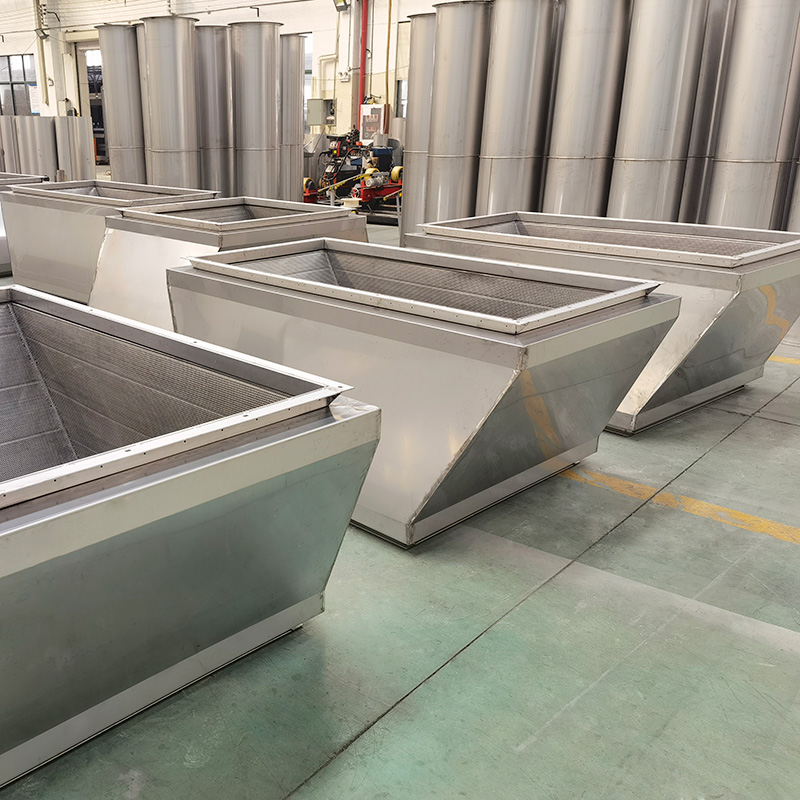
What Is Industrial Ventilation?
Industrial ventilation is the engineering of systems that control airborne contaminants in industrial workplaces. The two main categories:
Local exhaust ventilation (LEV): captures contaminants at the source before they reach the worker's breathing zone.
General ventilation (GV): dilutes contaminants with outdoor air to maintain acceptable concentrations throughout the workplace.
Industrial ventilation is required by occupational health regulations (OSHA, ACGIH, NIOSH, EU-OSHA) for many manufacturing processes.
The Wuxi Weishan industrial product line covers industrial ventilation systems for manufacturing facilities.
What Are the Main System Types?
|
System Type |
Purpose |
Capture Method |
Typical Applications |
|
Local exhaust ventilation (LEV) |
Capture at source |
Hood, enclosure |
Welding, soldering, dust, fumes |
|
General ventilation (GV) |
Dilution |
Supply + exhaust |
Background contaminants, heat |
|
Process ventilation |
Maintain process conditions |
Process-specific |
Cleanrooms, semiconductor, pharma |
|
Make-up air |
Replace exhaust air |
Supply fans |
Balance building pressure |
|
Combustion air |
Supply air for burners |
Direct intake |
Boilers, heaters, ovens
|
Most industrial facilities combine multiple system types to address all the contaminants and conditions.
What Are the Industrial Ventilation Standards?
Major standards and regulations:
OSHA 29 CFR 1910.94: Ventilation (US occupational safety).
ACGIH Industrial Ventilation Manual: design manual for LEV and GV.
NIOSH: recommended exposure limits (RELs).
ACGIH TLVs: threshold limit values for chemical exposure.
ASHRAE Handbook—HVAC Applications: industrial ventilation design.
EN 16798: European ventilation standards.
EU-OSHA: European occupational safety standards.
For each project, the applicable regulations must be consulted.
What Are the System Components?
The components of an industrial ventilation system:
Hood: captures the contaminant at the source.
Duct: transports the contaminated air to the cleaning device.
Air cleaning device: removes the contaminant (dust collector, scrubber, filter).
Fan: provides the airflow and pressure.
Discharge: exhausts the cleaned air to the atmosphere.
Each component must be sized and selected for the specific contaminant and airflow.
How Is the Hood Selected?
The hood is the most important component of an LEV system. The hood capture velocity is the air velocity at the source that draws the contaminant into the hood.
Common hood types:
|
Hood Type |
Capture Mechanism |
Best For |
|
Enclosing hood |
Surrounds the source |
High-volume, high-velocity |
|
Canopy hood |
Above the source |
Hot processes, rising contaminants |
|
Slot hood |
Linear slot along the source |
Tanks, conveyors, processes |
|
Capturing hood |
Near the source |
Welding, soldering, grinding |
|
Push-pull hood |
Push air from one side, pull from other |
Large tanks, plating baths
|
Capture velocities for common contaminants:
|
Contaminant |
Capture Velocity (fpm) |
|
Vapors, gases |
50–100 |
|
Welding fumes |
100–200 |
|
Dust (low velocity) |
100–200 |
|
Dust (high velocity) |
200–500 |
|
Hot processes (rising) |
100–200 (with canopy) |
The duct velocity (transport velocity) must be high enough to keep the contaminant moving but not so high that it causes excessive wear.
How Is the Duct Sized?
The duct is sized to maintain the transport velocity throughout the system:
|
Contaminant |
Minimum Transport Velocity (fpm) |
|
Vapors, gases |
1,000–1,500 |
|
Welding fumes |
2,000–3,000 |
|
Wood dust |
3,500–4,000 |
|
Metal dust |
4,000–5,000 |
|
Abrasive dust |
5,000–6,000 |
|
Moist materials |
4,000–5,000 |
Higher velocity prevents settling in the duct; lower velocity reduces wear and pressure drop.
The Wuxi Weishan galvanized welded air duct and stainless steel welded duct product lines cover all common duct sizes and materials.
What Are the Air Cleaning Devices?
Common air cleaning devices:
|
Device |
Mechanism |
Best For |
|
Cyclone |
Centrifugal separation |
Coarse dust, pre-cleaning |
|
Baghouse (fabric filter) |
Filtration |
Fine dust, large volume |
|
Cartridge collector |
Filtration |
Fine dust, small to medium volume |
|
Wet scrubber |
Liquid scrubbing |
Gases, vapors, hazardous dust |
|
Electrostatic precipitator (ESP) |
Electrical charging |
Sub-micron particles, smoke |
|
HEPA filter |
Filtration |
Cleanroom exhaust, hazardous dust |
|
Activated carbon |
Adsorption |
Vapors, odors |
For dust collection, baghouse and cartridge collectors are most common. For gases and vapors, wet scrubbers and carbon adsorbers are used.
How Is the Fan Selected?
The fan must provide the design airflow at the design static pressure. The static pressure is the sum of:
Duct friction loss: per the friction chart at the design airflow.
Fitting losses: per the equivalent length method.
Air cleaning device loss: per the manufacturer's data.
Hood loss: per the hood design.
Discharge loss: for atmospheric discharge or stack.
For typical industrial systems:
|
System |
Static Pressure (in. w.c.) |
|
Welding fume LEV |
4–8 |
|
Dust collection |
6–12 |
|
General ventilation |
1–3 |
|
Process ventilation |
4–10 |
|
Cleanroom exhaust |
6–12 |
Fan types:
Centrifugal: most common for industrial; backward curved, forward curved, radial blade.
Axial: high volume, low pressure.
Mixed flow: between centrifugal and axial.
What Is Make-Up Air?
Make-up air is the outdoor air supplied to replace the air exhausted by the ventilation system. Without adequate make-up air, the building becomes depressurized, causing:
Drafts and cold spots.
Difficulty opening doors.
Backdraft from combustion appliances.
Infiltration of unconditioned air.
The make-up air system typically includes:
Filtered outdoor air intake: at a clean location.
Heating or cooling: to temper the outdoor air.
Distribution duct: to distribute the air throughout the building.
Volume control: to balance with the exhaust system.
For winter operation, the make-up air must be heated to maintain the indoor temperature.
What Is the Discharge Stack?
The discharge stack is the duct that exhausts the cleaned air to the atmosphere. The stack must:
Discharge at adequate height: above the building, away from intake air.
Discharge at adequate velocity: typically 3,000–5,000 fpm to prevent downdraft and re-entrainment.
Comply with emissions regulations: EPA, local air quality.
Be accessible for testing: emissions monitoring per the air permit.
The discharge stack may also include:
Stack cap: to prevent rain ingress.
Bird screen: to prevent bird ingress.
Drain: to remove condensation.
How Are Industrial Ventilation Systems Verified?
Verification of industrial ventilation systems:
Airflow measurement: pitot tube traverse or thermal anemometer at each hood.
Static pressure measurement: at the fan inlet and outlet, and at key points in the duct.
Capture velocity measurement: anemometer at the hood face.
Contaminant measurement: air sampling for the specific contaminant.
Visual inspection: hood, duct, cleaning device, fan, discharge.
Documentation: report with measured values and comparison to design.
For OSHA compliance, the verification must demonstrate that the contaminant concentration is below the permissible exposure limit (PEL).
What Are the Common Defects?
Common defects in industrial ventilation systems:
|
Defect |
Cause |
Prevention |
|
Poor capture |
Insufficient hood velocity, hood too far |
Increase fan speed, redesign hood |
|
Duct settling |
Low velocity, low transport velocity |
Increase transport velocity |
|
Duct leakage |
Poor sealing, damaged duct |
Seal joints, inspect duct |
|
Filter breakthrough |
Worn filter, wrong filter |
Replace filter, use correct filter |
|
Fan failure |
Bearing failure, motor failure |
Maintain fan, replace bearings |
|
Stack re-entrainment |
Poor stack design, wind |
Increase stack height, relocate |
|
Backdraft |
Insufficient make-up air |
Increase make-up air, balance system |
|
Noise |
High velocity, fan noise |
Add silencer, limit velocity |
Each defect is preventable with discipline. Periodic inspection and testing catch most defects.
What Are the Energy Considerations?
Industrial ventilation systems are energy-intensive. The energy consumption depends on:
Airflow: higher airflow = higher fan energy.
Static pressure: higher pressure = higher fan energy (linear with pressure).
Operating hours: longer hours = more energy.
Fan efficiency: more efficient fan = less energy.
Typical specific fan power (SFP) for industrial systems:
|
System |
SFP (W/CFM) |
|
Welding fume LEV |
1.0–2.0 |
|
Dust collection |
1.5–3.0 |
|
General ventilation |
0.3–0.8 |
|
Cleanroom exhaust |
2.0–4.0 |
For energy efficiency, the system should be designed with variable frequency drives (VFDs) on the fan, low leakage duct, and efficient filters.
What Are the Regulatory Requirements?
Major regulatory requirements for industrial ventilation:
OSHA Permissible Exposure Limits (PELs): maximum airborne concentration of contaminants.
ACGIH Threshold Limit Values (TLVs): more stringent than OSHA PELs; recommended best practice.
EPA air permits: required for systems that emit regulated pollutants.
Local air quality regulations: state and local regulations may be more stringent.
EPA NESHAP: National Emission Standards for Hazardous Air Pollutants for specific industries.
OSHA ventilation standards: 29 CFR 1910.94.
For each project, the applicable regulations must be consulted and the system designed to meet them.
What Is the Future of Industrial Ventilation?
Trends in industrial ventilation:
Smart sensors: real-time monitoring of airflow, pressure, and contaminant levels.
Demand-controlled ventilation (DCV): variable airflow based on production schedule.
Energy recovery: energy wheels, run-around coils for make-up air.
Improved filtration: nanofiber filters with higher efficiency and lower pressure drop.
AI-based optimization: AI algorithms for system optimization.
For a ventilation system designer, the trend toward smart sensors and AI-based optimization is creating new opportunities for value-added services.
Conclusion
Industrial ventilation system design is the engineering of local exhaust, general ventilation, and process ventilation systems for manufacturing facilities. The objective is to control airborne contaminants to protect worker health, protect equipment, and maintain product quality. Wuxi Weishan provides the industrial product line, galvanized welded air duct, stainless steel welded duct, and integrative systems for industrial ventilation. The workshop, about, and contact pages provide additional information for new customers.
Frequently Asked Questions
What is the difference between local exhaust and general ventilation?
Local exhaust ventilation (LEV) captures contaminants at the source. General ventilation (GV) dilutes contaminants with outdoor air. LEV is preferred for high-toxicity or high-concentration contaminants; GV is used for low-concentration, widespread contaminants.
What is the OSHA permissible exposure limit (PEL)?
The OSHA PEL is the maximum airborne concentration of a contaminant that a worker may be exposed to over an 8-hour time-weighted average. PELs vary by contaminant.
What is the ACGIH TLV?
The ACGIH Threshold Limit Value (TLV) is the recommended exposure limit published by the American Conference of Governmental Industrial Hygienists. TLVs are typically more stringent than OSHA PELs.
What is a hood capture velocity?
Hood capture velocity is the air velocity at the source that draws the contaminant into the hood. Typical capture velocities are 50–500 fpm, depending on the contaminant.
What is the transport velocity?
Transport velocity is the minimum air velocity in the duct that prevents the contaminant from settling. Typical transport velocities are 1,000–6,000 fpm, depending on the contaminant.
What is a cyclone dust collector?
A cyclone dust collector uses centrifugal force to separate dust from the airstream. It is used for coarse dust and as a pre-cleaner for finer dust collectors.
What is a baghouse?
A baghouse is a fabric filter dust collector. The dusty air passes through fabric bags (or envelopes), and the dust is collected on the outside of the bags. Baghouses are used for fine dust and large airflow.
What is a wet scrubber?
A wet scrubber uses liquid (typically water or a chemical solution) to remove contaminants from the airstream. Wet scrubbers are used for gases, vapors, and hazardous dust.
What is make-up air?
Make-up air is the outdoor air supplied to replace the air exhausted by the ventilation system. Without adequate make-up air, the building becomes depressurized.
What is a variable frequency drive (VFD)?
A VFD is an electronic controller that varies the fan speed (and therefore the airflow and energy consumption). VFDs are used for demand-controlled ventilation and energy savings.
How is the ventilation system verified?
The system is verified by airflow measurement, static pressure measurement, capture velocity measurement, contaminant measurement, and visual inspection. The verification report documents the measured values and comparison to design.
What is the future of industrial ventilation?
The future is toward smart sensors, demand-controlled ventilation, energy recovery, improved filtration, and AI-based optimization.
 +85247166614



 Current
location:Home >news
>Industry news
>Industrial Ventilation System Design For Manufacturing Facilities
Current
location:Home >news
>Industry news
>Industrial Ventilation System Design For Manufacturing Facilities