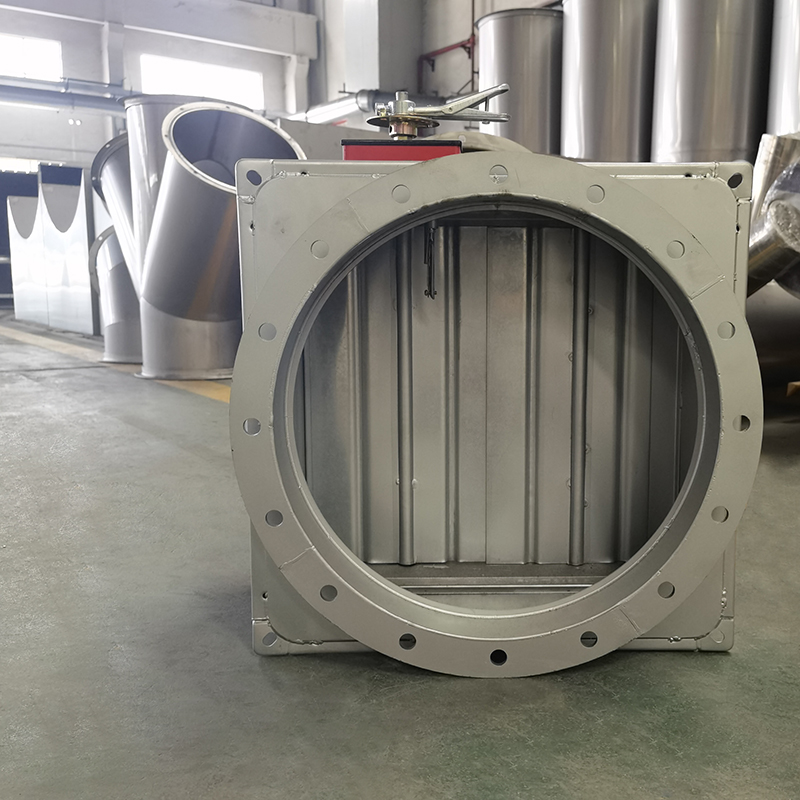
What Is a Fire Damper?
A fire damper is a listed device installed in a duct at a fire-rated wall or floor penetration. The damper closes automatically when:
The temperature at the fusible link exceeds the rated temperature (typically 165°F / 74°C or 212°F / 100°C), OR
A signal is received from a fire alarm or building management system (for motorized fire dampers).
Fire dampers are required by building codes (NFPA 90A, NFPA 90B, IBC, EN 1366) at:
Fire-rated wall penetrations (typically 1-hour, 2-hour, or 3-hour rated).
Fire-rated floor penetrations.
Where the duct crosses a fire compartment boundary.
The Wuxi Weishan fire damper product line is UL-listed and CE-marked for fire-rated wall and floor penetrations.
What Is a Smoke Damper?
A smoke damper is a motorized damper that closes on signal from a smoke detection system or building management system. Smoke dampers are used to:
Control smoke spread: prevent smoke from moving between zones during a fire.
Maintain tenable conditions: keep escape routes free of smoke.
Support smoke management systems: pressurize stairwells, exhaust smoke from fire floors.
Smoke dampers are typically UL 555S listed for leakage and cycle rating.
What Is a Combination Fire-Smoke Damper?
A combination fire-smoke damper combines the functions of a fire damper and a smoke damper:
Closes on signal from smoke detection (smoke function).
Closes on fusible link activation (fire function).
Provides low leakage (smoke function).
Has fire rating (fire function).
Combination dampers are used in:
Hospital smoke control systems.
High-rise stairwell pressurization.
Atrium smoke exhaust.
Critical life-safety applications.
Combination dampers are more expensive than single-function dampers but provide both functions in one device.
What Codes Govern Fire and Smoke Dampers?
Major codes and standards:
NFPA 90A: Standard for the installation of air conditioning and ventilating systems. Specifies fire damper requirements.
NFPA 90B: Standard for the installation of warm air heating and air conditioning systems.
NFPA 80: Standard for fire doors and other opening protectives. Specifies fire damper testing.
NFPA 92: Standard for smoke control systems.
NFPA 92A: Standard for smoke control systems utilizing barriers and pressure differences.
NFPA 92B: Standard for smoke management systems in malls, atria, and large spaces.
IBC: International Building Code. References NFPA 90A and NFPA 92 for damper requirements.
EN 1366-2: European standard for fire damper testing.
UL 555: Standard for fire dampers.
UL 555S: Standard for smoke dampers.
CE marking: required for European projects.
For each project, the local code must be consulted.
What Is the Fire Resistance Rating?
The fire resistance rating is the time the damper maintains its integrity and insulation when exposed to a standard fire test (per ASTM E119 or EN 1366-2):
|
Rating |
Time |
Notes |
|
1-hour |
60 minutes |
Typical for residential and commercial walls |
|
1.5-hour |
90 minutes |
Typical for corridor walls |
|
2-hour |
120 minutes |
Typical for stairwell and elevator shaft walls |
|
3-hour |
180 minutes |
Typical for high-rise and essential facilities |
The fire resistance rating of the damper must match the fire resistance rating of the wall or floor penetration.
What Are the Fusible Link Ratings?
Standard fusible link ratings:
|
Rating |
Application |
|
165°F (74°C) |
Standard for HVAC systems |
|
212°F (100°C) |
For systems with higher ambient temperature (e.g., boiler rooms) |
|
286°F (141°C) |
For high-temperature service |
|
360°F (182°C) |
For very high temperature
|
The fusible link is a one-time-use device. After activation, it must be replaced before the damper can be returned to service.
What Are the Leakage Classes for Smoke Dampers?
Smoke damper leakage is classified per UL 555S:
|
Class |
Leakage Rate (cfm/ft² @ 1 in. w.c.) |
Best For |
|
Class I |
< 4 |
Critical life-safety |
|
Class II |
< 8 |
Standard smoke control |
|
Class III |
< 16 |
Non-critical smoke control |
For hospital and stairwell pressurization applications, Class I or II is required.
What Is the Cycle Rating?
Smoke dampers must be cycled (opened and closed) repeatedly during testing and during their service life. UL 555S specifies:
|
Cycle Rating |
Number of Cycles |
Application |
|
30,000 cycles |
Standard |
Most smoke control |
|
100,000 cycles |
High-cycle |
Frequently cycled dampers
|
For motorized smoke dampers, the actuator must be rated for the required cycle count.
What Is the Difference Between Dynamic and Static Closure?
Static closure: the damper closes when the fan is off. The differential pressure is zero or low.
Dynamic closure: the damper closes against the design airflow. The differential pressure can be significant (up to 4 in. w.c. or more).
For dynamic closure applications (e.g., supply duct downstream of the fan), the damper must be rated for dynamic closure. UL 555S includes a dynamic closure rating for smoke dampers.
For fire dampers, the closure is typically static (the fan shuts down before damper closure). However, fire dampers can also be rated for dynamic closure if required.
How Are Fire Dampers Tested?
Fire damper testing per NFPA 80:
Initial installation: visual inspection to verify installation per the manufacturer's instructions and the listing.
Operational test: cycle the damper (for motorized dampers) to verify open/close operation.
Drop test: for gravity-actuated dampers, verify the damper drops to the closed position when the fusible link is released.
Fusible link inspection: replace the fusible link if it shows signs of damage or aging.
Annual inspection: visual inspection and operational test.
Documentation: maintain a record of inspections, tests, and replacements.
For hospitals and other critical facilities, semi-annual testing may be required.
What Are the Installation Requirements?
Installation requirements for fire and smoke dampers:
Location: at the fire-rated wall or floor penetration, within the wall or floor assembly.
Orientation: per the manufacturer's installation instructions. Some dampers are rated for vertical or horizontal orientation only.
Access: provide access door for inspection and fusible link replacement.
Duct connection: the duct must be connected per the manufacturer's instructions (typically flanged or slip-joint).
Support: the duct must be supported independently from the damper to avoid interfering with damper operation.
Sleeve: the wall or floor sleeve must be installed per the listing.
Improper installation is the most common cause of fire damper failure during a fire.
What Are the Common Defects in Fire Dampers?
Common defects in fire dampers:
|
Defect |
Cause |
Prevention |
|
Failure to close |
Fusible link failure, actuator failure |
Test annually, replace fusible link |
|
Failure to open |
Linkage binding, corrosion |
Lubricate linkage, inspect |
|
High leakage |
Worn seals, blade misalignment |
Replace seals, realign blades |
|
Damaged fusible link |
Mechanical damage, age |
Replace fusible link |
|
Corroded blades |
Humid environment |
Use appropriate material |
|
Improper installation |
Deviation from listing |
Install per manufacturer's instructions |
|
Missing access door |
Forgot during installation |
Verify access door at installation
|
Each defect is preventable with discipline. Annual inspection catches most defects.
What Is Smoke Management?
Smoke management is the control of smoke movement during a fire. The objectives are:
Life safety: maintain tenable conditions in escape routes.
Property protection: limit smoke damage to non-fire areas.
Firefighter access: support firefighting operations.
Smoke management strategies:
Pressurization: maintain positive pressure in stairwells and elevator shafts to keep smoke out.
Exhaust: remove smoke from the fire floor using dedicated exhaust systems.
Compartmentation: prevent smoke spread between zones using smoke dampers.
Purge: dilute smoke with outdoor air to maintain tenable conditions.
Smoke dampers are key components of all smoke management strategies.
What Is Stairwell Pressurization?
Stairwell pressurization is a smoke management strategy that maintains positive pressure in stairwells during a fire. The objective is to keep the stairwell free of smoke so that occupants can escape.
Components of a stairwell pressurization system:
Dedicated supply fan: supplies outdoor air to the stairwell.
Pressure sensor: monitors the stairwell pressure relative to the building.
Modulating damper: modulates the supply airflow to maintain the design pressure.
Pressure relief vent: vents excess air to prevent over-pressurization.
For high-rise buildings, stairwell pressurization is required by IBC and most local codes.
What Is the Future of Fire and Smoke Damper Technology?
Trends in fire and smoke damper technology:
Self-testing dampers: dampers that automatically cycle and report status.
IoT integration: dampers connected to building management systems with real-time monitoring.
Smart actuators: actuators with built-in position feedback and diagnostics.
Improved seals: lower-leakage seals for higher efficiency.
Wireless monitoring: wireless sensors that monitor damper status.
For a damper manufacturer, the trend toward smart actuators and IoT integration is creating new opportunities for value-added products.
Conclusion
Fire dampers, smoke dampers, and combination fire-smoke dampers are life-safety devices required by building and fire codes. Wuxi Weishan produces the fire damper and damper product lines for code-compliant life-safety applications. The electric damper and pneumatic damper product lines cover motorized dampers for smoke control. The selection depends on the code requirements, the fire resistance rating, the leakage class, and the testing protocol.
Frequently Asked Questions
What is the difference between a fire damper and a smoke damper?
A fire damper closes automatically on heat (fusible link) to prevent fire spread. A smoke damper closes on signal from a smoke detection system to control smoke movement.
What is a combination fire-smoke damper?
A combination fire-smoke damper combines both functions: closes on smoke signal AND on heat. Used in critical life-safety applications.
What is the standard fusible link rating?
Standard fusible link ratings are 165°F (74°C) for standard HVAC and 212°F (100°C) for higher ambient temperature. Other ratings are available for specialty applications.
What is the fire resistance rating?
The fire resistance rating is the time the damper maintains integrity when exposed to a standard fire test. Standard ratings are 1-hour, 1.5-hour, 2-hour, and 3-hour.
How often should fire dampers be tested?
Fire dampers should be inspected and tested annually per NFPA 80. Some jurisdictions (hospitals, high-rise) require more frequent testing.
What is the difference between dynamic and static closure?
Static closure: the damper closes with the fan off. Dynamic closure: the damper closes against the design airflow. UL 555S rates dampers for dynamic closure.
What is the leakage class for smoke dampers?
UL 555S Class I is < 4 cfm/ft², Class II is < 8 cfm/ft², Class III is < 16 cfm/ft² at 1 in. w.c. Lower leakage is required for critical applications.
What is stairwell pressurization?
Stairwell pressurization maintains positive pressure in stairwells during a fire to keep smoke out and provide a tenable escape route for occupants.
What is the cycle rating for smoke dampers?
UL 555S specifies 30,000 cycles (standard) or 100,000 cycles (high-cycle). The actuator must be rated for the required cycle count.
What is the difference between motorized and gravity fire dampers?
Motorized fire dampers close on signal (electric or pneumatic). Gravity fire dampers close when the fusible link releases and gravity pulls the damper closed. Gravity dampers are used in vertical orientation; motorized dampers are used in horizontal orientation.
What are the common defects in fire dampers?
Common defects include failure to close (fusible link failure), failure to open (linkage binding), high leakage (worn seals), damaged fusible link (mechanical damage), and improper installation (deviation from listing).
What is the future of fire and smoke damper technology?
The future is toward self-testing dampers, IoT integration, smart actuators, improved seals, and wireless monitoring.
 +85247166614



 Current
location:Home >news
>Industry news
>Fire Dampers, Smoke Control, And HVAC Life-Safety Code Compliance
Current
location:Home >news
>Industry news
>Fire Dampers, Smoke Control, And HVAC Life-Safety Code Compliance