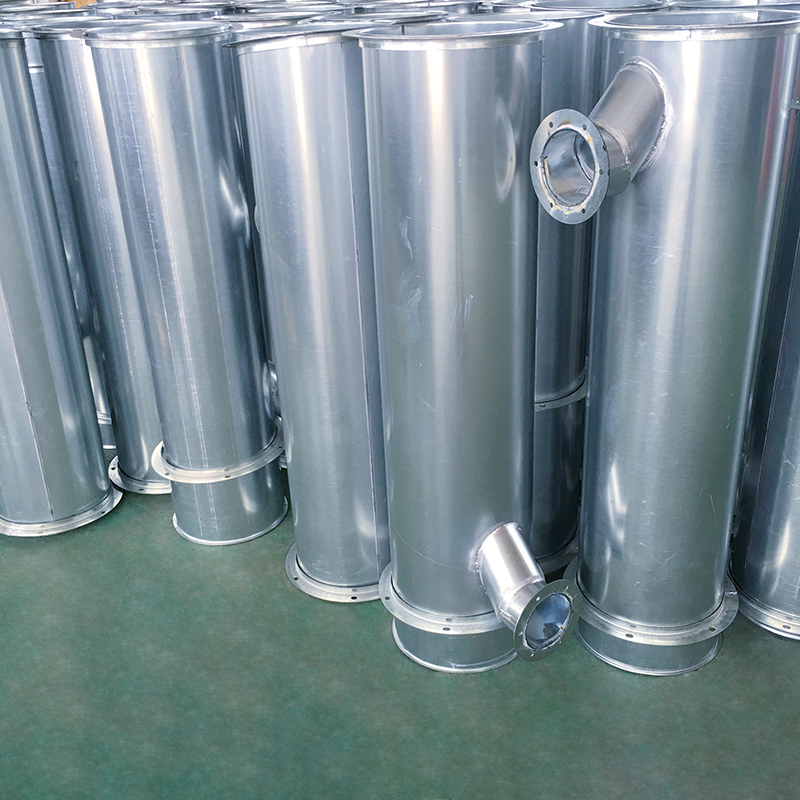
Galvanized steel duct is the workhorse of commercial ventilation. It's everywhere — office buildings, hospitals, schools, shopping malls, data centers — and for good reason. The zinc coating protects the steel substrate from corrosion without painting, it forms easily on standard roll-forming equipment, and it costs less per installed meter than stainless steel, aluminum, or welded carbon steel with a full coating system.
But "galvanized duct" covers a wider range of quality than most specifications acknowledge. The zinc coating process, the coating weight, the sheet gauge, and the connection method all affect how long the duct lasts and how well it performs. This article breaks down the technical decisions that separate a 25-year installation from one that starts rusting in 8.
Hot-Dip vs. Electro-Galvanized: Two Very Different Products
The galvanizing method matters more than most people realize. Both processes produce a zinc-coated steel sheet, but the coating characteristics, thickness, and long-term performance are fundamentally different.
Hot-Dip Galvanized (HDG)
The steel sheet passes through a molten zinc bath at approximately 460°C. The zinc metallurgically bonds to the steel surface, forming a series of zinc-iron alloy layers topped by a pure zinc outer layer. The result is a coating that:
• Is metallurgically bonded to the substrate — it won't peel or delaminate
• Provides cathodic (sacrificial) protection — zinc corrodes preferentially to the underlying steel, so even at cut edges and small scratches, the steel is protected
• Has a characteristic spangled appearance (the crystalline pattern visible on the surface)
• Typical coating thickness: 45–90μm per side for sheet galvanized after forming; 20–45μm per side for continuous-sheet galvanizing (coil coated)
Hot-dip is the premium option for ductwork. The thicker coating translates directly to longer corrosion protection, especially at cut edges and punched holes where the zinc-iron alloy layers provide better edge protection than electroplated zinc.
Electro-Galvanized (EG)
Electroplating deposits zinc from an electrolyte solution at room temperature. The coating is thinner, smoother, and more uniform in appearance than hot-dip:
• Typical coating thickness: 5–20μm per side
• Brighter, more uniform surface finish — better for exposed aesthetic applications
• Weaker sacrificial protection due to thinner coating
• Cut edges are vulnerable — the thin zinc at sheared edges corrodes quickly
Electro-galvanized sheet is cheaper and works well for light-duty indoor duct where appearance matters and the environment is dry and non-corrosive. For anything with moisture, temperature cycling, or moderate corrosive load, hot-dip is the safer specification.
Zinc Coating Weight: G90, Z275, and What the Designations Mean
Coating weight designations tell you how much zinc is on the steel. More zinc = longer protection. The two common designation systems:
ASTM (US) — G-designation:
• G30: 0.30 oz/ft² total (both sides combined) ≈ 90μm total
• G60: 0.60 oz/ft² total ≈ 180μm total
• G90: 0.90 oz/ft² total ≈ 275μm total — the standard for commercial HVAC duct
EN 10346 (European) — Z-designation:
• Z100: 100 g/m² total (both sides) ≈ 14μm per side
• Z200: 200 g/m² total ≈ 28μm per side
• Z275: 275 g/m² total ≈ 39μm per side — roughly equivalent to G90
• Z350: 350 g/m² total — for aggressive environments
For standard commercial HVAC ductwork, G90 (Z275) is the baseline specification. It provides reliable corrosion protection for 20–25 years in normal indoor environments (ISO 12944 C2 class). For more corrosive environments — swimming pool natatoriums, coastal installations, food processing with washdown — step up to G120 or Z350.
A common mistake: specifying G60 to save 10–15% on material cost, then dealing with edge corrosion complaints at year 12. The zinc cost difference between G60 and G90 is marginal compared to the service life extension.
Sheet Gauge and Duct Dimension Standards
Galvanized duct is fabricated from sheet steel in standard gauges. The relationship between sheet thickness and duct dimensions follows SMACNA (Sheet Metal and Air Conditioning Contractors' National Association) standards in North America, or DW/144 in the UK, with equivalent national standards in other markets.
Typical gauge-to-dimension relationships for rectangular duct at 1" w.g. (250 Pa) static pressure:
|
Gauge |
Thickness (mm) |
Max Duct Width (mm) |
|
26 ga |
0.48 |
600 |
|
24 ga |
0.61 |
900 |
|
22 ga |
0.76 |
1200 |
|
20 ga |
0.91 |
1500 |
|
18 ga |
1.22 |
1800+ |
Higher pressure classes (2" w.g. / 500 Pa) require stepping up one gauge for the same dimension. The duct fabricator's pressure-class tables govern the final specification — these values are starting points, not design limits.
Connection Methods: TDF, Angle Iron Flange, and Slip-and-Drive
How you join duct sections determines installation speed, air leakage, and long-term maintenance. Three connection methods dominate galvanized duct installation:
TDF (Transverse Duct Flange) / Common Plate Flange
The TDF connection forms a flange directly from the duct wall material — no separate angle iron needed. The sheet metal edge is folded back on itself to create a flange profile, and adjacent sections are bolted together with a gasket between them.
Advantages:
• Fastest installation method — no separate flange pieces to fabricate or bolt on
• Lower material cost (no angle iron)
• Adequate sealing for most commercial HVAC (leakage class C per SMACNA)
• Works well for ducts up to approximately 1,200mm on the long side
Limitations:
• Lower structural rigidity than angle iron flanges — not suitable for high-pressure systems (> 2" w.g.)
• Gasket integrity degrades over time in high-temperature applications (above 80°C)
• Not ideal for ducts that need frequent disassembly for cleaning
TDF is the default connection method for commercial HVAC trunk and branch ducts up to medium size. It accounts for 70–80% of connections in a typical office building ventilation installation.
Angle Iron Flange
Separate L-shaped steel (or galvanized) angle sections are attached to the duct edges, either by welding or mechanical clipping. The two flanged duct ends are bolted together with a full gasket seal.
Advantages:
• Highest structural rigidity — handles high static pressure (4"+ w.g.) without flexing
• Better sealing performance — the bolted flange compresses the gasket uniformly
• Suitable for large ducts (1,500mm+), high-pressure systems, and fans connections
• Easy to disassemble for maintenance
Limitations:
• More expensive (extra material, extra labor for flange attachment)
• Heavier — adds weight to the duct section
• Requires more installation time for bolting
Angle iron flanges are specified for high-pressure applications, fan inlet/outlet connections, large ducts above 1,200mm, and any location where the duct system pressure class demands it.
Slip-and-Drive (S-Drive / Pittsburgh Lap with Drive Cleats)
A longitudinal joint method where one edge of the sheet is formed into a Pittsburgh lap (a right-angle fold that captures the opposite edge), and drive cleats are inserted to lock the joint.
Advantages:
• Very fast for long straight runs — the longitudinal seam can be formed and driven continuously
• Low cost — minimal additional hardware
• Adequate for low-to-medium pressure applications
Limitations:
• Not suitable for transverse (cross-section) connections — this is a seam method, not a section-to-section joint
• Leakage rate is higher than flanged connections
• Not recommended for systems requiring SMACNA Class A or B leakage ratings
Application Environments and Performance
Central Air Conditioning
The most common application for galvanized duct. Supply and return air ducts in commercial buildings operate at moderate temperatures (12–45°C), moderate pressures (250–1,000 Pa), and in non-corrosive indoor environments. G90 galvanized duct with TDF connections handles these conditions without issue for 25+ years.
The main failure mechanism in AC duct isn't corrosion from the outside — it's condensation on the exterior surface when cold supply air passes through warm, humid ceiling plenum spaces. The solution is external insulation with a vapor barrier (typically 25–50mm closed-cell elastomeric or fiberglass with foil-faced jacket). If the insulation is installed correctly, the galvanized surface never sees conditions that promote corrosion.
General Ventilation
Factory ventilation, warehouse air circulation, parking garage exhaust — these applications expose galvanized duct to a wider range of conditions. The critical factor is the airstream composition:
• Dry, non-corrosive air: G90 galvanized performs well indefinitely
• Moderate humidity: G90 handles it, but watch for condensation at low points in horizontal runs. Provide drainage or specify G120
• Chemical fumes, chlorinated atmospheres: Galvanized zinc reacts with acids and halogens. Move to stainless steel or coated carbon steel for these environments
Cleanroom and Pharmaceutical
Cleanroom supply duct operates in a controlled environment — low humidity, filtered air, neutral pH. Galvanized duct works here, but many cleanroom specifications require stainless steel or aluminum for the duct interior surface to prevent any possibility of particle generation from zinc oxidation. The exterior of cleanroom duct can be galvanized without issue.
Kitchen Exhaust (Grease Duct)
Galvanized duct is not suitable for commercial kitchen grease exhaust. The combination of grease accumulation, moisture, and elevated temperatures accelerates zinc corrosion. Kitchen exhaust duct is typically fabricated from carbon steel (welded) or stainless steel, per fire code requirements for grease duct construction.
Expected Service Life and Corrosion Factors
The service life of galvanized duct depends on the environment's corrosivity class (per ISO 12944):
|
Environment |
ISO Class |
Expected Life (G90) |
Typical Locations |
|
Very low |
C1 |
40+ years |
Heated offices, clean rooms |
|
Low |
C2 |
25–40 years |
Unheated storage, schools |
|
Medium |
C3 |
15–25 years |
Light industrial, food processing |
|
High |
C4 |
10–15 years |
Chemical plants, coastal areas |
|
Very high |
C5 |
5–10 years |
Heavy industrial, offshore |
These estimates assume the zinc coating is intact. Physical damage (scratches, impact, improper support) that removes the zinc layer exposes bare steel, which will begin corroding at a rate determined by the environment. Proper handling during fabrication and installation is as important as the coating specification.
Installation and Fabrication Best Practices
Handling and Storage
Store galvanized sheet flat, separated by interleaving material, in a dry area. Stacked sheets with moisture trapped between them develop white rust (zinc oxide) — a powdery white deposit that, while not immediately destructive, consumes zinc and reduces the effective coating thickness.
Avoid dragging sheets across each other during fabrication. Sliding contact scratches the zinc coating, creating thin spots that corrode first.
Cut Edge Protection
Every cut edge — sheared, laser-cut, or plasma-cut — exposes bare steel at the sheet cross-section. For G90 material, the zinc's sacrificial protection extends approximately 3–5mm from the edge. Beyond that distance, the steel is unprotected.
For most duct connections, this is acceptable — the TDF flange fold covers the cut edge, and the gasket seals it from moisture. For exposed cut edges (at access openings, at duct penetrations through exterior walls), apply a zinc-rich touch-up paint to restore protection.
Sealing and Leakage
Even well-fabricated galvanized duct leaks at the joints. SMACNA leakage classes:
• Class A: ≤ 4 CFM per 100 ft² at 1" w.g. — for cleanrooms, hospitals, critical systems
• Class B: ≤ 6 CFM per 100 ft² at 1" w.g. — standard commercial HVAC
• Class C: ≤ 20 CFM per 100 ft² at 1" w.g. — general ventilation, non-critical
Gasket material at flanged connections matters. Neoprene (closed-cell) provides the best balance of compressibility, durability, and cost. EPDM works for higher temperatures. Avoid open-cell foam — it compresses too much and degrades within 5–7 years.
For Class A requirements, seal all longitudinal seams with mastic or gasket tape in addition to the flange gaskets.
Fire Rating Considerations
Galvanized duct passing through fire-rated assemblies requires a fire damper at the penetration — the galvanized sheet itself does not provide fire resistance. The zinc coating will vaporize at temperatures above 420°C, but this is irrelevant in a fire event because the steel substrate loses structural integrity at approximately 550°C. Fire dampers, not duct material, handle the fire separation requirement.
Maintenance Realities
Galvanized duct is often called "maintenance-free," which is misleading. It's low-maintenance — different thing entirely. A reasonable program:
• Annual visual inspection of exposed duct in mechanical rooms and plenum spaces. Look for white rust, physical damage, and disconnected supports.
• 5-year internal inspection via access openings. Check for internal corrosion, accumulated debris, and biological growth (in systems with moisture issues).
• 10-year gasket assessment at flanged connections. If leakage has increased, gasket replacement is usually the fix — not duct replacement.
• Re-insulation check every 5–7 years. Damaged or missing vapor barrier on cold-air ducts leads to external condensation and accelerated zinc consumption.
 +85247166614



 Current
location:Home >news
>Industry news
>Galvanized Steel Duct: Zinc Coating Standards, Connection Methods, And Long-Term Corrosion Performance
Current
location:Home >news
>Industry news
>Galvanized Steel Duct: Zinc Coating Standards, Connection Methods, And Long-Term Corrosion Performance