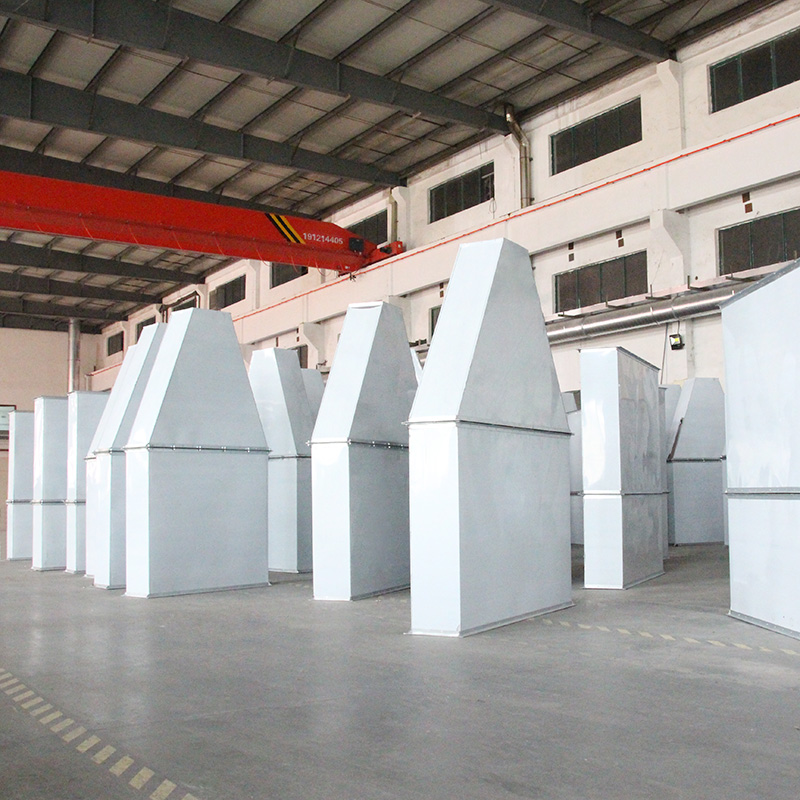
For duct fabrication, the most common PP sheet thicknesses are 3mm to 8mm, depending on duct dimensions and operating pressure.
PP Duct in Practice: Where It Makes Sense
Chemical Laboratories and Fume Hood Exhaust
University labs and pharmaceutical R&D facilities generate mixed chemical vapors — hydrochloric acid, nitric acid, organic solvents. PP duct handles this cocktail without the corrosion that destroys galvanized duct in 2–3 years. The typical specification calls for 3–5mm PP sheet with hot-air-welded seams and flanged connections.
Electroplating and Surface Treatment Shops
Chromic acid, sulfuric acid, and alkaline cleaners create one of the most aggressive ventilation environments in manufacturing. PP duct resists all three. Most electroplating exhaust systems specify 5mm PP sheet for duct runs above 300mm dimension, with 8mm sheet for main headers carrying combined exhaust from multiple bath lines.
Food Processing Facilities
PP meets FDA 21 CFR and EU 10/2011 food contact requirements. In meat processing plants, dairy facilities, and beverage production lines, PP duct doesn't rust when washed down with caustic cleaning solutions (NaOH-based CIP fluids at 60–80°C). The smooth interior surface (Ra < 1.6 μm) also resists bacterial adhesion better than corroded metal.
Wastewater Treatment Plants
H₂S, ammonia, and moisture combine to destroy metal ductwork in pump stations and sludge handling areas. PP duct systems in these installations routinely outlast galvanized alternatives by 3–4x. The material also dampens noise from blower discharge better than thin-gauge metal.
PP Duct vs. Metal Duct: The Real Numbers
Running a side-by-side comparison for a typical chemical plant exhaust system (2,000 m³/h, 50m total duct length, rectangular 400×300mm):
Weight: PP duct weighs approximately 1.5 kg/m vs. 8.5 kg/m for galvanized steel (0.8mm). That's roughly 82% lighter, which translates directly to simpler support structures and faster installation — two workers can handle 3-meter sections that would normally require a lift.
Material cost: PP sheet costs roughly 30–40% less per square meter than 304 stainless steel sheet. Compared to galvanized steel, PP material cost is similar or slightly higher, but when you factor in that galvanized duct needs replacement every 5–8 years in corrosive environments while PP lasts 15–20 years, the life-cycle cost of PP is 40–60% lower.
Installation speed: Hot air welding goes faster than bolting angle-iron flanges with gaskets. A crew of two can weld and install 15–20 meters per day in straightforward runs. Pre-fabricated sections with flanged ends push that to 30+ meters per day.
Installation: Thermal Expansion and Support Spacing
The single most misunderstood aspect of PP duct installation is thermal expansion. PP has a linear thermal expansion coefficient of approximately 1.5 × 10⁻⁴ /°C — about 10 times that of steel. A 10-meter duct run experiencing a 40°C temperature swing will expand roughly 60mm.
This isn't a problem if you design for it:
Expansion loops: Every 20–30 meters of straight run, incorporate a flexible expansion loop or offset. A simple 200mm offset in a 400mm duct absorbs most thermal movement.
Sliding supports: Use sliding bracket hangers (not rigid clamps) at intermediate support points. Fix the duct at one end of each run section; let it slide at all other points.
Support spacing: For rectangular PP duct in 5mm sheet:
• 400×300mm: support every 1.5–2.0 meters
• 600×400mm: support every 1.2–1.5 meters
• 800×500mm: support every 1.0–1.2 meters
These spacings assume uniform support from below (angle-iron cradle or U-bracket with rounded edges). Point loading on sharp edges causes stress cracking over time.
Flanges and Connections
PP duct systems typically use three connection methods:
1. PP flanged connections: Flat PP flanges (10–15mm thick) welded to duct ends, bolted together with PP or stainless steel fasteners, sealed with EPDM or FKM gaskets. Most common for systems that need periodic disassembly for inspection.
2. Socket-fusion joints: For circular PP duct, socket fusion creates permanent, leak-tight joints similar to PP piping systems. Fast and reliable, but not demountable.
3. PP-to-metal transitions: When connecting PP duct to existing metal systems or equipment nozzles, use a PP flange bolted to a steel companion flange with a compatible gasket. EPDM works for most chemical services; PTFE gaskets handle aggressive solvents.
Limitations and Design Constraints
PP duct isn't universal. Honest assessment of its limitations:
• UV degradation: Unmodified PP degrades under sustained UV exposure. Outdoor installations require UV-stabilized compound or protective paint coating.
• Static charge: PP is an electrical insulator. In environments with flammable vapors or explosive dust, specify conductive PP (carbon-loaded) or install static grounding straps.
• Mechanical impact: Below 0°C, PP becomes brittle. Areas with forklift traffic or impact risk need physical guards regardless of temperature.
• Pressure rating: PP duct systems typically operate at -500 to +2,000 Pa. High-pressure systems above 3,000 Pa require thicker sheets and closer support spacing, which erodes the cost advantage.
Maintenance and Inspection
One underappreciated advantage of PP duct systems is how easy they are to maintain. The smooth, non-porous interior surface doesn't trap dust or corrosion byproducts the way pitted metal does. Routine inspection involves:
• Visual checks at welded joints every 12 months — look for stress cracks, especially at tee intersections and support bracket contact points
• Gasket inspection at flanged connections every 24 months — replace EPDM gaskets if they show compression set or chemical swelling
• Interior cleaning with water or mild detergent — no abrasive tools needed; the PP surface cleans easily and dries quickly
For systems handling highly concentrated acids, a wall thickness check with an ultrasonic gauge every 3–5 years confirms the material hasn't thinned below design minimum. In most installations, PP duct shows negligible wall loss even after a decade of service with aggressive chemical exhaust.
Final Thoughts
PP duct solves a specific problem — corrosion-resistant ventilation at reasonable cost — better than any metal alternative in its temperature range. It won't replace stainless steel in high-temperature or high-pressure applications, but for the 80% of industrial exhaust systems operating below 90°C with acidic or alkaline contaminants, polypropylene ductwork delivers longer service life, lower installed cost, and dramatically less maintenance.
 +85247166614



 Current
location:Home >news
>Industry news
>PP Duct Vs. Metal Duct: Why Polypropylene Is Winning In Corrosive Environments
Current
location:Home >news
>Industry news
>PP Duct Vs. Metal Duct: Why Polypropylene Is Winning In Corrosive Environments