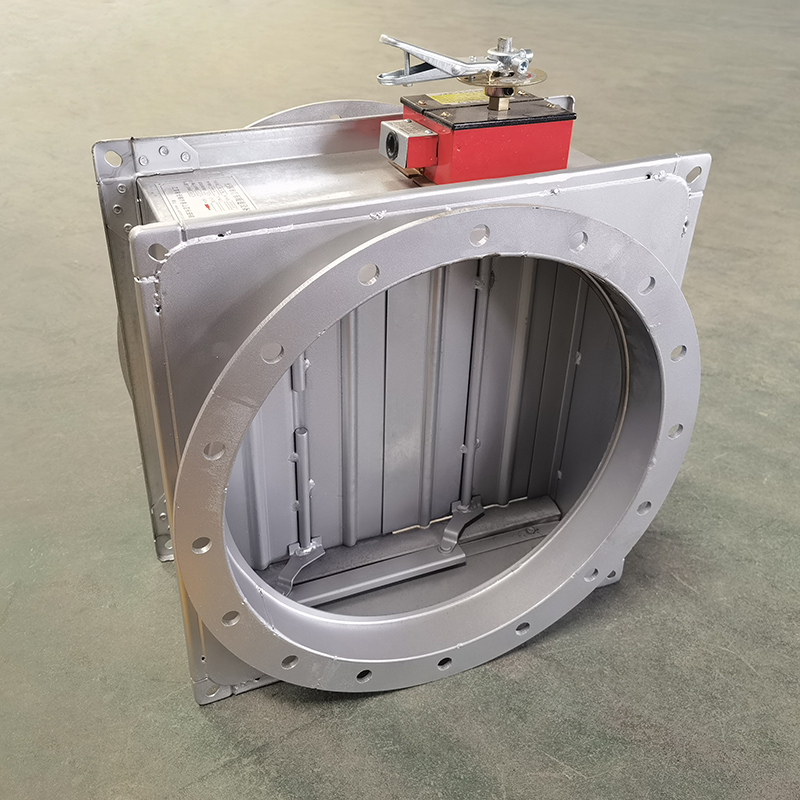
Most fire damper specifications are written as a single table row: size, temperature rating, normally open or normally closed, accessory list. That row then gets installed and forgotten for a decade. The question nobody asks is what the device actually does between the alarm and the all-clear, which is why so many dampers turn up seized, painted shut or fitted the wrong way round at the first serious inspection.
What follows is that account, in the order the events happen.
T+0: the alarm sounds, and the damper does nothing
This is deliberate. A
fire damper is not a smoke detector and it is not a control device. It is a passive barrier that holds its open position until a physical condition — temperature — tells it to move. At the moment of alarm, the blade stays exactly where it was, because the air handling system may still be running and the compartment may still need ventilation for egress.
What does change at T+0 is the signal path. Most units in commercial buildings carry a 24 V control circuit to the building fire alarm panel, either for status feedback or for remote release. If the specification called for a smoke-detector interface, the panel can command closure well before the thermal element reaches its rating. That is a design choice made on the drawing, not a property of the damper, and it should be recorded as such.
Normally open is the default, and that is the point
In supply, return and exhaust ducts that cross a fire compartment wall, the damper sits open in normal service and closes on fire. A normally closed unit is used where the duct serves a space that should be isolated when the building is not in fire mode — some smoke control configurations, some laboratory exhaust branches. Getting this backwards is one of the more expensive mistakes available, because a normally open unit wired to close on power loss will shut a smoke exhaust path at exactly the wrong moment.
The two trigger mechanisms
The thermal release is either a fusible alloy link or a shape-memory alloy element. The fusible link melts at a set temperature and the blade is driven shut by a spring or by gravity. The memory alloy changes crystallographic form at a set temperature and produces the same movement without a melting step. The second type is more expensive and does not leave a molten residue in the frame, which matters in cleanroom and food-plant ducts where a melted alloy spatter is an contamination event rather than a maintenance item.
Both mechanisms are single-use. Once tripped, the unit must be re-armed with a new link or a new actuator, and the frame and blade must be checked for distortion before it goes back into service.
T+3 minutes: 70°C units close the first group
At 70 °C, dampers on the supply and return air side of the compartment begin to shut. This temperature is not arbitrary — it is below the point at which a ducted air supply actively feeds a fire, and above the normal operating range of any correctly designed HVAC system.
A 70 °C fire damper belongs on the ventilation path, paired with the supply or return fan. When it closes, the fan may keep running; the duct is simply sealed at the compartment boundary.
T+15 minutes: the 280°C group, and why it stops the fan
The second group is a different animal. A 280 °C damper sits on the smoke exhaust path, downstream of the smoke exhaust fan's intake or on the branch where a smoke exhaust duct joins the vertical shaft. At 280 °C it closes, and in a properly interlocked system it also trips the smoke exhaust fan.
The logic is that by 280 °C the smoke layer has become hot enough that continuing to extract is no longer helping occupants and is now spreading heat and possibly fire through the shaft. Closing the damper and stopping the fan converts the shaft from a chimney into a sealed volume.
What "280 °C" is really measuring
The rating describes the temperature at which the release operates, not the temperature the assembly survives. A 280 °C rated damper is tested for a period of fire exposure at that condition, and the test standard — UL 555 in North America, EN 15650 in Europe, GB 15930 in China — defines the exposure curve, the leakage allowed past the closed blade, and the mechanical cycling the unit must survive beforehand.
This distinction matters when someone asks whether a 280 °C unit can be used on a 70 °C duty. Physically it can be installed. Functionally it will not protect the compartment, because it will still be open at 150 °C while the fire pushes hot gas through the wall. Rating is a duty, not a maximum.
Blade geometry and the free-area tax
Every
fire damper reduces the duct's effective open area. Frame, blade edges, linkage and the blade stack in the open position all take a cut. Typical losses run from 15 % on a large single-blade unit to over 25 % on a small multi-blade assembly, and the consequence is a local velocity increase that the fan has to pay for.
|
Nominal size |
Gross area |
Free area at 20 % loss |
Local velocity multiplier |
|
400 × 400 mm |
0.160 m² |
0.128 m² |
1.25 × |
|
600 × 400 mm |
0.240 m² |
0.192 m² |
1.25 × |
|
1000 × 500 mm |
0.500 m² |
0.400 m² |
1.25 × |
At 8 m/s duct velocity a 25 % area loss pushes local velocity to 10.7 m/s. That is still acceptable for a damper body, but it will generate a pressure drop and a noise signature that show up in the commissioning report as an unexplained item. Sizing the damper one frame larger than the duct and using a transition is often cheaper than absorbing the loss in fan static.
Where the damper has to sit
The governing rule is the compartment boundary. Any duct crossing a fire-rated wall, floor slab or machine-room partition needs a damper at that penetration, mounted in the plane of the barrier or as close to it as the tested installation detail allows. Distance from the wall face is not a matter of installer convenience; it is part of the qualification, and moving the unit 600 mm down the duct can void it.
Two placements cause most of the arguments on site:
• On a smoke exhaust system, the damper belongs at the fan intake header or where the branch meets the vertical shaft, not at the far end of the branch.
• On a duct passing through a shaft wall, the damper must be accessible for inspection from the corridor side, which usually means an access panel sized to the frame and labelled.
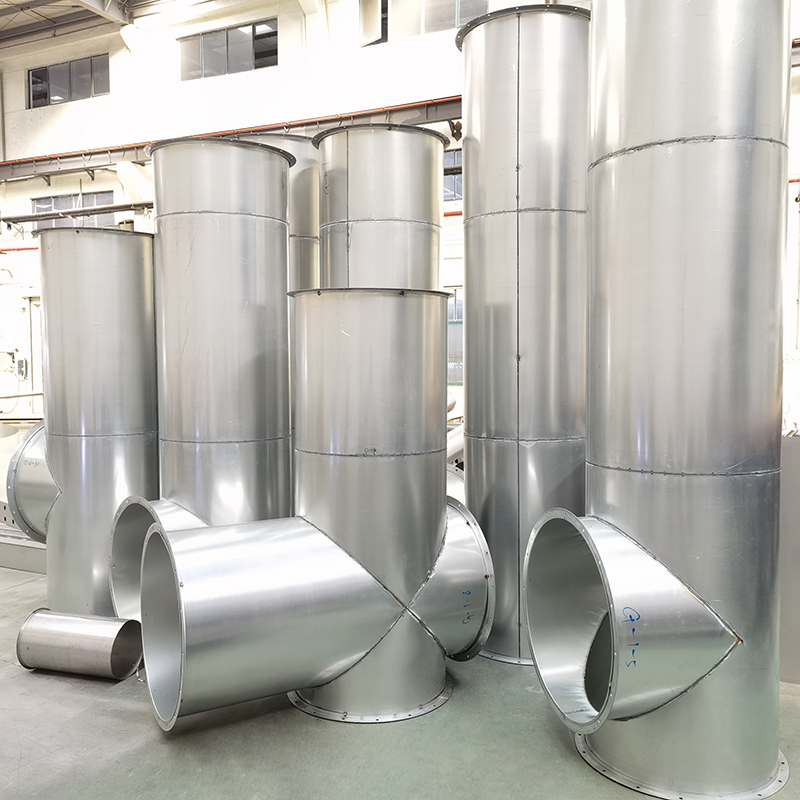
Wuxi Weishan supplies these units as part of a duct package rather than as loose hardware, which lets the frame, the sleeve and the access panel be detailed together before the wall is built.
The maintenance schedule that decides whether any of this works
A damper that has not been cycled in five years is a damper that may not close. The failure modes are mundane and predictable.
What actually fails in service
• Paint and plaster. A blade painted over during redecoration welds itself to the frame. This is the single most common defect found in existing buildings.
• Dust and grease. Kitchen exhaust and dust-laden ducts build a layer on the blade edge and the linkage that adds friction beyond the spring's ability to overcome.
• Linkage corrosion. In humid or coastal plant rooms the fusible link housing corrodes and the release no longer travels its full stroke.
• Distorted frames. Frames installed without adequate support deform when the duct expands, and a distorted frame will not seat a blade.
The service routine is therefore not complicated: confirm the blade moves freely by hand or by test actuator, confirm the seal is intact, confirm the thermal element is the correct rating and undamaged, clean the blade and frame, and re-arm with a new link after any trip. Record the date on the frame. A unit with no record and no label should be treated as unverified.
Specifying a fire damper for export projects
For a project outside China, three lines in the specification do most of the work of avoiding trouble later. First, state the test standard and the fire resistance period, not just the temperature. Second, state the required leakage class with the blade closed, because "fire damper" alone does not define it. Third, state the installation detail by reference to the tested configuration, including sleeve length and the gap allowed to the wall.
Wuxi Weishan builds
fire dampers in square, rectangular and circular form, in 70 °C and 280 °C ratings, with normally open or normally closed configuration and an optional linkage to the fire alarm system. The units are produced alongside the ductwork they will be fitted to, in a 10,000 m² facility in Huishan District, Wuxi, which means the frame tolerance and the duct flange tolerance come from the same drawing set.
The last thing worth saying is the least technical. A fire damper is the only component in an air system whose entire purpose is to fail into a safe state. It gets one chance to work. Everything above — the rating, the position, the free area, the maintenance record — exists to make sure that chance is not wasted on a device that was painted shut in 2019.
 +85247166614



 Current
location:Home >news
>Industry news
>Fire Damper Behaviour In A Real Fire: A Minute-by-Minute Account