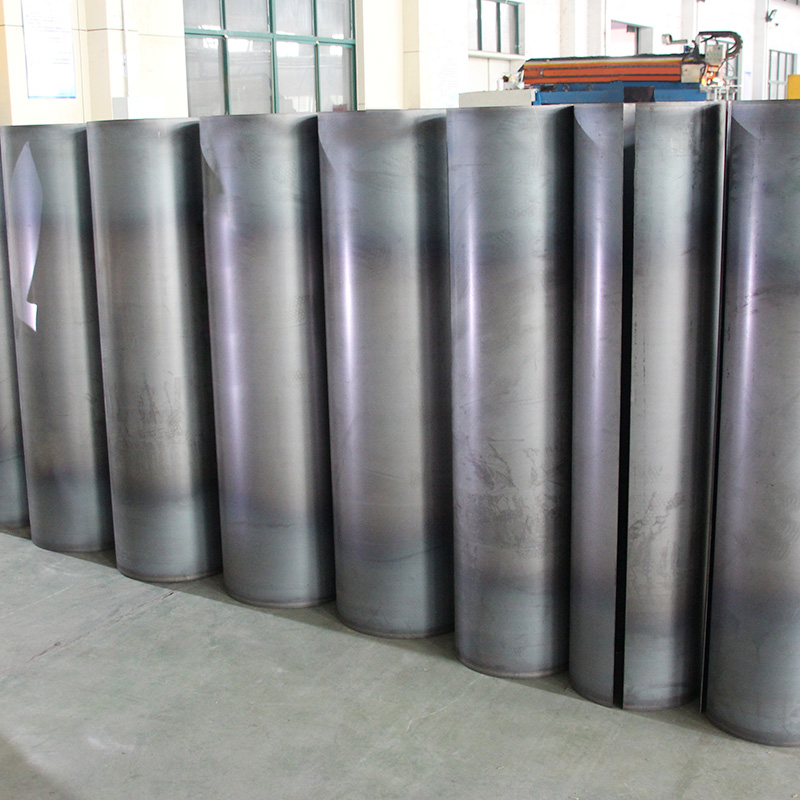
Walk into any steel mill, foundry, or power plant and you'll see ductwork that looks nothing like the galvanized rectangular trunk lines in an office building. These ducts are welded from carbon steel plate, often 1.0–1.5mm thick, built to handle temperatures that would melt a spiral seam lock and pressures that would pop a snap-lock joint apart. Carbon steel welded duct isn't the default choice for every HVAC job. But when the application demands it, nothing else quite fills the gap.
This article covers what carbon steel duct is, where it earns its place, and the fabrication details that determine whether a welded duct system performs for 20 years or starts leaking in 5.
Why Carbon Steel for Ductwork
Carbon steel (typically Q235B or equivalent grades like S235JR, A36) sits in a sweet spot between cost and performance. It costs significantly less than stainless steel — often 30–40% less per kilogram — while offering tensile strength in the 370–500 MPa range. For ductwork that needs to withstand industrial temperatures, abrasive particulate, or high static pressures, carbon steel provides the structural backbone at a price point that doesn't require a capital project justification.
The material's weldability is the other key factor. Carbon steel with a carbon content below 0.25% welds cleanly with standard MIG and TIG processes, producing strong, consistent seams without preheating in most thickness ranges. This is what makes large-diameter and large-cross-section welded ducts practical — you can fabricate them to virtually any size on site or in a shop, rather than being limited to the sizes available in standard spiral or lock-forming machinery.
Plate Thickness Selection: 0.75mm, 1.0mm, 1.2mm, 1.5mm — What Drives the Choice
Thickness selection for carbon steel duct depends on three factors: duct dimensions, operating pressure, and the presence of abrasives or vibration.
|
Duct Width/Diameter |
Recommended Thickness |
Typical Application |
|
≤ 500mm |
0.75–1.0mm |
Small exhaust branches, lab fume extraction |
|
500–1000mm |
1.0–1.2mm |
General industrial exhaust, kitchen hood mains |
|
1000–1500mm |
1.2–1.5mm |
High-volume dust collection, furnace exhaust |
|
> 1500mm |
1.5mm+ |
Large industrial process duct, power plant flue |
These are starting points, not rules. SMACNA's duct construction standards provide detailed pressure-class tables that correlate duct dimension, gauge, and reinforcement spacing. For high-pressure systems (above 2,000 Pa static), move up one thickness increment regardless of dimension.
A note on going thinner: 0.75mm carbon steel welded duct is feasible for small ducts in low-pressure applications, but the welding margin is narrow. At this thickness, burn-through risk increases, and the heat-affected zone becomes a larger proportion of the total cross-section. Most experienced fabricators won't weld below 0.75mm without switching to a different joining method.
Welding Process: MIG vs. TIG for Duct Fabrication
MIG (GMAW) — The Production Standard
Gas Metal Arc Welding is the default for most
carbon steel duct fabrication. It's fast, consistent, and produces strong full-penetration welds on material 0.75mm and thicker. A typical setup uses 0.8–1.0mm ER70S-6 wire with CO₂ or Ar/CO₂ mix shielding gas at 180–220A.
Advantages for duct fabrication:
• High deposition rate — long continuous seams on rectangular ducts can be welded in minutes
• Forgiving of minor fit-up gaps — important when fabricating large ducts from multiple plate sections
• Lower skill threshold — consistent results with moderately trained welders
TIG (GTAW) — For Critical Seams
TIG welding produces cleaner, more precise welds with better visual quality. It's slower and requires a higher skill level, but it's the right choice when:
• The duct carries highly corrosive gases and weld quality directly affects corrosion resistance
• Aesthetic appearance matters (exposed ductwork in architectural applications)
• Thin material (0.75mm) where heat input control is critical
For most industrial carbon steel duct applications, MIG is the practical and economic choice. TIG gets specified for specialty jobs or when the client specifically requires it.
Weld Quality and Inspection
Regardless of process, weld quality on duct seams affects two things: air leakage and structural integrity. A properly welded seam should be continuous, full-penetration (or at minimum 80% penetration for lighter-gauge material), free of porosity, and smooth enough that it doesn't create turbulence points in the airflow.
For high-pressure or critical systems, a dye penetrant test on a sample of production welds catches surface defects before the duct goes into service.
Anti-Corrosion Treatment: The Step That Determines Service Life
Carbon steel rusts. That's not a failure of the material — it's a material property. The question isn't whether untreated carbon steel will corrode in a duct system, but how quickly. The answer depends entirely on the protective coating system.
Primer + Topcoat System
The standard approach for carbon steel duct in corrosive environments:
1. Surface preparation: Shot blast or hand-clean to Sa 2.0 or St 3 grade, removing mill scale, rust, and contaminants
2. Primer: Epoxy zinc-rich primer (60–80μm DFT) or red oxide primer (30–50μm DFT). The zinc-rich option provides cathodic protection similar to galvanizing — the zinc corrodes preferentially to the steel
3. Topcoat: Epoxy topcoat (80–120μm DFT) for chemical resistance, or polyurethane topcoat for UV resistance if the duct runs outdoors
Total dry film thickness of 150–200μm provides 10–15 years of protection in moderate industrial atmospheres (ISO 12944 C3 environment class). In more aggressive environments (C4/C5 — chemical plants, coastal marine), push to 250μm+ and schedule recoating at 7–10 year intervals.
When Unprotected Carbon Steel Is Acceptable
Not every carbon steel duct needs a full coating system. In dry indoor environments with non-corrosive airstreams — a warehouse ventilation system, for example — a light shop primer or even bare steel may provide adequate service life. The key factors:
• Relative humidity below 60% in the served space
• No condensate formation in the duct
• Non-corrosive particulate in the airstream
If any of these conditions is uncertain, spec the coating.
Where Carbon Steel Duct Earns Its Place
High-Temperature Exhaust
Carbon steel duct handles continuous temperatures up to about 400°C (with appropriate high-temp coating) and intermittent exposure to 500°C+. This puts it in applications where galvanized duct would fail:
• Boiler exhaust and flue connections
• Heat treatment furnace ventilation
• Industrial oven exhaust
• Engine test cell exhaust
For temperatures above 500°C, you start moving into stainless steel or specialty alloys — but for the vast majority of industrial exhaust above normal HVAC temperatures, carbon steel is the standard.
Heavy Dust and Abrasive Service
Dust collection systems in woodworking, metalworking, and mineral processing carry particulate that erodes duct walls over time. Carbon steel's thickness (1.0–1.5mm vs. 0.5–0.8mm for typical spiral duct) means it takes longer to wear through. And when it does wear, a welded patch is a 10-minute fix — you can't patch a spiral lock seam.
In extremely abrasive applications (fly ash, sandblasting exhaust, cement handling), ceramic-lined or AR400 steel ducts are options, but plain carbon steel at 1.5mm often provides the best cost-per-year-of-service.
Commercial Kitchen Exhaust
Grease-laden exhaust from commercial kitchens presents a specific challenge: the grease itself is mildly corrosive, and the high humidity from cooking creates condensation that attacks unprotected steel. Carbon steel duct at 1.0–1.2mm with an epoxy interior coating is the standard for kitchen exhaust mains and risers. It handles the thermal load (grease ducts must be rated for fire events), resists grease corrosion, and provides the structural rigidity needed for vertical risers that may run multiple stories.
Large-Section Industrial Duct
When you need a duct that's 1,500mm × 2,000mm or larger, standard roll-forming equipment can't produce it in one piece. Carbon steel plate, cut and welded to size, is the practical solution. This is common in power plant FGD (flue gas desulfurization) systems, large dust collection headers, and process exhaust in chemical plants.
Carbon Steel vs. Galvanized Steel Duct: When to Choose Which
The choice between carbon steel and galvanized isn't just about the material — it's about the application environment.
Choose carbon steel welded duct when:
• Operating temperature exceeds 200°C (galvanized zinc coating degrades above this)
• Duct dimensions exceed standard spiral/lock-forming capabilities
• System pressure is high (> 2,500 Pa) and welded construction provides better sealing
• The airstream contains abrasives that would wear through thinner galvanized material
• Custom fabrication to non-standard dimensions is required on-site
Choose galvanized steel duct when:
• Operating temperature stays below 200°C
• The environment is moderate — standard HVAC, commercial ventilation
• Fabrication speed matters — galvanized sheet is faster to form and join
• Budget is a primary constraint and the application doesn't demand carbon steel's advantages
• Aesthetic appearance of exposed ductwork is important (galvanized has a uniform, clean look)
In many industrial facilities, both materials coexist. The main exhaust trunk from a furnace is carbon steel (high temperature, high pressure), while the branch ducts to general workspace ventilation are galvanized (ambient temperature, low pressure).
Fabrication and Installation Notes
On-Site Welding vs. Shop Fabrication
Large-diameter or large-cross-section carbon steel ducts are almost always shop-fabricated in manageable sections, then field-welded or flange-connected. Shop fabrication allows better quality control — consistent weld parameters, proper positioning, and pre-coating before shipment.
Field welding is unavoidable for some installations, particularly retrofit work or when dimensions depend on as-built conditions. Field welds must be ground smooth, cleaned, and touch-up coated immediately to prevent corrosion starting at the unprotected weld zone.
Flange Connections
For sections that need to be bolted together (for maintenance access, future modifications, or where field welding isn't practical), angle iron flanges or flat bar flanges with gasket seals are the standard. Bolt spacing should be 150–200mm centers for pressure integrity. Neoprene or silicone gasket material handles temperatures up to 200°C; high-temp applications use ceramic fiber gasket.
Support Spacing
Carbon steel duct is heavier than galvanized. Support spacing depends on duct dimensions and material thickness, but a general rule for rectangular duct:
• Up to 1,000mm width: supports at 2.5–3.0m intervals
• 1,000–1,500mm width: supports at 2.0–2.5m intervals
• Above 1,500mm width: supports at 1.5–2.0m intervals
Threaded rod with steel angle cleats is the standard support method. For vibration-prone systems (fan connections, pulsating exhaust), use vibration isolators at support points.
 +85247166614



 Current
location:Home >news
>Industry news
>Carbon Steel Duct: When Welded Construction Outperforms Spiral And Snap-Lock Alternatives
Current
location:Home >news
>Industry news
>Carbon Steel Duct: When Welded Construction Outperforms Spiral And Snap-Lock Alternatives