1. Introduction
With the continuous upgrading of industrial production standards and the increasing emphasis on indoor air quality and environmental protection, ventilation systems are facing higher requirements for durability, corrosion resistance, and hygiene. As the key carrier of air transmission and distribution, air ducts directly determine the operational efficiency, service life, and safety of the entire ventilation system. Traditional spiral ducts made of galvanized steel or aluminum have limitations in harsh environments (such as high humidity, corrosive gases, and strict hygiene requirements), often suffering from corrosion, rust, air leakage, and frequent maintenance, which affect the stable operation of the system and increase long-term operational costs.
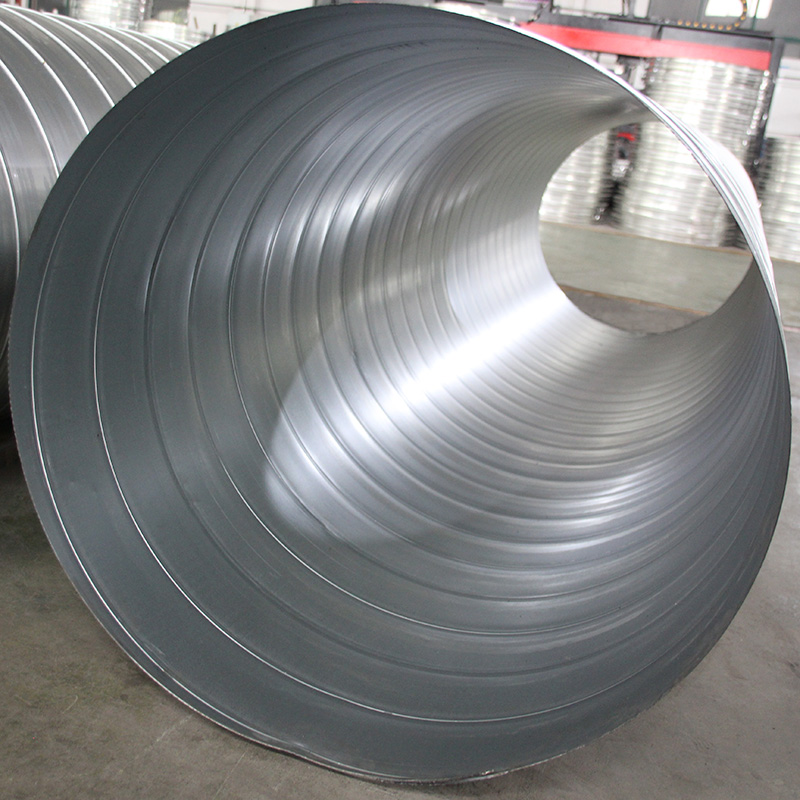
Stainless steel spiral air ducts, integrating the advantages of stainless steel materials and spiral forming technology, have outstanding performance in corrosion resistance, hygiene, structural strength, and airtightness. They are made of high-quality stainless steel sheets (such as 304, 316L) through automated spiral rolling, locking, and forming, without the need for welding or riveting in the forming process, which ensures the integrity of the duct structure and avoids the hidden dangers of weld seam corrosion and air leakage. In recent years, with the continuous improvement of stainless steel processing technology and the popularization of energy-saving and environmental protection concepts, stainless steel spiral air ducts have been widely applied in high-demand fields such as food processing, pharmaceutical manufacturing, chemical industry, hospitals, and high-end commercial buildings, showing broad application prospects and practical value.
Against this background, this paper focuses on the technical specifications and application advantages of stainless steel spiral air ducts, systematically sorts out the material selection, fabrication, installation, and quality control standards, comprehensively analyzes their performance advantages and application characteristics, and combines practical engineering cases to verify their application effects. This paper aims to help relevant practitioners fully grasp the core technical points of stainless steel spiral air ducts, standardize their application in engineering practice, and promote the sustainable development of ventilation systems towards high-performance, durable, and compliant directions.
2. Core Technical Specifications of Stainless Steel Spiral Air Ducts
The technical specifications of stainless steel spiral air ducts cover material selection, forming and fabrication, installation, and quality inspection, which are the core basis for ensuring their performance and service life. These specifications must comply with relevant international and national standards, and be adjusted according to the actual application environment and performance requirements. The detailed technical specifications are elaborated as follows:
2.1 Material Selection Specifications
The material selection of stainless steel spiral air ducts is the foundation to ensure their corrosion resistance, mechanical strength, and hygiene performance. The selection must be based on the application environment (corrosion level, humidity, temperature), conveying medium, and hygiene requirements, and strictly comply with the specifications of ASTM A240, GB/T 12771, and other standards. The key material selection specifications are as follows:
- Stainless Steel Grade Selection: Commonly used stainless steel grades for spiral air ducts include 304, 316L, and 2205 duplex stainless steel. 304 stainless steel (18% Cr, 8% Ni) is suitable for general corrosive environments (such as indoor ventilation, commercial buildings), with excellent atmospheric corrosion resistance and low cost; 316L stainless steel (added 2~3% Mo on the basis of 304) has significantly improved corrosion resistance to chloride ions and strong corrosive media, suitable for harsh environments such as coastal areas, chemical plants, food processing plants, and pharmaceutical workshops; 2205 duplex stainless steel has high mechanical strength and excellent corrosion resistance, suitable for high-pressure, high-corrosion scenarios (such as chemical exhaust, high-temperature flue gas conveying). For high-hygiene scenarios (food, pharmaceutical), the stainless steel material must meet the requirements of GB 4806.9 (food contact materials) or ISO 11135 (medical device sterilization).
- Material Thickness Specifications: The thickness of the stainless steel sheet is determined according to the working pressure of the duct and the application scenario, ensuring sufficient structural strength and pressure resistance. The specific thickness requirements are as follows: low-pressure ducts (working pressure ≤500Pa): thickness ≥0.6mm; medium-pressure ducts (500Pa < working pressure ≤1500Pa): thickness ≥0.8mm; high-pressure ducts (working pressure >1500Pa): thickness ≥1.0mm. For large-diameter ducts (diameter >1200mm) or high-pressure systems, the thickness should be appropriately increased by 0.2~0.3mm to avoid deformation.
- Material Quality Requirements: The stainless steel sheet shall be free of defects such as cracks, scratches, rust, and uneven thickness; the chemical composition (Cr, Ni, Mo content) and mechanical properties (tensile strength, yield strength, elongation) shall meet the requirements of the selected grade. For 304 stainless steel, the tensile strength shall be 515~655MPa, yield strength ≥205MPa, elongation ≥40%; for 316L stainless steel, the tensile strength shall be 485~620MPa, yield strength ≥170MPa, elongation ≥40%. The surface roughness Ra of the sheet shall not exceed 0.8μm for high-hygiene scenarios, ensuring smoothness and easy cleaning.
2.2 Forming and Fabrication Technical Specifications
The forming and fabrication of stainless steel spiral air ducts adopt automated spiral forming technology, which requires strict control of processing precision, forming quality, and surface treatment to ensure the structural integrity and airtightness of the duct. The key fabrication specifications are as follows:
- Forming Technology: The stainless steel sheet is uncoiled, leveled, and then rolled into a spiral shape through a professional spiral duct forming machine, with adjacent edges locked by a snap-lock or seamed lock structure, forming a seamless or semi-seamless circular duct. The forming process shall be automated, with uniform spiral pitch (usually 20~30mm) and dimensional precision: the diameter error ≤±0.5mm, the straightness error ≤3mm/m, and the roundness error ≤3mm/m. The forming process shall avoid damage to the surface of the stainless steel sheet, and the protective film shall be retained during processing to prevent scratches and corrosion.
- Cutting and Bending Specifications: Laser cutting or plasma cutting is adopted for sheet cutting, with smooth cut surface, no burrs, and dimensional error ≤±0.1mm. Bending is carried out by a hydraulic bending machine, with a bending radius not less than 1.5 times the sheet thickness (for 304, 316L stainless steel) to avoid cracks at the bending part. For thick-plate ducts (thickness >2.0mm), annealing treatment shall be carried out after bending to eliminate internal stress, with annealing temperature 1050~1100℃ and cooling method of water cooling or air cooling.
- Welding Specifications (if required): For special-shaped ducts or flange connections, TIG welding (tungsten inert gas welding) is adopted, with welding wire matching the stainless steel grade (ER308 for 304, ER316L for 316L). The weld seam shall be continuous, uniform, and free of defects such as cracks, pores, and incomplete fusion; the width of the weld seam shall be 1.5~2 times the sheet thickness, and the inner surface of the weld seam shall be smooth (protrusion height ≤2mm) to avoid increasing air resistance. After welding, the weld seam shall be pickled and passivated to remove oxide scale and welding slag, and form a dense oxide film to improve corrosion resistance.
- Surface Treatment Specifications: The inner and outer surfaces of the duct shall be polished to No. 4 grade or above (Ra ≤0.8μm) for high-hygiene scenarios, ensuring smoothness and avoiding dust accumulation and bacterial growth. For ducts used in corrosive environments, pickling and passivation treatment shall be carried out after fabrication, with the surface neutral (pH 6~8) and free of acid residue. The surface shall be free of scratches, burrs, and rust, and the protective film shall be retained until installation.
2.3 Installation Technical Specifications
The installation quality of stainless steel spiral air ducts directly affects their operational stability, airtightness, and service life. The installation shall be carried out in strict accordance with GB 50243-2016 and JGJ/T 141-2017, with the following key specifications:
- Pre-Installation Preparation: Review the design drawings, conduct on-site surveys to confirm that the installation space, reserved holes, and structural size are consistent with the design. Inspect the fabricated ducts for deformation, damage, and welding defects; clean the inner surface of the ducts to remove dust, oil, and other impurities. Prepare installation equipment (lifting equipment, welding equipment) and tools (measuring tools, sealants), and calibrate the measuring tools to ensure measurement accuracy.
- Support and Hanger Installation: The support and hanger shall be made of the same grade of stainless steel as the duct to avoid galvanic corrosion. The cross-sectional size of the support and hanger shall be calculated according to the duct weight, air pressure, and installation span: the span of horizontal ducts (diameter ≤1000mm) shall not exceed 3m, and the span of vertical ducts shall not exceed 3m (installed at each floor). The support and hanger shall be installed on the building load-bearing structure, with a buffer pad (silicone rubber, PTFE) between the hanger and the duct to reduce vibration and prevent surface damage. In earthquake-prone areas (seismic intensity ≥7 degrees), anti-seismic brackets shall be installed, with horizontal anti-seismic bearing capacity not less than 1.2 times the duct weight.
- Duct Connection: The connection between duct sections adopts flange connection, with the flange made of the same stainless steel grade as the duct. The flange shall be flat, with evenly distributed bolt holes (spacing 120~150mm), and the bolts shall be stainless steel. The joint between flanges shall be sealed with stainless steel gaskets or high-temperature resistant sealants (silicone rubber, PTFE), with gasket thickness 3~5mm, ensuring airtightness. The connection between the duct and fan, valve, and other equipment shall be equipped with stainless steel bellows flexible joints (length 150~200mm) to reduce vibration and noise transmission.
- Airtightness Testing: After installation, airtightness testing shall be carried out, with the test method complying with GB 50243-2016. The air leakage rate of low-pressure ducts shall not exceed 8%, medium-pressure ducts ≤5%, and high-pressure ducts ≤3%. For high-hygiene or high-pressure systems, the air leakage rate shall meet Class A requirements (≤2%). If the leakage rate exceeds the standard, the leakage points shall be repaired (re-sealing, weld seam repair) and the test shall be re-conducted.
2.4 Quality Inspection Specifications
Quality inspection shall be carried out throughout the process of material selection, fabrication, and installation to ensure that the stainless steel spiral air ducts meet the design requirements and relevant standards. The key inspection items are as follows:
- Material Inspection: Check the quality certificate, material test report, and production batch number of the stainless steel sheet, confirm the consistency of grade, specification, and performance with the design. Conduct sampling inspection for chemical composition and mechanical properties for large-batch or key projects.
- Fabrication Inspection: Inspect the dimensional precision (diameter, length, straightness), forming quality (no deformation, wrinkles), weld seam quality (visual inspection, non-destructive testing for key projects), and surface treatment (polishing grade, pickling passivation effect) of the duct.
- Installation Inspection: Inspect the installation accuracy (straightness, verticality), support and hanger installation (firmness, spacing), duct connection (sealing, bolt tightening torque), and airtightness test results. For high-hygiene scenarios, inspect the inner surface cleanliness of the duct.
3. Application Advantages of Stainless Steel Spiral Air Ducts
Compared with traditional spiral ducts (galvanized steel, aluminum) and rectangular ducts, stainless steel spiral air ducts have unique and outstanding advantages in performance, durability, hygiene, and energy conservation, which are the core reasons for their wide application in high-demand fields. The detailed advantages are analyzed as follows:
3.1 Excellent Corrosion Resistance and Long Service Life
Stainless steel materials (especially 316L, 2205) have strong resistance to humid air, chemical gases (chloride ions, sulfuric acid, phosphoric acid), and corrosive media, which can effectively avoid corrosion, rust, and perforation of the duct. Compared with galvanized steel spiral ducts (service life 10~15 years), stainless steel spiral ducts have a service life of 25~30 years under normal use and regular maintenance, which is 1.5~2 times that of galvanized steel ducts. In harsh environments such as coastal areas, chemical plants, and food processing plants, the corrosion resistance advantage of stainless steel spiral ducts is more obvious, reducing the frequency of duct replacement and long-term operational costs.
3.2 High Hygiene Performance, Meeting Strict Industry Standards
Stainless steel materials are non-toxic, harmless, and non-polluting, and the smooth inner surface (Ra ≤0.8μm) is not easy to accumulate dust, dirt, and bacteria, which is easy to clean and disinfect. This makes stainless steel spiral ducts especially suitable for fields with strict hygiene requirements, such as food processing, pharmaceutical manufacturing, hospitals, and clean rooms. The material meets the requirements of GB 4806.9 and ISO 11135, ensuring that the air conveyed is free of pollution and meets the hygiene standards of the industry. In addition, the seamless spiral structure avoids dust accumulation at the joints, further improving the hygiene performance of the ventilation system.
3.3 Superior Airtightness and Energy Conservation
The spiral locking structure of stainless steel spiral ducts and the strict sealing treatment of flange connections ensure excellent airtightness, with an air leakage rate ≤2% (Class A), which is far lower than that of galvanized steel spiral ducts (5~8%) and rectangular ducts (8~10%). Good airtightness can effectively reduce air volume loss, reduce the load of the fan, and achieve energy-saving effects. Practice shows that compared with traditional galvanized steel spiral ducts, stainless steel spiral ducts can save 15~20% of energy consumption in the operation process. At the same time, the smooth inner surface of the duct reduces air resistance (air resistance coefficient 0.02~0.03), improves ventilation efficiency, and further reduces energy consumption.
3.4 High Structural Strength and Strong Pressure Resistance
The circular cross-sectional structure of spiral ducts and the spiral locking design of the duct wall, combined with the high mechanical strength of stainless steel materials, make the stainless steel spiral ducts have strong pressure resistance and structural stability. They can withstand a working pressure of up to 2500Pa, suitable for high-pressure ventilation systems (such as industrial exhaust, high-rise building ventilation). Compared with rectangular ducts (prone to deformation at corners), stainless steel spiral ducts are not easy to deform under external pressure or internal negative pressure, ensuring the structural integrity and stable operation of the duct system.
3.5 Flexible Layout, Space Saving, and Easy Installation
The circular cross-section of stainless steel spiral ducts has good flexibility in layout, which can be easily arranged in narrow spaces such as ceilings, wall cavities, and equipment rooms. Compared with rectangular ducts, they have a smaller cross-sectional area under the same air volume, saving installation space and improving the utilization rate of building space. In addition, the single-section length of stainless steel spiral ducts can be customized up to 12m, reducing the number of joints by 60~70% compared with rectangular ducts. The installation is fast and convenient, with installation efficiency 2~3 times that of traditional rectangular ducts, shortening the construction period and reducing construction costs.
3.6 Environmental Protection, Recyclable, and Low Maintenance Cost
Stainless steel materials are recyclable, non-toxic, and harmless, in line with the concept of green environmental protection, and can be recycled after the service life of the duct, reducing environmental pollution. The structural stability of stainless steel spiral ducts is good, and the smooth inner surface is easy to clean and maintain. For general ventilation systems, the cleaning cycle is 12 months; for high-hygiene systems, the cleaning cycle is 6 months, which is longer than that of traditional ducts. The maintenance workload and cost are only 15~20% of that of galvanized steel ducts, reducing the long-term operational burden.
4. Practical Application Scenarios of Stainless Steel Spiral Air Ducts
Due to their excellent comprehensive performance, stainless steel spiral air ducts are widely applied in high-demand fields that require corrosion resistance, high hygiene, and long service life. According to the different requirements of application environments and performance, the selection of stainless steel grades, specifications, and installation methods is also different. The detailed application scenarios are as follows:
4.1 Food Processing Industry
Food processing plants (dairy products, meat products, pastries, beverages) have high requirements for hygiene and corrosion resistance, as the ventilation system needs to avoid dust accumulation, bacterial growth, and corrosion caused by cleaning agents and food residues. Stainless steel spiral ducts (316L grade) are selected, with polished inner surface (Ra ≤0.8μm) and excellent corrosion resistance, which can withstand the erosion of cleaning agents (such as sodium hypochlorite) and high humidity environments. They are used for fresh air supply, exhaust, and clean air ventilation in production workshops, ensuring the hygiene and safety of food production.
4.2 Pharmaceutical Manufacturing Industry
Pharmaceutical workshops (API production, preparation production, clean rooms) have extremely strict requirements for air cleanliness, hygiene, and corrosion resistance. Stainless steel spiral ducts (316L or 2205 grade) are adopted, with seamless structure, polished surface, and no dead corners, which can avoid dust accumulation and bacterial growth. The ducts are used in the ventilation system of clean rooms (Class 100~10000), ensuring that the air conveyed meets the cleanliness requirements, and resisting the corrosion of chemical solvents and pharmaceutical raw materials.
4.3 Chemical Industry
Chemical plants (petrochemical, fine chemical, chemical fertilizer) have harsh working environments, involving high temperature, high humidity, and corrosive gases (chloride ions, sulfur dioxide, acid mist). Stainless steel spiral ducts (316L or 2205 duplex stainless steel) are selected, with strong corrosion resistance and high temperature resistance, which can withstand the erosion of corrosive media and high-temperature flue gas. They are used for exhaust of harmful gases, ventilation of production workshops, and conveying of corrosive gas, ensuring the safety of production and the health of workers.
4.4 High-End Public Buildings
High-end public buildings (hospitals, luxury hotels, high-end office buildings, airports) have high requirements for indoor air quality, appearance quality, and durability. Stainless steel spiral ducts (304 or 316L grade) are selected, with beautiful appearance, excellent airtightness, and low noise, which can match the high-end positioning of the building. In hospitals, they are used in the ventilation system of operating rooms, wards, and laboratories to prevent cross-infection; in luxury hotels and office buildings, they are used in central air conditioning ventilation systems to provide a comfortable indoor environment.
4.5 Special Occasions
Stainless steel spiral ducts are also widely used in special occasions such as coastal areas, underground garages, and tunnels. In coastal areas, they resist the corrosion of salt spray and humid air; in underground garages, they are used for exhaust of vehicle exhaust and fresh air supply, with corrosion resistance to exhaust gas; in tunnels, they are used for ventilation, with high structural strength and pressure resistance, ensuring stable operation in harsh environments.
5. Comparison Between Stainless Steel Spiral Ducts and Conventional Spiral Ducts
To further highlight the application advantages of stainless steel spiral ducts, this section compares them with conventional spiral ducts (galvanized steel, aluminum) in terms of performance, material, service life, and application scope, as shown in the following table:
Comparison Index
Stainless Steel Spiral Ducts (316L)
Galvanized Steel Spiral Ducts
Aluminum Spiral Ducts
Corrosion Resistance
Excellent, resistant to chloride ions and strong corrosive media
General, prone to corrosion in humid/corrosive environments
Good, but poor in strong corrosive environments
Hygiene Performance
High, smooth surface, easy to clean, meets food/pharmaceutical standards
General, surface galvanized layer is easy to fall off, easy to accumulate dust
Good, but not suitable for high-hygiene scenarios
Service Life
25~30 years
10~15 years
15~20 years
Airtightness
Excellent, air leakage rate ≤2% (Class A)
Good, air leakage rate 5~8%
Good, air leakage rate 4~6%
Structural Strength
High, pressure resistance up to 2500Pa
Medium, pressure resistance up to 2000Pa
Medium, pressure resistance up to 1500Pa
Maintenance Cost
Low, 15~20% of galvanized steel ducts
High, frequent maintenance and replacement
Medium, prone to scratch and deformation
Application Scope
High-demand fields (food, pharmaceutical, chemical, high-end buildings)
General ventilation (commercial, residential, ordinary industrial)
Lightweight requirements (airports, high-rises)
It can be seen from the comparison that stainless steel spiral ducts have obvious advantages over conventional spiral ducts in corrosion resistance, hygiene, service life, and airtightness, especially suitable for high-demand scenarios, while conventional spiral ducts are more suitable for general ventilation environments with low requirements.
6. Compliance with Relevant Standards and Codes
The material selection, fabrication, installation, and quality inspection of stainless steel spiral air ducts must comply with relevant international standards, national codes, and industry specifications to ensure the quality, safety, and compliance of the ventilation system. The main relevant standards and codes are as follows:
- International Standards: ASTM A240 (Standard Specification for Chromium and Chromium-Nickel Stainless Steel Plate, Sheet, and Strip), ASTM E1592 (Standard Specification for Spiral Round Ducts), ISO 16975 (Ventilation for Buildings - Performance Requirements for Ventilation Systems), EN 12237 (Ventilation for Buildings - Ductwork - Construction and Installation).
- National Codes: GB/T 12771 (Stainless Steel Tubes for Fluid Conveyance), GB 50243-2016 (Code for Construction and Acceptance of Ventilation and Air Conditioning Engineering), GB 4806.9 (National Food Safety Standard - Food Contact Materials and Articles - Stainless Steel Products), GB/T 19516-2019 (Spiral Ducts for Ventilation and Air Conditioning).
- Industry Specifications: JGJ/T 141-2017 (Technical Specification for Installation of Ventilation and Air Conditioning Ducts), CECS 207-2006 (Technical Specification for FRP Ventilation Ducts in Buildings), HG/T 20696 (Code for Construction and Acceptance of Stainless Steel Piping Engineering).
In engineering practice, the application of stainless steel spiral air ducts shall be based on the above standards and codes, combined with the specific conditions of the project, to ensure that all technical indicators meet the requirements. At the same time, regular inspection and acceptance shall be carried out to ensure the quality of the project.
7. Practical Engineering Case Analysis
To verify the application effect of stainless steel spiral air ducts, this section selects a large-scale pharmaceutical factory clean room project for case analysis.
7.1 Project Overview
A large-scale pharmaceutical factory, with a total construction area of 30,000㎡, mainly produces injections and oral preparations. The clean room of the factory requires a Class 1000 ventilation system, with strict requirements for air cleanliness, hygiene, and corrosion resistance. The ventilation system adopts stainless steel spiral air ducts, with a total length of 1200m, including clean air supply ducts, exhaust ducts, and return air ducts. The working pressure of the duct system is 1200Pa (medium pressure), and the design service life is 30 years.
7.2 Implementation Scheme
- Duct Selection: According to the project requirements, 316L stainless steel spiral ducts are selected, with a material thickness of 0.8mm (medium pressure). The inner and outer surfaces are polished to No. 4 grade (Ra ≤0.8μm), meeting the hygiene requirements of pharmaceutical clean rooms. The diameter of the duct is 400~1500mm, and the air velocity is controlled at 4~8m/s to ensure air cleanliness. The air tightness level is Class A, ensuring the air leakage rate ≤2%.
- Fabrication and Installation: The ducts are fabricated by automated spiral forming machines, with a single-section length of 10m, reducing the number of joints. Laser cutting is adopted for sheet cutting, and TIG welding is used for flange connection, with ER316L welding wire. After welding, the weld seam is pickled and passivated to ensure corrosion resistance. The support and hanger are made of 316L stainless steel, installed on the building beams, with a spacing of 2.5m. The connection between duct sections is sealed with PTFE gaskets, and the connection with the fan is equipped with stainless steel bellows flexible joints. After installation, airtightness testing is carried out, with an average air leakage rate of 1.8%, meeting the Class A requirement.
- Maintenance Plan: A regular maintenance plan is formulated, including cleaning the inner surface of the duct every 6 months (using professional cleaning equipment), inspecting the duct structure, joints, and support and hanger every 12 months, and maintaining the fan and valve every 3 months. This ensures the stable operation of the ventilation system and the cleanliness of the clean room.
7.3 Application Effect
After the completion of the project, the stainless steel spiral duct system operates stably. The air tightness is excellent, and the air volume loss is small, ensuring that the air cleanliness of the clean room meets the Class 1000 requirement. The 316L stainless steel material has excellent corrosion resistance, and no corrosion, rust, or air leakage occurs after 4 years of operation, even in the environment of frequent cleaning with chemical solvents. The smooth inner surface avoids dust accumulation and bacterial growth, meeting the hygiene requirements of pharmaceutical production. The service life of the duct is expected to reach 30 years, and the maintenance cost is only 18% of that of galvanized steel spiral ducts. The project has achieved good economic and social benefits, verifying the rationality and applicability of stainless steel spiral air ducts in high-demand scenarios.
8. Conclusion
Stainless steel spiral air ducts, integrating the material advantages of stainless steel and the structural advantages of spiral forming technology, have excellent corrosion resistance, hygiene performance, airtightness, and structural strength. Their core technical specifications cover material selection, fabrication, installation, and quality inspection, which must be strictly followed to ensure their performance and service life. Compared with conventional spiral ducts, stainless steel spiral air ducts have obvious advantages in service life, corrosion resistance, hygiene, and energy conservation, making them the preferred choice for high-demand fields such as food processing, pharmaceutical manufacturing, chemical industry, and high-end public buildings.
With the continuous improvement of industrial production standards and the increasing stringency of energy conservation and environmental protection requirements, the application of stainless steel spiral air ducts will become more widespread. In future engineering practice, it is necessary to further optimize the material selection scheme, improve the fabrication and installation technology, strengthen the whole-process quality control, and combine new materials and new processes to further improve the performance and applicability of stainless steel spiral air ducts. At the same time, it is necessary to pay attention to regular maintenance and maintenance to ensure the long-term stable and efficient operation of the duct system.
This paper systematically explains the technical specifications and application advantages of stainless steel spiral air ducts, combines practical engineering cases to verify their application effect, and provides comprehensive technical guidance for relevant practitioners. It is hoped that this paper can promote the standardized and professional application of stainless steel spiral air ducts, and contribute to the construction of high-performance, durable, and compliant ventilation systems in various industries.
 +85247166614



 Current
location:Home >news
>Industry news
>Stainless Steel Spiral Air Ducts: Technical Specifications, Performance Advantages, And Engineering Application Details
Current
location:Home >news
>Industry news
>Stainless Steel Spiral Air Ducts: Technical Specifications, Performance Advantages, And Engineering Application Details