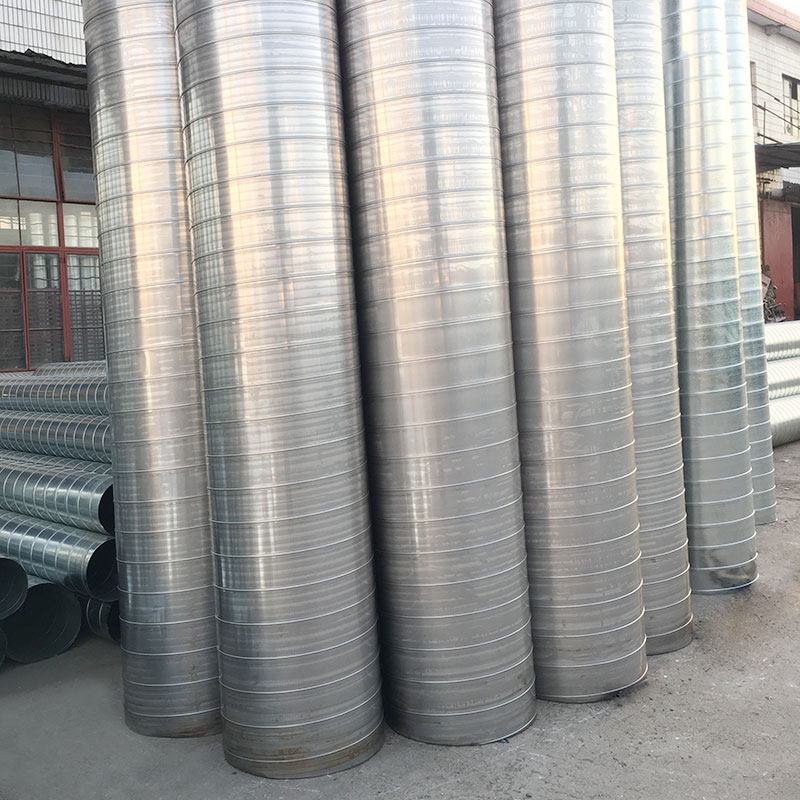
Spiral ductwork is a critical component in heating, ventilation, and air conditioning (HVAC) systems, widely adopted in commercial, industrial, and institutional projects due to its superior structural integrity, aerodynamic performance, and cost-effectiveness. Unlike conventional rectangular ducts, spiral ducts feature a cylindrical structure formed by helically winding metal sheets, which endows them with unique mechanical and fluid dynamic properties that address the limitations of traditional duct systems. This article elaborates on the core design, manufacturing process, performance characteristics, typical applications, and installation maintenance of spiral ductwork, providing a comprehensive professional reference for HVAC engineers, contractors, and project managers.
1. Definition and Core Design of Spiral Ductwork
A
spiral duct, also referred to as a spiral-wound duct, is a tubular ventilation element fabricated by continuously winding a flat metal coil into a seamless helical shape. The fundamental design principle of spiral ductwork lies in the helical interlocking seam, which distributes mechanical stress evenly across the duct surface, ensuring enhanced structural stability compared to rectangular ducts with discrete joints.
The key design parameters of spiral ductwork include duct diameter, wall thickness, spiral pitch, and material grade. Standard diameters range from 100mm to 2000mm, with custom sizes available for specialized high-flow or limited-space applications. Wall thickness is determined by the operating pressure (positive or negative) and material type, typically ranging from 0.6mm to 1.2mm for galvanized steel ducts. The spiral pitch, usually 25mm to 50mm, directly affects the seam strength and airtightness of the duct.
2. Manufacturing Process and Material Selection
The manufacturing of spiral ductwork involves a highly automated process to ensure precision and consistency. The workflow begins with material cutting: flat metal coils are uncoiled and cut into strips of specified width according to the duct diameter and wall thickness. Subsequently, the metal strips are fed into a spiral forming machine, which rolls and locks the edges of the strip into a continuous helical seam through cold forming, eliminating the need for welding or riveting. Finally, the formed ducts are cut into pre-determined lengths, and end flanges or slip joints are installed for on-site connection.
Material selection for spiral ductwork is primarily based on the application environment, operating pressure, and corrosion resistance requirements. The most commonly used materials include: galvanized steel (G235/G350), which offers cost-effectiveness and basic corrosion resistance for general HVAC applications; stainless steel (304/316), suitable for corrosive environments such as chemical plants, food processing facilities, and coastal areas; and aluminum, preferred for lightweight and low-temperature applications due to its excellent thermal conductivity and anti-corrosion performance. For special scenarios, such as cleanrooms, galvanized steel ducts with anti-bacterial coatings are available to meet hygiene standards.
3. Performance Advantages of Spiral Ductwork
Compared to traditional rectangular ductwork, spiral ducts exhibit significant advantages in aerodynamics, structural strength, airtightness, and cost-effectiveness, making them the preferred choice for modern HVAC systems.
3.1 Aerodynamic Efficiency: The smooth cylindrical inner surface of spiral ducts minimizes air turbulence and frictional resistance, reducing static pressure loss by 25%-35% compared to rectangular ducts with sharp corners. This improvement in airflow efficiency allows HVAC systems to operate with lower fan power consumption, reducing energy costs by 10%-15% during long-term operation.
3.2 Structural Integrity: The helical interlocking seam of spiral ducts distributes external pressure and mechanical load evenly, providing superior rigidity and deformation resistance. Unlike rectangular ducts, which require additional bracing and reinforcement to prevent sagging or deformation under high pressure, spiral ducts can withstand operating pressures up to 2000 Pa without additional reinforcement, making them suitable for high-pressure HVAC systems and industrial ventilation.
3.3 Excellent Airtightness: The continuous helical seam of spiral ducts has fewer joints compared to rectangular ducts, which rely on multiple longitudinal and transverse seams. With proper sealing (using gasket seals or sealant), the air leakage rate of spiral ducts can be controlled below 5 m³/(h·m²) at 500 Pa, far lower than the industry standard of 10 m³/(h·m²) for rectangular ducts. This reduces energy waste and ensures consistent indoor air quality and temperature distribution.
3.4 Cost-Effectiveness: Although the initial material cost of spiral ductwork may be slightly higher than that of rectangular ducts, the savings in labor, installation time, and energy consumption offset this difference. Spiral ducts can be installed 40%-60% faster than rectangular ducts due to their pre-fabricated long sections and simple slip-joint connections, significantly reducing on-site labor costs. Additionally, the material utilization rate of spiral ducts is over 95%, compared to 70%-80% for rectangular ducts, reducing material waste.
4. Typical Applications of Spiral Ductwork
Due to their versatile performance, spiral ducts are widely used in various industries and scenarios, including:
4.1 Commercial Buildings: Office buildings, shopping malls, hotels, and airports often adopt spiral ductwork for central HVAC systems. The sleek cylindrical design is suitable for exposed ductwork in open-ceiling spaces, combining functionality with aesthetic appeal. The low noise and high airflow efficiency of spiral ducts also ensure a comfortable indoor environment for occupants.
4.2 Industrial Facilities: Chemical plants, power plants, manufacturing workshops, and warehouses use spiral ducts for industrial ventilation, exhaust, and dust collection. The corrosion resistance of stainless steel or coated spiral ducts makes them suitable for harsh industrial environments, while their high-pressure resistance meets the requirements of large-airflow ventilation systems.
4.3 Institutional Buildings: Hospitals, schools, and laboratories require high hygiene standards and stable airflow. Spiral ducts with smooth inner surfaces are easy to clean and disinfect, reducing the accumulation of dust and bacteria, making them ideal for these applications. In cleanrooms, spiral ducts with anti-static coatings are used to prevent dust adsorption and ensure air purity.
4.4 Residential Applications: With the development of high-end residential buildings, spiral ducts are increasingly used in large villas and apartment complexes. Their compact design saves installation space, and the low noise and energy efficiency meet the requirements of modern residential comfort.
5. Installation and Maintenance Considerations
Proper installation and regular maintenance are essential to ensure the long-term performance of spiral ductwork. During installation, the following points should be noted: first, ensure the alignment of duct sections to avoid air leakage at joints; second, use appropriate hanging brackets (spaced 1.5m-2.0m apart) to prevent duct sagging; third, seal all joints with high-quality sealant or gasket to ensure airtightness; fourth, install flexible connectors at the connection between the duct and the fan to reduce vibration transmission.
For maintenance, regular inspection and cleaning are required. The smooth inner surface of spiral ducts makes cleaning easier—high-pressure air or professional duct cleaning equipment can be used to remove dust and debris. For corrosive environments, regular inspection of the duct surface for rust or corrosion is necessary, and damaged areas should be repaired or replaced in a timely manner. Additionally, the airtightness of joints should be checked periodically to ensure no air leakage.
6. Conclusion
Spiral ductwork, with its scientific design, superior performance, and wide applicability, has become an indispensable component in modern HVAC systems. Its aerodynamic efficiency, structural strength, airtightness, and cost-effectiveness address the core needs of commercial, industrial, and institutional projects, while its versatile design and material options adapt to various application environments. As the HVAC industry moves towards energy conservation, environmental protection, and intelligence, spiral ductwork will continue to play a key role in optimizing ventilation systems, providing reliable and efficient solutions for building comfort and industrial production.
 +85247166614



 Current
location:Home >news
>Industry news
>Spiral Ductwork: Design Principles, Performance Advantages And Industrial Applications
Current
location:Home >news
>Industry news
>Spiral Ductwork: Design Principles, Performance Advantages And Industrial Applications