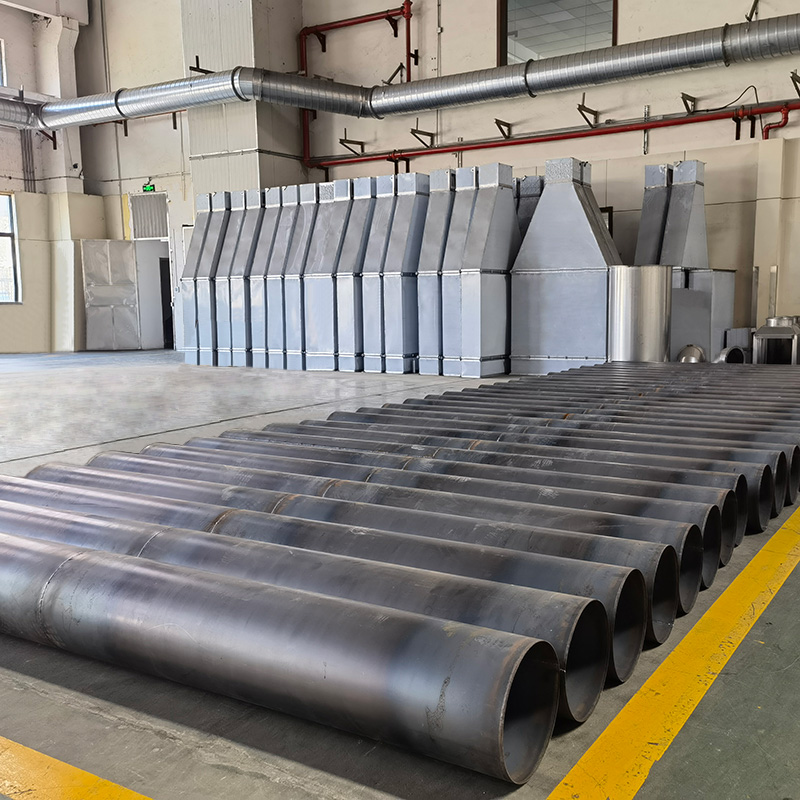
1. Introduction
With the rapid development of modern industry, especially the continuous upgrading of chemical industry, environmental protection and water treatment industries, the requirements for ventilation, exhaust and conveying pipelines are constantly improving. Corrosion resistance, lightweight, economy and environmental protection have become the core indicators for selecting pipeline materials. Traditional metal ducts have the defects of poor corrosion resistance, heavy weight, high processing and maintenance costs, and are easy to rust and corrode in harsh environments (such as acid-base, chemical vapor, humid environment), which seriously affects the service life of the pipeline and the normal operation of the system. Although some plastic ducts (such as PVC, FRP) have certain corrosion resistance, they have limitations in high temperature resistance, mechanical strength or processing performance.
Polypropylene (PP) is a thermoplastic polymer material with excellent comprehensive performance, which has the characteristics of chemical stability, corrosion resistance, lightweight, high mechanical strength, easy processing and low cost. PP ducts made of PP material through extrusion, molding and other processes can effectively make up for the defects of traditional ducts, and have become the preferred pipeline material in many corrosive and harsh working environments. At present, PP ducts have been widely used in chemical production, waste gas treatment, water treatment, electronics manufacturing, food processing and other fields, and have achieved good application effects.
However, in practical application, there are still problems such as improper material grade selection, mismatched specification size, inappropriate connection mode and insufficient consideration of environmental adaptability, which lead to reduced service life of PP ducts, pipeline leakage, system failure and other hidden dangers. Therefore, it is particularly important to comprehensively analyze the characteristics of PP ducts, clarify their application scenarios and put forward scientific selection guidelines, so as to provide a reference for relevant practitioners.
This paper takes PP ducts as the research object, systematically sorts out their core characteristics, classifies and discusses their application scenarios, formulates scientific selection guidelines, and verifies the application effect through practical cases. The research results are of great significance for promoting the standardized application of PP ducts, improving the operation efficiency of ventilation and exhaust systems, and reducing the operation and maintenance costs of enterprises.
2. Core Characteristics of PP Ducts
PP ducts have excellent comprehensive performance, and their core characteristics are mainly reflected in physical properties, chemical properties, mechanical properties and processing properties. These characteristics determine the application scope and service performance of PP ducts, and are also the key basis for selecting PP ducts.
2.1 Physical Properties
The physical properties of PP ducts are closely related to their application environment and service life, and the key indicators include density, thermal performance, wear resistance and surface properties:
- Density: The density of PP material is 0.90~0.91g/cm³, which is only 1/8 of steel and 1/2 of PVC material. The lightweight characteristics of PP ducts make them easy to transport, install and maintain, which can effectively reduce the load of building structures and the cost of transportation and installation. For example, a PP duct with a diameter of 500mm and a length of 6m weighs only about 25kg, while the weight of a galvanized steel duct of the same specification is more than 150kg.
- Thermal Performance: PP ducts have good thermal stability, and their long-term service temperature range is -10℃~80℃, and the short-term service temperature can reach 100℃. They have good heat insulation performance, and the thermal conductivity is only 0.24W/(m·K), which is much lower than that of metal ducts (galvanized steel: 45W/(m·K)), which can effectively reduce heat loss and energy consumption. However, it should be noted that PP ducts are easy to deform when the temperature exceeds 80℃ for a long time, so they are not suitable for high-temperature environments above 100℃.
- Wear Resistance: The surface of PP ducts is smooth, with a friction coefficient of only 0.2~0.3, which has good wear resistance and can effectively reduce the resistance of gas or liquid transportation. At the same time, the smooth surface is not easy to accumulate dust, dirt and medium residues, which is convenient for cleaning and maintenance.
- Surface Properties: The surface of PP ducts is smooth and flat, without burrs and defects, and has good hydrophobicity and stain resistance. It is not easy to be wetted by water and other media, and can avoid the growth of bacteria and microorganisms, which is suitable for food processing, medical and other fields with high hygiene requirements.
2.2 Chemical Properties
Excellent chemical stability and corrosion resistance are the most prominent advantages of PP ducts, which are also the key reasons why they are widely used in corrosive environments. The chemical properties of PP ducts are mainly reflected in the following aspects:
- Corrosion Resistance: PP material is inert to most acids, bases, salts and organic solvents, and can resist the corrosion of dilute sulfuric acid, hydrochloric acid, nitric acid, sodium hydroxide, potassium hydroxide and other common corrosive media. It is not easy to react with the conveyed medium, and can maintain the integrity and performance stability of the pipeline for a long time. However, PP ducts are not resistant to strong oxidizing media (such as concentrated sulfuric acid, concentrated nitric acid, chlorine gas) and some organic solvents (such as benzene, toluene), which will cause aging, cracking and damage of the pipeline.
- Weather Resistance: PP ducts have poor weather resistance, and are easy to age, brittle and discolor when exposed to sunlight (ultraviolet radiation) for a long time. Therefore, when PP ducts are used outdoors, they need to be coated with anti-ultraviolet paint or wrapped with anti-ultraviolet materials to extend their service life.
- Non-Toxicity: Food-grade PP material is non-toxic, tasteless and non-polluting, and does not release toxic and harmful substances when in contact with food, water and other media. It meets the national food safety standards and is suitable for food processing, drinking water conveying and other fields.
2.3 Mechanical Properties
The mechanical properties of PP ducts determine their load-bearing capacity, pressure resistance and service reliability. The key mechanical indicators include tensile strength, impact strength, bending strength and pressure resistance:
- Tensile Strength: The tensile strength of PP material is 20~30MPa, which is lower than that of metal materials, but higher than that of PVC materials. The tensile strength of PP ducts can meet the requirements of general ventilation and exhaust systems, but it is not suitable for high-pressure conveying scenarios.
- Impact Strength: The impact strength of PP material is 10~20kJ/m², which has good toughness and can withstand a certain degree of impact and vibration without cracking. However, the impact strength of PP material will decrease significantly at low temperature (below -10℃), and it is easy to be brittle, so it is not suitable for low-temperature environments below -10℃.
- Bending Strength: The bending strength of PP material is 30~40MPa, which has good rigidity and can maintain the shape of the pipeline without deformation under normal working conditions. For large-size PP ducts, reinforcement measures should be taken to improve their bending strength.
- Pressure Resistance: The working pressure of PP ducts is usually 0.1~0.6MPa, which is suitable for low-pressure and medium-pressure ventilation and exhaust systems. The pressure resistance of PP ducts is related to their wall thickness, specification size and processing quality. The thicker the wall thickness, the higher the pressure resistance.
2.4 Processing Properties
PP material has excellent processing performance, which can be processed into ducts of various specifications and shapes through extrusion, injection molding, hot melting and other processes. The processing properties of PP ducts are mainly reflected in the following aspects:
- Extrusion Processing: PP material has good fluidity and can be extruded into ducts of various diameters (from 50mm to 2000mm) and wall thicknesses through an extruder. The processing process is simple, efficient and suitable for mass production.
- Hot Melt Connection: PP ducts can be connected by hot melt welding, which has the advantages of firm connection, good sealing performance and no leakage. The hot melt connection process is simple, easy to operate, and does not require additional connection components (such as bolts, flanges), which can reduce the installation cost.
- Molding Processing: PP material can be processed into special-shaped ducts (such as elbows, tees, reducers) through injection molding or molding processes, which can meet the needs of different installation spaces and system layouts. The special-shaped ducts have good consistency and can be perfectly matched with straight ducts.
- Cutting and Drilling: PP ducts are easy to cut and drill, and can be cut into the required length according to the installation needs, and drilled to install accessories (such as valves, sensors). The cutting and drilling process does not require special equipment, and the operation is simple and convenient.
2.5 Advantages and Limitations of PP Ducts
Based on the above core characteristics, PP ducts have obvious advantages in practical application, but also have certain limitations, which need to be fully considered in the selection and application process:
2.5.1 Advantages
- Excellent corrosion resistance, suitable for various corrosive environments, long service life (usually 10~15 years, which is 2~3 times that of galvanized steel ducts).
- Lightweight, easy to transport, install and maintain, reducing transportation and installation costs by 30%~50% compared with metal ducts.
- Good processing performance, can be made into various specifications and shapes, strong adaptability to installation space.
- Low cost, the price of PP material is lower than that of stainless steel, FRP and other materials, and the operation and maintenance cost is low.
- Non-toxic and environmentally friendly, food-grade PP ducts can be used in food, medical and other fields with high hygiene requirements.
2.5.2 Limitations
- Poor high-temperature resistance, long-term service temperature cannot exceed 80℃, not suitable for high-temperature media and high-temperature environments.
- Poor weather resistance, easy to age when exposed to sunlight, need anti-ultraviolet treatment when used outdoors.
- Low pressure resistance, only suitable for low-pressure and medium-pressure systems, not suitable for high-pressure conveying scenarios.
- Poor low-temperature toughness, easy to be brittle at low temperature below -10℃, not suitable for low-temperature environments.
- Not resistant to strong oxidizing media and some organic solvents, which limits its application in some special corrosive environments.
3. Core Application Scenarios of PP Ducts
According to the characteristics of PP ducts (excellent corrosion resistance, lightweight, easy processing, low cost), they are widely used in various industrial and civil fields, especially in corrosive, low-temperature and low-pressure working environments. The core application scenarios are classified and discussed as follows:
3.1 Chemical Industry
The chemical industry is the main application field of PP ducts, which is mainly used for the ventilation, exhaust and conveying of corrosive gases, liquids and chemical raw materials. The specific application scenarios include:
- Chemical Production Workshops: Used for ventilation and exhaust of corrosive gases (such as acid mist, alkali mist, chemical vapor) generated in the production process, to reduce the concentration of corrosive gases in the workshop, protect the health of workers and the safety of equipment. For example, in the sulfuric acid production workshop, PP ducts are used to discharge acid mist; in the alkali production workshop, PP ducts are used to discharge alkali mist.
- Chemical Raw Material Conveying: Used for conveying non-strong oxidizing chemical raw materials (such as dilute acid, dilute alkali, salt solution), with the advantages of corrosion resistance, no pollution and low energy consumption. For example, in the chemical reagent production enterprise, PP ducts are used to convey dilute hydrochloric acid and dilute sulfuric acid.
- Waste Gas Treatment Systems: Used as the pipeline of chemical waste gas treatment systems (such as absorption tower, adsorption tower), to convey waste gas to the treatment equipment for purification. PP ducts can resist the corrosion of waste gas, ensure the normal operation of the treatment system, and reduce the maintenance cost of the pipeline.
3.2 Environmental Protection Industry
In the environmental protection industry, PP ducts are mainly used for waste gas treatment, wastewater treatment and environmental ventilation, with the advantages of corrosion resistance, environmental protection and low cost. The specific application scenarios include:
- Waste Gas Treatment: Used for the ventilation and conveying of industrial waste gas (such as printing and dyeing waste gas, electroplating waste gas, coating waste gas), which can resist the corrosion of harmful substances in the waste gas and ensure the smooth operation of the waste gas treatment system. For example, in the electroplating workshop, PP ducts are used to discharge electroplating waste gas containing heavy metal ions.
- Wastewater Treatment: Used for the ventilation of wastewater treatment plants (such as aeration tanks, sedimentation tanks), to discharge the odor generated in the wastewater treatment process, and improve the working environment of the wastewater treatment plant. At the same time, PP ducts can also be used for the conveying of wastewater treatment chemicals (such as flocculants, disinfectants).
- Environmental Ventilation: Used for the ventilation of environmental protection equipment and workshops, to ensure the air circulation and reduce the concentration of harmful gases, which is suitable for the occasions with high environmental protection requirements.
3.3 Water Treatment Industry
In the water treatment industry, PP ducts are mainly used for the ventilation of water treatment equipment and the conveying of water treatment media, with the advantages of non-toxic, corrosion resistance and hygiene. The specific application scenarios include:
- Drinking Water Treatment: Used for the ventilation of drinking water treatment equipment (such as filter tanks, disinfection tanks), to ensure the air circulation and improve the water treatment effect. Food-grade PP ducts can also be used for the conveying of drinking water, which is non-toxic and pollution-free, meeting the national drinking water safety standards.
- Industrial Wastewater Treatment: Used for the ventilation of industrial wastewater treatment equipment and the conveying of treated water, which can resist the corrosion of industrial wastewater and ensure the normal operation of the water treatment system. For example, in the printing and dyeing wastewater treatment plant, PP ducts are used to convey the treated wastewater.
- Seawater Desalination: Used for the ventilation of seawater desalination equipment and the conveying of desalinated water, which can resist the corrosion of seawater and reduce the maintenance cost of the pipeline.
3.4 Electronics and Semiconductor Industry
The electronics and semiconductor industry has high requirements for the cleanliness and corrosion resistance of the production environment. PP ducts are widely used in the ventilation and exhaust systems of electronic factories and semiconductor factories due to their smooth surface, non-toxicity and corrosion resistance. The specific application scenarios include:
- Clean Room Ventilation: Used for the ventilation of clean rooms in electronic and semiconductor factories, to ensure the air cleanliness and temperature and humidity stability in the clean room. The smooth surface of PP ducts is not easy to accumulate dust, which is conducive to maintaining the cleanliness of the clean room.
- Waste Gas Exhaust: Used for the exhaust of harmful gases (such as volatile organic compounds, acid-base gases) generated in the production process of electronic components and semiconductors, to protect the production equipment and the health of workers.
- Chemical Conveying: Used for the conveying of chemicals (such as cleaning agents, etchants) used in the production process, which can resist the corrosion of chemicals and avoid pollution of the production environment.
3.5 Food Processing Industry
The food processing industry has high requirements for the hygiene and non-toxicity of the pipeline. Food-grade PP ducts are non-toxic, tasteless, non-polluting, and easy to clean, which are widely used in the ventilation and conveying systems of food processing factories. The specific application scenarios include:
- Workshop Ventilation: Used for the ventilation of food processing workshops (such as beverage factories, dairy factories, meat processing factories), to ensure the air circulation and improve the hygiene level of the workshop.
- Material Conveying: Used for the conveying of food raw materials (such as water, syrup, fruit juice) and food additives, which is non-toxic and pollution-free, ensuring the safety of food.
- Waste Gas and Wastewater Exhaust: Used for the exhaust of waste gas and wastewater generated in the food processing process, to keep the workshop clean and tidy and meet the food hygiene standards.
3.6 Other Application Scenarios
In addition to the above fields, PP ducts are also widely used in medical industry, laboratory, civil building ventilation and other fields:
- Medical Industry: Used for the ventilation of medical laboratories, operating rooms and pharmaceutical workshops, to ensure the air cleanliness and avoid cross-contamination. Food-grade PP ducts can also be used for the conveying of medical reagents and drugs.
- Laboratory: Used for the ventilation of chemical laboratories, physical laboratories and biological laboratories, to discharge harmful gases and protect the safety of experimental personnel.
- Civil Building Ventilation: Used for the ventilation of residential buildings, office buildings and commercial buildings, especially in the kitchen and bathroom ventilation systems, with the advantages of corrosion resistance, lightweight and easy installation.
4. Selection Guidelines for PP Ducts
The selection of PP ducts should follow the principles of ""performance matching, application adaptation, economy and safety"", fully consider the working environment, conveying medium, pressure, temperature and other factors, and select the appropriate material grade, specification size, connection mode and pressure grade to ensure the normal operation of the pipeline and extend its service life. The specific selection guidelines are as follows:
4.1 Selection of Material Grade
PP materials have different grades according to their performance, and the selection of material grade should be based on the conveying medium, working temperature and corrosion environment. Common PP material grades and their application scope are as follows:
- General PP (PP-H): The most common PP grade, with good chemical stability and mechanical properties, suitable for general corrosive environments (such as dilute acid, dilute alkali), working temperature -10℃~80℃, suitable for general ventilation and exhaust systems.
- High-Impact PP (PP-I): On the basis of general PP, it is modified by adding impact modifiers, which has higher impact strength and toughness, suitable for environments with vibration and impact (such as mechanical equipment ventilation), working temperature -15℃~80℃.
- Heat-Resistant PP (PP-R): Modified by heat-resistant materials, the long-term service temperature can reach 95℃, short-term service temperature can reach 110℃, suitable for medium-temperature environments (such as hot gas conveying), but the corrosion resistance is slightly lower than that of general PP.
- Food-Grade PP (PP-F): Meets the national food safety standards, non-toxic, tasteless, non-polluting, suitable for food processing, drinking water conveying and other fields with high hygiene requirements.
- Corrosion-Resistant PP (PP-C): Modified by corrosion-resistant materials, it has better corrosion resistance, can resist some organic solvents and weak oxidizing media, suitable for harsh corrosive environments (such as chemical industry waste gas treatment).
Selection points: According to the type of conveying medium (acid, alkali, organic solvent, food, etc.), working temperature and corrosion degree, select the appropriate material grade. For example, for food conveying, select food-grade PP; for high-temperature gas conveying, select heat-resistant PP; for harsh corrosive environments, select corrosion-resistant PP.
4.2 Determination of Specification Size
The specification size of PP ducts includes diameter (or cross-sectional size), wall thickness and length, which should be determined according to the conveying flow rate, pressure and installation space. The key points are as follows:
- Diameter (Cross-Sectional Size): The diameter of circular PP ducts is usually 50mm~2000mm, and the cross-sectional size of rectangular PP ducts is usually 100mm×100mm~1000mm×800mm. The diameter should be calculated according to the conveying flow rate and flow velocity: Q = A × v × 3600, where Q is the conveying flow rate (m³/h), A is the cross-sectional area of the duct (㎡), and v is the flow velocity (m/s). The flow velocity of PP ducts is usually controlled at 1~10m/s: for gas conveying, the flow velocity is 3~8m/s; for liquid conveying, the flow velocity is 1~3m/s. Too high a flow velocity will increase energy consumption and pipeline wear; too low a flow velocity will lead to medium accumulation and blockage.
- Wall Thickness: The wall thickness of PP ducts is usually 3mm~20mm, which is determined according to the working pressure and diameter. The higher the working pressure and the larger the diameter, the thicker the wall thickness. The wall thickness should meet the pressure resistance requirement: for working pressure ≤0.1MPa, the wall thickness is 3~5mm; for working pressure 0.1~0.3MPa, the wall thickness is 5~10mm; for working pressure 0.3~0.6MPa, the wall thickness is 10~20mm. At the same time, the wall thickness should also consider the corrosion degree of the conveying medium, and the wall thickness should be appropriately increased in harsh corrosive environments.
- Length: The standard length of PP ducts is 4m~6m, which can be cut into the required length according to the installation needs. The length of the duct should be minimized to reduce the number of joints and leakage points. For long-distance conveying, the number of joints should be reduced as much as possible, and the connection should be sealed tightly.
4.3 Selection of Connection Mode
The connection mode of PP ducts directly affects the sealing performance, connection strength and service life of the pipeline. Common connection modes include hot melt welding, flange connection, socket connection and thread connection. The selection should be based on the working pressure, conveying medium and installation environment:
- Hot Melt Welding: The most commonly used connection mode for PP ducts, with the advantages of firm connection, good sealing performance, no leakage and low cost. It is suitable for low-pressure and medium-pressure systems (working pressure ≤0.6MPa), and is widely used in chemical industry, environmental protection, water treatment and other fields. The hot melt welding temperature is usually 200~220℃, and the welding quality should be strictly controlled to avoid welding defects (such as incomplete welding, false welding).
- Flange Connection: Suitable for high-pressure systems (working pressure >0.6MPa) and scenarios that need to be disassembled and maintained frequently (such as equipment connection, valve installation). The flange is made of PP or steel (coated with anti-corrosion layer), and the connection is sealed with rubber gaskets. The advantages are convenient disassembly and assembly, high connection strength; the disadvantage is high cost and easy leakage if the sealing is not tight.
- Socket Connection: Simple structure, easy to operate, suitable for small-diameter PP ducts (diameter ≤160mm) and low-pressure systems (working pressure ≤0.1MPa). The socket is sealed with rubber gaskets, which has good sealing performance, but the connection strength is low, not suitable for high-pressure and large-diameter ducts.
- Thread Connection: Suitable for small-diameter PP ducts (diameter ≤50mm) and scenarios that need to be disassembled frequently (such as instrument connection, small pipeline connection). The thread is processed on the duct end, and the connection is sealed with thread sealant or Teflon tape. The advantages are simple disassembly and assembly; the disadvantage is low pressure resistance and easy leakage.
4.4 Matching of Pressure Grade
The pressure grade of PP ducts should be matched with the working pressure of the system, and the pressure grade of the duct should be higher than the maximum working pressure of the system to ensure the safety and reliability of the pipeline. Common pressure grades of PP ducts are 0.1MPa, 0.25MPa, 0.4MPa, 0.6MPa, and the selection should be based on the following principles:
- For low-pressure systems (working pressure ≤0.1MPa), select PP ducts with pressure grade 0.1MPa or 0.25MPa, such as general ventilation systems, indoor ventilation systems.
- For medium-pressure systems (working pressure 0.1~0.4MPa), select PP ducts with pressure grade 0.25MPa or 0.4MPa, such as chemical waste gas treatment systems, water treatment ventilation systems.
- For high-pressure systems (working pressure 0.4~0.6MPa), select PP ducts with pressure grade 0.4MPa or 0.6MPa, such as high-pressure gas conveying systems, chemical raw material conveying systems.
- It should be noted that the pressure grade of PP ducts is related to their wall thickness and diameter. The thicker the wall thickness and the smaller the diameter, the higher the pressure grade. When selecting, the pressure grade should be checked according to the wall thickness and diameter to ensure matching.
4.5 Consideration of Environmental Adaptability
The environmental adaptability of PP ducts is an important factor affecting their service life, and the selection should fully consider the working temperature, humidity, sunlight, corrosion degree and other environmental factors:
- Temperature Adaptability: According to the working temperature, select the appropriate material grade and wall thickness. For high-temperature environments (50~80℃), select heat-resistant PP ducts and appropriately increase the wall thickness; for low-temperature environments (-10~0℃), select high-impact PP ducts to avoid brittle fracture; for environments with temperature higher than 80℃ or lower than -10℃, PP ducts are not suitable, and other materials (such as FRP, stainless steel) should be selected.
- Humidity Adaptability: PP ducts have good moisture resistance, but in high-humidity environments (such as coastal areas, rainy areas), the surface of the duct is easy to condense water droplets, which may affect the normal operation of the system. Therefore, heat insulation and moisture-proof measures should be taken, such as wrapping heat insulation cotton on the outer surface of the duct.
- Sunlight Adaptability: PP ducts are easy to age when exposed to sunlight for a long time, so when used outdoors, anti-ultraviolet treatment should be taken, such as coating anti-ultraviolet paint, wrapping anti-ultraviolet film or installing a protective cover.
- Corrosion Adaptability: According to the corrosion degree of the working environment and the type of conveying medium, select the appropriate material grade and wall thickness. For harsh corrosive environments (such as concentrated acid, concentrated alkali, organic solvent), corrosion-resistant PP ducts should be selected, and the wall thickness should be appropriately increased to extend the service life.
4.6 Common Selection Mistakes and Prevention Measures
In the selection of PP ducts, there are many common mistakes that lead to reduced service life of the pipeline and system failure. The common mistakes and prevention measures are summarized as follows:
- Mistake 1: Improper Material Grade Selection: Selecting general PP ducts for harsh corrosive environments or high-temperature environments, resulting in pipeline aging, cracking and leakage. Prevention measures: Clarify the conveying medium, working temperature and corrosion degree, and select the appropriate material grade according to the material grade selection guidelines.
- Mistake 2: Insufficient Wall Thickness: Selecting PP ducts with too thin wall thickness to save cost, resulting in insufficient pressure resistance and easy deformation and damage of the pipeline. Prevention measures: Calculate the required wall thickness according to the working pressure and diameter, and select the duct with sufficient wall thickness, and add a safety factor (usually 1.2~1.5).
- Mistake 3: Mismatched Connection Mode: Selecting socket connection or thread connection for high-pressure systems, resulting in pipeline leakage. Prevention measures: Select the connection mode according to the working pressure and installation needs, and use hot melt welding or flange connection for high-pressure systems.
- Mistake 4: Ignoring Environmental Adaptability: Using PP ducts outdoors without anti-ultraviolet treatment, or using PP ducts in high-temperature or low-temperature environments beyond their service temperature range, resulting in pipeline aging and brittle fracture. Prevention measures: Fully consider the environmental factors, take corresponding protective measures (such as anti-ultraviolet, heat insulation, moisture-proof), and avoid using PP ducts in environments beyond their adaptability range.
 +85247166614



 Current
location:Home >news
>Industry news
>Comprehensive Analysis Of PP Ducts: Characteristics, Applications And Selection Guidelines
Current
location:Home >news
>Industry news
>Comprehensive Analysis Of PP Ducts: Characteristics, Applications And Selection Guidelines