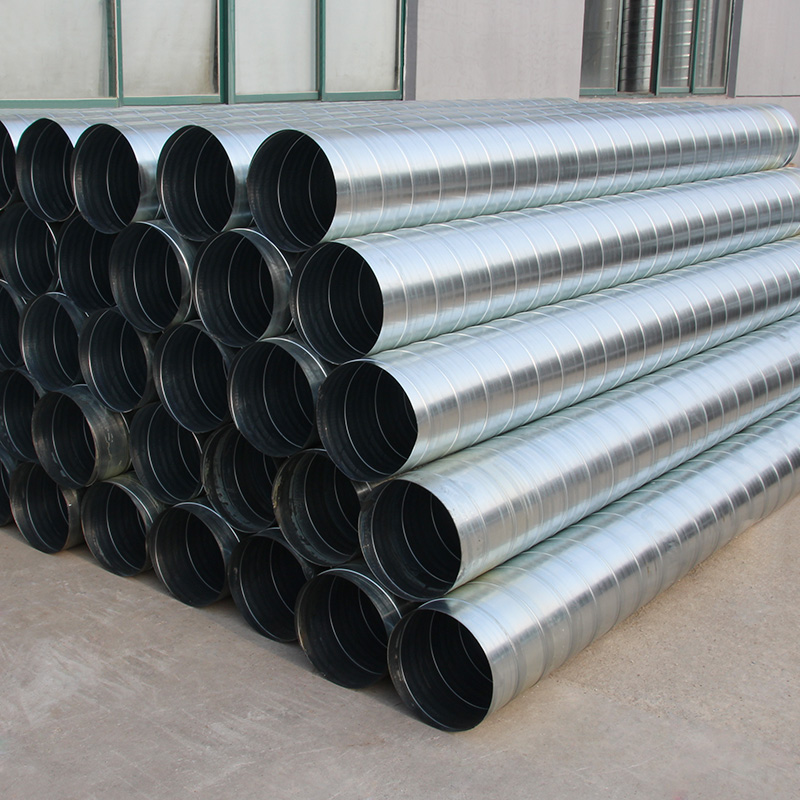
Air Conditioning Ventilation Ducts: Professional Standards, Applications And Key Requirements
Release time:2026-07-13 Visits:563
Air conditioning ventilation ducts are core components of HVAC systems, responsible for transporting conditioned air (supply, return, fresh, and exhaust air) to maintain indoor comfort, air quality, and thermal balance. Widely applied in commercial, residential, and light industrial buildings, their design, material selection, and installation directly affect system efficiency and operational stability. This article concisely elaborates on their core functions, classification, key design points, and installation/maintenance requirements, providing a professional and concise guide.
1. Core Functions and Classification
The primary functions of
air conditioning ventilation ducts include air distribution, pressure balance, and noise reduction, ensuring uniform delivery of cooled/heated air and discharge of polluted air. Based on usage and structure, they are mainly classified into four types:
• Supply air ducts: Deliver conditioned air from air handling units (AHUs) to indoor spaces; • Return air ducts: Collect indoor air for reconditioning; • Fresh air ducts: Introduce filtered outdoor air to improve indoor air quality; • Exhaust air ducts: Discharge indoor pollutants and excess heat outdoors. By cross-sectional shape, they are divided into rectangular (space-saving) and circular (superior aerodynamics) ducts.
2. Design and Material Selection
Designed for low to medium-pressure systems (static pressure ≤1500 Pa), key parameters include airflow velocity (3-8 m/s for commercial/residential buildings) and cross-sectional size, determined by air volume and space constraints. The inner surface must be smooth to minimize pressure loss and dust accumulation.
Common materials include galvanized steel (cost-effective, durable for general scenarios), stainless steel (corrosion-resistant for high-hygiene areas), and fiberglass (lightweight, insulated for special environments). Material thickness (0.6-1.2mm) is determined by duct size and operating pressure.
3. Typical Applications
Air conditioning ventilation ducts are essential in various scenarios: commercial buildings (offices, malls, hotels) for central air conditioning systems; residential buildings (apartments, villas) for home HVAC; hospitals and cleanrooms for high-hygiene air distribution; and light industrial workshops for temperature regulation and air purification.
4. Installation and Maintenance Essentials
Installation requires level and stable hanging brackets (spaced 1.5-2.0m) to avoid deformation. Joints use flanges with gaskets and sealants to ensure airtightness, and fireproof sleeves are required for ducts passing through firewalls.
Maintenance focuses on regular inspection (for loose joints or corrosion), periodic cleaning (to remove dust and bacteria), and timely repair of cracks or leaks, ensuring long-term stable operation and energy efficiency.
Conclusion
As a key part of air conditioning systems, ventilation ducts play a vital role in indoor comfort and air quality. Adhering to professional design, material selection, and installation standards ensures their efficiency and durability, making them indispensable for modern buildings.
 +85247166614



 Current
location:Home >news
>Industry news
>Air Conditioning Ventilation Ducts: Professional Standards, Applications And Key Requirements
Current
location:Home >news
>Industry news
>Air Conditioning Ventilation Ducts: Professional Standards, Applications And Key Requirements