What Is Duct Leakage?
Duct leakage is the rate at which air escapes from the duct system through seams, joints, and penetrations. Leakage is measured in:
CFM per 100 ft² of duct surface area at a reference static pressure (typically 1 in. w.c. or 250 Pa).
% of total airflow: leakage as a percentage of design airflow.
Typical leakage rates:
|
Duct Type |
Typical Leakage (% of airflow) |
|
Spiral duct (lock-seam) |
1–3% |
|
Welded rectangular (with mastic) |
2–5% |
|
Rectangular (Pittsburgh lock + mastic) |
5–10% |
|
Rectangular (Pittsburgh lock only) |
10–20% |
|
Flexible duct (extended) |
5–15% |
|
Flexible duct (compressed) |
15–30% |
Leakage above 10% indicates poor sealing, damaged duct, or undersized duct (operating at higher pressure than designed).
What Are the SMACNA Leakage Classes?
SMACNA HVAC Duct Construction Standards define leakage classes based on allowable leakage at a reference static pressure:
|
Class |
Allowable Leakage (cfm / 100 ft² @ 1 in. w.c.) |
Best For |
|
Seal Class A |
4 |
Low-pressure residential |
|
Seal Class B |
8 |
Low-pressure commercial |
|
Seal Class C |
12 |
Medium-pressure commercial |
|
Seal Class D |
24 |
High-pressure industrial |
|
Seal Class E |
48 |
Very high-pressure industrial |
|
Seal Class F |
96 |
Specialty high-pressure (cleanrooms, hospitals)
|
Higher classes (D, E, F) require welded seams, gasketed flanges, and rigorous sealing. Lower classes (A, B, C) allow lock-seam construction with mastic.
For industrial ventilation and process exhaust, Seal Class C or D is typical. For cleanroom and hospital applications, Seal Class E or F is required.
What Are DW143 and DW144?
DW143 and DW144 are the UK ductwork construction standards, published by BESA (Building Engineering Services Association):
DW143: Specification for sheet metal ductwork. Covers materials, construction, joints, supports, and sealing.
DW144: Specification for ductwork cleaning. Covers cleanliness levels for different applications.
DW143 leakage classes (Class A, B, C) are similar to SMACNA but use metric units and slightly different test pressures:
|
Class |
Allowable Leakage (L/s per m² @ 1,000 Pa) |
Notes |
|
Class A |
0.027 |
Welded seams, gasketed flanges |
|
Class B |
0.080 |
Lock-seam with mastic |
|
Class C |
0.150 |
Lock-seam only |
For European projects, DW143 is the typical reference. Wuxi Weishan fabricates per both SMACNA and DW143.
What Is EN 12237?
EN 12237 is the European standard for ductwork airtightness:
Class A: < 0.027 L/s·m² @ 1,000 Pa (equivalent to DW143 Class A)
Class B: < 0.080 L/s·m² @ 1,000 Pa
Class C: < 0.150 L/s·m² @ 1,000 Pa
EN 12237 also defines test methods and acceptance criteria. For cleanroom and hospital projects, Class A is typically required.
What Sealing Materials Are Used?
Sealing materials for ductwork:
|
Material |
Application |
Notes |
|
Butyl rubber sealant |
Seams, joints, penetrations |
Most common; good adhesion, flexible |
|
Duct mastic (water-based) |
Seams, joints |
Good for rectangular duct; paintable |
|
Duct mastic (solvent-based) |
Seams, joints, high-temperature |
Better adhesion, faster curing |
|
Gasket (EPDM, neoprene) |
Flanged joints |
Reusable, good for high-pressure |
|
Closed-cell foam tape |
Temporary joints, low-pressure |
Easy to apply, limited life |
|
Welded seam |
Permanent joints, high-pressure |
Best seal; requires skilled labor |
|
Liquid sealant (silicone, urethane) |
Seams, penetrations |
Good for irregular shapes |
For high-pressure or high-temperature service, welded seams are preferred. For lower pressure, mastic and gaskets are sufficient.
How Are Seams Sealed?
Seam sealing depends on the duct type:
Spiral Duct
Lock-seam: the helical lock-seam provides the primary seal; additional butyl sealant is applied at the seam for higher leakage classes.
Coupling joints: each coupling is wrapped with butyl tape and secured with a band clamp or self-tapping screws.
Rectangular Duct
Pittsburgh lock: the corner lock is the primary seam; butyl sealant is applied inside the corner before locking.
Drive cleat: the cleat joint is sealed with butyl tape and mastic.
Flanged joints: gaskets (EPDM, neoprene) are placed between flanges and the joint is bolted.
Welded Rectangular
Welded seam: the full-penetration weld is the primary seal; mastic or sealant is applied over the weld for additional protection.
Flanged joints: same as rectangular with gaskets.
For high-pressure service (Seal Class D, E, F), welded seams are required throughout. For lower pressure, lock-seam with mastic is sufficient.
How Is the Joint Prepared?
Joint preparation:
Clean the surface: remove oil, dirt, and debris from the joint area with a solvent wipe.
Apply sealant: apply butyl sealant or mastic to the joint before assembly.
Assemble the joint: bring the components together and secure with cleats, flanges, or welds.
Smooth the sealant: smooth the sealant over the joint with a spatula or finger to ensure full coverage.
Cure the sealant: allow the sealant to cure per the manufacturer's instructions before pressure testing.
Inspect: visually inspect the joint for gaps, voids, or missing sealant.
Proper joint preparation is the most important factor in achieving the leakage class.
How Is Duct Leakage Tested?
Duct leakage testing methods:
Class Testing (Total Leakage)
Seal all openings: cap all open ends, branches, and outlets.
Connect blower: connect a calibrated blower to the duct system.
Pressurize: pressurize the duct to the reference static pressure (e.g., 1 in. w.c. or 250 Pa).
Measure flow: measure the airflow required to maintain the reference pressure. This is the total leakage.
Calculate: compare to the allowable leakage rate for the duct class.
Section Testing (Section Leakage)
Section the duct: divide the duct into test sections using temporary seals.
Test each section: pressurize each section to the reference pressure and measure the leakage.
Identify leaks: locate and repair leaks in failing sections.
Leak Location
Soap bubble test: apply soapy water to the joint; bubbles indicate leaks.
Ultrasonic leak detector: detects the high-frequency sound of turbulent flow at leaks.
Thermal imaging: detects temperature differences due to airflow at leaks.
Smoke pencil or smoke bomb: visualize leaks with smoke.
For critical systems, ultrasonic or thermal imaging is used. For general systems, soap bubble is sufficient.
What Are the Common Defects in Sealing?
Common defects in duct sealing:
|
Defect |
Cause |
Prevention |
|
Gaps in sealant |
Insufficient application, poor joint prep |
Apply continuous bead, prepare joint |
|
Missing sealant at corners |
Rushed installation |
Inspect every corner |
|
Worn gasket |
Age, chemical exposure |
Replace gasket during maintenance |
|
Damaged mastic |
Mechanical damage, UV exposure |
Protect mastic during construction |
|
Leaking flange |
Improper gasket, loose bolts |
Use proper gasket, torque bolts |
|
Open penetration |
Missed during sealing |
Inspect every penetration |
|
Cracked sealant |
Building movement, thermal cycling |
Use flexible sealant, allow for movement |
Each defect is preventable with discipline. Visual inspection and pressure testing catch most defects.
How Is Leakage Related to Energy Efficiency?
Leakage has a direct impact on energy efficiency:
Supply duct leakage: conditioned air leaks out before reaching the room; the system delivers less air than designed.
Return duct leakage: return air leaks out, pulling in unconditioned air through building envelope; the system works harder to condition the air.
Energy waste: fan energy is wasted moving air that does not reach the intended space.
Pressure imbalance: leakage can cause room pressure imbalance, leading to drafts, odors, or contamination.
Typical energy impact:
|
Leakage (% of airflow) |
Energy Penalty |
|
5% |
5% increase in fan energy |
|
10% |
10% increase |
|
20% |
20% increase |
For a 20,000 CFM system at 20% leakage, 4,000 CFM of conditioned air is wasted. The annual energy cost of the waste can be significant.
What Are the Repair Procedures?
Repair procedures for leaking duct:
Identify the leak: use soap bubble or ultrasonic to locate the leak.
Clean the area: remove dirt and old sealant from around the leak.
Apply sealant: apply butyl sealant or mastic to the leak.
For large gaps: use mastic reinforced with fiberglass mesh.
For flange leaks: replace the gasket and re-torque the bolts.
For seam failures: re-seam or weld the failed section.
Re-test: pressure test to verify the repair.
For inaccessible leaks, the duct may need to be opened, repaired, and re-closed.
How Are New Duct Systems Verified?
Verification of new duct systems:
Factory leakage test: ducts can be factory-tested for leakage before shipping.
Field leakage test: the installed system is tested section-by-section or as a whole.
Documentation: leakage test reports document the measured leakage and the class achieved.
Air balance: the system is balanced after leakage testing to deliver the design airflow.
For high-pressure or critical systems, factory testing plus field testing is recommended.
What Standards Apply to Specific Applications?
Application-specific standards:
Cleanrooms: EN 16798, ISO 14644 — Class A or better.
Hospitals: HTM 03-01 (UK), ASHRAE 170 (US) — Class A or B.
Pharmaceutical: FDA, GMP — Class A or B.
Kitchen exhaust: NFPA 96 — welded, no screws or penetrations in grease duct.
Combustion air: NFPA 54, IRC — sealed.
Asbestos abatement: Class A or better with negative pressure.
For each application, the appropriate standard defines the required leakage class.
What Is the Future of Duct Sealing?
Trends in duct sealing:
Aerosol-based sealants: aerosol-applied sealants that flow into leaks and seal them.
Self-sealing gaskets: gaskets that expand or contract with temperature to maintain seal.
Welded seams as default: increased use of welded seams for lower leakage.
Inline leakage monitoring: sensors that monitor leakage in real time.
Pre-insulated sealed duct: factory-sealed pre-insulated duct panels.
For a duct manufacturer, the trend toward welded seams and pre-sealed duct panels reflects the demand for lower leakage and faster installation.
Conclusion
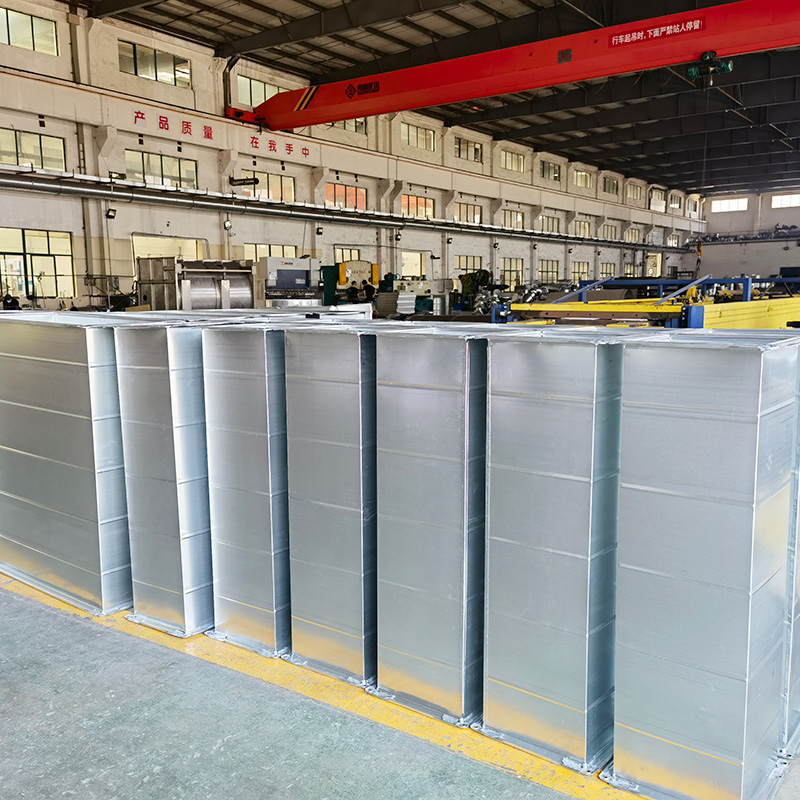
Duct leakage is a major source of energy waste and indoor air quality issues. SMACNA, DW143/DW144, and EN 12237 define leakage classes that allow designers and contractors to specify and verify duct tightness. Sealing materials include butyl sealant, mastic, gaskets, and welded seams. Joint preparation and visual inspection are critical. Wuxi Weishan fabricates galvanized welded air duct, rectangular duct, and related products with welded seams and sealed flanges per SMACNA and DW143. The duct flange and duct fittings product lines include gasketed and welded options for each leakage class.
Frequently Asked Questions
What is the most common duct leakage class?
Seal Class B or C (SMACNA) is most common for commercial HVAC. Class A is used for residential. Class D, E, F is used for industrial and cleanroom.
What is the leakage rate for welded duct?
Welded duct typically has 1–3% leakage, lower than lock-seam duct at 5–15%. Welded duct is the preferred choice for high-pressure and cleanroom service.
What sealant is used for duct joints?
Butyl rubber sealant is the most common for seams. Duct mastic is used for rectangular duct joints. Gaskets (EPDM, neoprene) are used for flanged joints.
How is duct leakage tested?
Duct leakage is tested with a calibrated blower that pressurizes the duct to the reference static pressure. The airflow required to maintain the pressure is the leakage. Class testing measures total leakage; section testing measures per-section leakage.
What is the reference pressure for leakage testing?
The reference pressure is typically 1 in. w.c. (250 Pa) for SMACNA. DW143 uses 1,000 Pa. The test pressure may be higher for high-pressure systems.
What is the difference between SMACNA and DW143?
SMACNA is the North American standard; DW143 is the UK standard. Both define leakage classes and construction methods. SMACNA uses imperial units; DW143 uses metric.
What is EN 12237?
EN 12237 is the European standard for ductwork airtightness. It defines three classes (A, B, C) similar to DW143.
What is the energy impact of duct leakage?
Duct leakage has a direct energy penalty: 5% leakage = 5% increase in fan energy; 20% leakage = 20% increase. For large systems, the annual cost of leakage can be significant.
What is the difference between seal class and pressure class?
Seal class defines the allowable leakage rate. Pressure class defines the maximum operating static pressure. They are independent but related: higher pressure classes typically require lower leakage (tighter sealing).
How are leaks in inaccessible duct located?
For inaccessible duct, ultrasonic leak detection or thermal imaging can locate leaks without opening the duct.
Can duct leakage be repaired without opening the duct?
Small leaks can be repaired with aerosol-based sealants that flow into the leak from inside the duct. Large leaks require opening the duct for repair.
What is the future of duct sealing?
The future is toward welded seams as default, aerosol-based sealants, self-sealing gaskets, inline leakage monitoring, and pre-insulated sealed duct panels.
 +85247166614



 Current
location:Home >news
>Industry news
>Duct Leakage Classification (SMACNA / DW143 / DW144) And Sealing For Welded Ductwork
Current
location:Home >news
>Industry news
>Duct Leakage Classification (SMACNA / DW143 / DW144) And Sealing For Welded Ductwork