1. Introduction
Building ventilation systems are an important part of modern building functional systems, responsible for regulating indoor air quality, maintaining thermal comfort, and ensuring the health and safety of indoor personnel. The ventilation duct, as the core component of the ventilation system, undertakes the task of air transmission and distribution, and its performance directly affects the operational efficiency, energy consumption, and service life of the entire ventilation system. In recent years, with the increasingly strict requirements of building energy conservation standards (such as GB 50189-2015) and the concept of green building deeply rooted in the hearts of the people, traditional metal ventilation ducts (such as galvanized steel ducts) have gradually exposed their inherent defects, such as poor thermal insulation performance, high energy loss, easy corrosion, heavy weight, and high installation and maintenance costs.
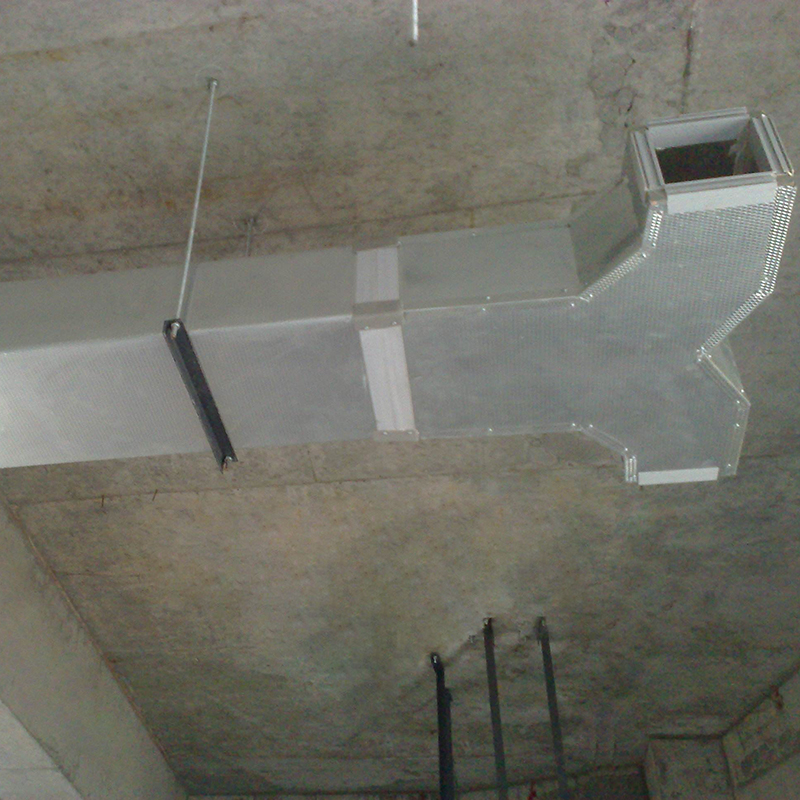
Composite ducts, which are composed of multiple functional materials through scientific compounding, have emerged as the times require. They combine the advantages of thermal insulation, corrosion resistance, light weight, and good air tightness, effectively making up for the deficiencies of traditional metal ducts. In practical applications, composite ducts can reduce the energy loss caused by air temperature difference in the ventilation process, improve the air supply quality, and reduce the load of ventilation fans, thus achieving significant energy-saving effects. At present, composite ducts have been widely used in commercial buildings, public facilities, industrial workshops, and residential buildings, and have become the preferred choice for energy-efficient building ventilation systems. Therefore, in-depth research on the performance characteristics, application advantages, and technical requirements of composite ducts is of great significance for promoting the upgrading of building ventilation systems and realizing green and energy-saving construction.
2. Composition, Classification and Core Performance Characteristics of Composite Ducts
Composite ducts are composed of two or more different materials with complementary properties, through bonding, pressing, or other processing technologies, to form a multi-layer structure with integrated functions of bearing, thermal insulation, air tightness, and corrosion resistance. Its composition, classification, and core performance are the basis for its application in building ventilation systems.
2.1 Composition of Composite Ducts
The typical structure of composite ducts is divided into three layers: the inner layer, the middle thermal insulation layer, and the outer protective layer, each of which undertakes different functional roles:
- Inner Layer: The inner layer is in direct contact with the circulating air, requiring good air tightness, smooth surface, corrosion resistance, and non-toxicity. Common materials include aluminum foil, glass fiber cloth, and engineering plastic plates. The inner layer surface shall be smooth and free of burrs to reduce air flow resistance and avoid dust accumulation.
- Middle Thermal Insulation Layer: The middle layer is the core functional layer of energy conservation, responsible for reducing the heat exchange between the air in the duct and the external environment, reducing energy loss. Common materials include rock wool, glass wool, polyurethane foam, and phenolic foam. The thermal insulation material shall have low thermal conductivity, non-combustibility, moisture resistance, and good mechanical strength.
- Outer Protective Layer: The outer layer is used to protect the middle thermal insulation layer from mechanical damage, moisture, and corrosion, and improve the overall structural strength of the duct. Common materials include galvanized steel plates, aluminum alloy plates, and composite plastic plates. The outer layer shall have good weather resistance and structural stability, and be easy to clean and maintain.
2.2 Classification of Composite Ducts
According to the type of core thermal insulation material and structural form, composite ducts can be divided into the following common types, which are suitable for different application scenarios:
- Glass Wool Composite Ducts: Taking glass wool as the middle thermal insulation layer, the inner and outer layers are aluminum foil or glass fiber cloth. It has the advantages of light weight, good thermal insulation, non-combustibility, low cost, and easy installation, and is suitable for low-pressure and medium-pressure ventilation systems in commercial buildings, residential buildings, and public facilities.
- Rock Wool Composite Ducts: Taking rock wool as the middle thermal insulation layer, the inner layer is aluminum foil, and the outer layer is galvanized steel plate or aluminum alloy plate. It has excellent fire resistance (fire resistance limit up to 1.5 hours), high temperature resistance, and sound insulation performance, and is suitable for high-temperature ventilation systems and fire smoke exhaust systems in industrial workshops and high-rise buildings.
- Polyurethane Composite Ducts: Taking polyurethane foam as the middle thermal insulation layer, the inner and outer layers are aluminum foil or engineering plastic plates. It has ultra-low thermal conductivity, excellent thermal insulation effect, light weight, and good air tightness, but it is flammable and needs to be treated with fire-retardant modification. It is suitable for low-temperature ventilation systems (such as air conditioning ducts) in commercial buildings and precision workshops.
- Phenolic Composite Ducts: Taking phenolic foam as the middle thermal insulation layer, the inner and outer layers are aluminum foil. It has good fire resistance, low thermal conductivity, moisture resistance, and corrosion resistance, and is suitable for high-humidity environments (such as swimming pools, kitchens) and corrosive environments (such as chemical workshops).
2.3 Core Performance Characteristics of Composite Ducts
Compared with traditional metal ducts, composite ducts have obvious advantages in performance, which are mainly reflected in the following aspects:
- Excellent Energy-Saving Performance: The middle thermal insulation layer of composite ducts has low thermal conductivity (generally ≤0.04W/(m·K)), which can effectively reduce the heat exchange between the air in the duct and the external environment. The air temperature loss in the ventilation process is controlled within 1~2℃, which is far lower than that of traditional metal ducts (5~8℃). This can significantly reduce the load of ventilation fans and air conditioning systems, and achieve energy saving of 15%~30%.
- Good Air Tightness: The composite duct adopts integrated forming technology and special sealing materials, and the air leakage rate is ≤2% under the design pressure, which is much lower than the national standard requirement (≤8% for low-pressure ducts). Good air tightness can avoid air leakage, ensure the ventilation efficiency, and further reduce energy loss.
- Light Weight and Easy Installation: The density of composite ducts is 1/5~1/3 of that of galvanized steel ducts, which greatly reduces the load on the building structure. At the same time, the composite duct can be prefabricated in the factory, cut and installed on site according to the actual size, without complex welding and processing, which shortens the construction period by 30%~50% and reduces the construction cost.
- Corrosion Resistance and Long Service Life: The inner and outer layers of composite ducts are made of corrosion-resistant materials, which can effectively resist the corrosion of smoke, condensed water, and external harmful gases, and avoid the rust and corrosion problems of traditional metal ducts. The service life of composite ducts is 15~20 years, which is twice that of traditional metal ducts (8~10 years).
- Good Fire Resistance and Sound Insulation Performance: Most composite ducts (such as rock wool and phenolic composite ducts) are made of non-combustible or flame-retardant materials, with a fire resistance limit of 1.0~1.5 hours, which meets the fire protection requirements of building ventilation systems. At the same time, the thermal insulation layer has good sound insulation performance, which can reduce the noise generated by air flow in the duct and improve the indoor acoustic environment.
3. Energy-Saving Mechanism and Application Advantages of Composite Ducts in Building Ventilation Systems
The energy-saving performance of composite ducts is the core advantage of their application in building ventilation systems. Its energy-saving mechanism is mainly reflected in reducing heat loss, improving air tightness, and reducing system load. At the same time, it also has obvious advantages in construction, operation, and maintenance.
3.1 Energy-Saving Mechanism of Composite Ducts
- Reduction of Heat Transfer Loss: The middle thermal insulation layer of composite ducts has excellent thermal insulation performance, which can effectively block the heat transfer between the air in the duct and the external environment. In summer, it can prevent the high-temperature air outside the duct from entering the duct, ensuring the cooling effect of the air conditioning system; in winter, it can prevent the heat loss of the hot air in the duct, reducing the energy consumption of the heating system. The thermal insulation effect of composite ducts is 3~5 times that of traditional metal ducts, which can significantly reduce the energy loss caused by heat transfer.
- Reduction of Air Leakage Loss: The air tightness of composite ducts is much better than that of traditional metal ducts. The air leakage rate of traditional metal ducts is generally 5%~10%, while that of composite ducts is ≤2%. Air leakage not only reduces the ventilation efficiency but also increases the energy consumption of the ventilation fan. The good air tightness of composite ducts can avoid air leakage, ensure that the designed air volume is delivered to the target area, and reduce the energy consumption caused by air leakage by 10%~15%.
- Reduction of System Operation Load: Due to the excellent thermal insulation and air tightness of composite ducts, the temperature loss and air volume loss of the ventilation system are significantly reduced, which can reduce the operating load of the ventilation fan and air conditioning unit. Under the same ventilation requirements, the power of the ventilation fan used with composite ducts can be reduced by 15%~25%, and the energy consumption of the air conditioning system can be reduced by 10%~20%, achieving significant energy-saving effects.
3.2 Application Advantages of Composite Ducts
In addition to energy-saving performance, composite ducts also have obvious advantages in practical application, which are mainly reflected in the following aspects:
- Reduction of Construction Costs: The light weight of composite ducts reduces the transportation and hoisting costs; the prefabricated production and simple installation process shorten the construction period, reduce the labor cost; the integrated structure avoids the additional installation of thermal insulation layers, reducing the material cost. Compared with traditional metal ducts, the comprehensive construction cost of composite ducts can be reduced by 20%~30%.
- Reduction of Operation and Maintenance Costs: Composite ducts have good corrosion resistance and long service life, which can avoid the frequent maintenance and replacement caused by rust and corrosion of traditional metal ducts. At the same time, the smooth inner surface of composite ducts is not easy to accumulate dust, reducing the cleaning frequency and maintenance cost. The annual operation and maintenance cost of composite ducts is only 1/3~1/2 of that of traditional metal ducts.
- Adaptability to Complex Environments: Composite ducts have good corrosion resistance, moisture resistance, and high-temperature resistance, and can be applied to various complex environments, such as high-humidity environments (swimming pools, bathrooms), corrosive environments (chemical workshops, coastal areas), and high-temperature environments (industrial workshops). Traditional metal ducts are easy to corrode and damage in these environments, while composite ducts can maintain stable performance.
- Contribution to Green Building: Composite ducts are made of environmentally friendly materials, which do not contain harmful substances and will not pollute the indoor air. At the same time, their excellent energy-saving performance can reduce the energy consumption of the building, reduce carbon emissions, and meet the requirements of green building and sustainable development. The application of composite ducts can help the building obtain green building certification (such as LEED, GB/T 50378).
4. Key Technical Requirements for Design, Fabrication and Installation of Composite Ducts
To ensure the performance and application effect of composite ducts in building ventilation systems, it is necessary to strictly follow the relevant technical requirements in the design, fabrication, and installation stages, and strengthen quality control.
4.1 Design Technical Requirements
- Material Selection: The selection of composite duct materials shall be based on the design requirements of the ventilation system (such as air volume, pressure, temperature, and environment), and comply with relevant standards. For low-pressure ventilation systems in general buildings, glass wool composite ducts can be selected; for high-temperature and fire-proof requirements, rock wool composite ducts can be selected; for high-humidity environments, phenolic composite ducts can be selected. The thermal conductivity of the thermal insulation layer shall not exceed 0.04W/(m·K), and the fire resistance limit shall meet the design requirements.
- Cross-Sectional Design: The cross-sectional size of the composite duct shall be determined according to the air volume and air flow rate. The air flow rate in the duct shall be controlled within 6~12 m/s to avoid excessive noise and energy loss. The cross-sectional shape can be rectangular or circular. Circular ducts have better air flow performance and lower energy loss, which are suitable for large air volume systems; rectangular ducts are more suitable for limited installation space.
- Layout Design: The layout of composite ducts shall be reasonable, shorten the air flow path, reduce the number of turns, and avoid unnecessary pressure loss. The horizontal duct shall be designed with a slope of not less than 2% towards the drainage point to facilitate the discharge of condensed water. The duct shall avoid passing through fire-resistant partition walls and floors; if it is necessary to pass through, fire-proof sealing treatment shall be carried out.
4.2 Fabrication Technical Requirements
- Prefabrication in Factory: Composite ducts shall be prefabricated in the factory to ensure the dimensional precision and fabrication quality. The cutting, bonding, and forming of the duct shall be carried out using professional equipment, and the dimensional error shall not exceed ±0.1mm. The bonding between layers shall be firm, and there shall be no gaps or delamination. The surface of the duct shall be smooth, free of burrs, and the joint shall be tight.
- Joint Fabrication: The joint of composite ducts shall be fabricated using special connectors and sealants. The joint shall be tight and firm, and the sealant shall be evenly applied to ensure air tightness. For rectangular ducts, the corner joint shall be reinforced with angle steel to improve structural strength; for circular ducts, the joint shall be locked or bonded firmly to avoid air leakage.
- Quality Inspection: After the fabrication of the composite duct, quality inspection shall be carried out, including dimensional precision, bonding quality, air tightness, and fire resistance. Unqualified products shall be reworked or scrapped. The fabricated ducts shall be stored in a dry and ventilated place to avoid moisture and damage.
4.3 Installation Technical Requirements
- Pre-installation Preparation: Before installation, the design drawings shall be reviewed in detail, and on-site surveys shall be conducted to confirm the installation space and reserved holes. The fabricated ducts shall be inspected for damage and deformation, and unqualified ducts shall not be installed. The installation equipment and tools shall be prepared, and the measuring tools shall be calibrated to ensure measurement accuracy.
- Support and Hanger Installation: Supports and hangers shall be installed according to the design spacing and load-bearing requirements. The spacing of supports and hangers for horizontal composite ducts shall not exceed 2.5m; for vertical ducts, hangers shall be installed at each floor, and the spacing shall not exceed 3m. The support and hanger shall be installed on the building load-bearing structure, and a buffer pad shall be installed between the hanger and the duct to avoid damage to the duct surface. The load-bearing capacity of the support and hanger shall be not less than 1.2 times the weight of the duct and the air in the duct.
- Duct Connection and Sealing: The connection between duct sections shall be tight and firm, and the sealant shall be evenly applied along the joint to ensure air tightness. The connection between the duct and the ventilation equipment (fan, valve) shall be equipped with flexible joints to reduce vibration and noise transmission. After connection, the joint shall be inspected for air leakage, and any leakage points shall be repaired in time.
- Fireproof Sealing: The gaps between the composite duct and the fire-resistant partition walls, floors, and other components shall be sealed with fireproof sealing materials (such as fireproof mud, fireproof sealant) to prevent fire and smoke from spreading. The fireproof sealing material shall have good fire resistance and adhesion, and the sealing thickness shall not be less than 20mm.
5. Application Scenarios and Practical Engineering Case Analysis
Composite ducts, with their excellent performance and application advantages, are widely used in various types of buildings. This section introduces the common application scenarios of composite ducts and analyzes practical engineering cases to verify their application effect.
5.1 Common Application Scenarios
- Commercial Buildings: Such as shopping malls, office buildings, hotels, etc. These buildings have large ventilation volume, high requirements for energy conservation and indoor comfort. Composite ducts (such as glass wool, polyurethane composite ducts) can reduce energy loss, improve air supply quality, and reduce operation and maintenance costs, which are widely used in air conditioning and ventilation systems.
- Public Facilities: Such as hospitals, schools, gymnasiums, etc. These buildings have high requirements for indoor air quality and fire safety. Composite ducts with good fire resistance and corrosion resistance (such as rock wool, phenolic composite ducts) can ensure the safe and stable operation of the ventilation system and meet the special functional requirements.
- Industrial Workshops: Such as chemical workshops, electronic workshops, food processing workshops, etc. These workshops have complex environments (high temperature, corrosion, high humidity). Composite ducts with good high-temperature resistance and corrosion resistance can adapt to the harsh environment and ensure the normal operation of the ventilation system.
- Residential Buildings: With the improvement of residential comfort requirements, composite ducts are increasingly used in residential ventilation systems. They have the advantages of light weight, low noise, and good energy saving, which can improve the indoor air quality and reduce the energy consumption of residents.
5.2 Practical Engineering Case Analysis
A large-scale commercial complex project is selected to analyze the application effect of composite ducts in building ventilation systems.
5.2.1 Project Overview
The commercial complex has a total construction area of 180,000㎡, including shopping malls, office buildings, and catering areas. The ventilation and air conditioning system of the project has a total air volume of 800,000 m³/h, including low-pressure and medium-pressure ventilation systems. The project requires strict control of energy consumption and construction cost, and the design service life is 20 years. After comprehensive comparison, the project adopts glass wool composite ducts for the low-pressure ventilation system and rock wool composite ducts for the medium-pressure and fire smoke exhaust systems.
5.2.2 Application Implementation
- Material Selection: The low-pressure ventilation system adopts glass wool composite ducts (thermal conductivity 0.038W/(m·K), air leakage rate ≤1.5%), which are light in weight and low in cost, suitable for large-area promotion. The medium-pressure and fire smoke exhaust systems adopt rock wool composite ducts (fire resistance limit 1.5 hours, high temperature resistance up to 300℃), which meet the fire protection and high-temperature requirements.
- Design and Fabrication: The cross-sectional size of the duct is determined according to the air volume and flow rate, and the circular cross-section is adopted for the main duct to reduce air flow resistance. The ducts are prefabricated in the factory, and the joint is sealed with special sealant to ensure air tightness. The supports and hangers are installed according to the design spacing, and buffer pads are installed to protect the duct surface.
- Installation and Commissioning: The installation of the duct is carried out in accordance with the technical requirements, and the air tightness test is carried out after installation. The air leakage rate of the duct is 1.2%, which is lower than the national standard requirement. After commissioning, the ventilation system operates stably, the air supply quality meets the design requirements, and the noise is controlled within 45dB.
5.2.3 Application Effect
After the completion of the project, the operation data show that the application of composite ducts has achieved significant energy-saving and economic effects:
- Energy Saving Effect: Compared with the traditional galvanized steel duct scheme, the energy consumption of the ventilation and air conditioning system is reduced by 22%, saving about 800,000 kWh of electricity every year, which is equivalent to reducing carbon emissions by 650 tons.
- Economic Effect: The comprehensive construction cost of composite ducts is 25% lower than that of traditional metal ducts, saving about 1.2 million yuan in construction cost. The annual operation and maintenance cost is reduced by 40%, saving about 150,000 yuan every year.
- Performance Effect: The ventilation system operates stably, the air tightness and thermal insulation performance are excellent, the indoor thermal comfort and air quality meet the design requirements, and the fire safety performance is up to standard. After 3 years of operation, the duct system is in good condition, with no corrosion, deformation, or air leakage.
The case shows that composite ducts have obvious advantages in energy saving, cost reduction, and performance stability, and are an ideal choice for building ventilation systems.
6. Compliance with Relevant Standards and Codes
The design, fabrication, and installation of composite ducts must comply with relevant international standards, national codes, and industry specifications to ensure the quality and safety of the project. The main relevant standards and codes are as follows:
- International Standards: ASTM C1396 (Standard Specification for Fibrous Glass Duct Board), EN 13403 (Ventilation for Buildings - Ductwork - Air Tightness of Ductwork Systems), ISO 16730 (Fire Safety Engineering - Smoke Control Systems), BS 5588 (Code of Practice for Fire Safety in Buildings).
- National Codes: GB 50243-2016 (Code for Construction and Acceptance of Ventilation and Air Conditioning Engineering), GB 50189-2015 (Code for Energy Conservation Design of Public Buildings), GB 15930-2007 (Fire Resistant Ducts for Buildings), GB/T 17795-2019 (Heat Insulation Materials for Building External Walls), GB/T 25975-2010 (Glass Wool for Thermal Insulation).
- Industry Specifications: JGJ/T 141-2017 (Technical Specification for Installation of Ventilation and Air Conditioning Ducts), CECS 207-2006 (Technical Specification for FRP Ventilation Ducts in Buildings), JGJ 142-2012 (Technical Specification for Energy Conservation of Ventilation and Air Conditioning in Residential Buildings), QB/T 4474-2013 (Composite Insulation Ducts for Air Conditioning and Ventilation).
In the actual project, it is necessary to strictly implement the requirements of the above standards and codes, combine the actual situation of the project, formulate a scientific and reasonable design and construction plan, and strengthen quality control to ensure that the application of composite ducts meets the standards.
7. Conclusion
Composite ducts, as a new type of energy-efficient and high-performance ventilation duct material, integrate the advantages of light weight, excellent thermal insulation, good air tightness, corrosion resistance, and easy installation. Compared with traditional metal ducts, they have obvious advantages in energy saving, cost reduction, and performance stability, and have become an important choice for building ventilation systems in the context of green building and energy conservation.
This paper systematically elaborates on the composition, classification, and core performance characteristics of composite ducts, analyzes their energy-saving mechanism and application advantages, clarifies the key technical requirements for design, fabrication, and installation, and verifies their application effect through practical engineering cases. It is pointed out that the application of composite ducts can not only reduce the energy consumption of building ventilation systems and reduce construction and operation and maintenance costs but also improve the indoor comfort and fire safety performance of buildings, which is in line with the development trend of green building and sustainable development.
With the continuous advancement of composite material technology and the increasingly strict requirements of building energy conservation standards, the performance of composite ducts will be further improved, and the application scope will be more extensive. It is hoped that this paper can provide practical technical guidance for the popularization and application of composite ducts in building ventilation systems, and promote the upgrading and development of the construction ventilation industry towards energy saving, environmental protection, and high efficiency.
 +85247166614



 Current
location:Home >news
>Industry news
>Composite Ducts: An Energy-Efficient And High-Performance Choice For Building Ventilation Systems
Current
location:Home >news
>Industry news
>Composite Ducts: An Energy-Efficient And High-Performance Choice For Building Ventilation Systems