A check valve has no actuator, no signal and no feedback. It is a flap that opens when flow pushes it and closes when flow stops. Because there is nothing to adjust, faults tend to be diagnosed late and attributed to the wrong component — the pump, the fan, the control sequence, anything but the piece of hardware that has one moving part.
The practical way in is backwards: start from what the system is doing, and work towards the type and mounting that would explain it.
Symptom one: the pump runs backwards after shutdown
Reverse rotation on shutdown means the disc is not seating before the column of water turns around. Three explanations cover most cases.
The first is a horizontal-line valve mounted on a vertical pipe, or the reverse. A lift-type check valve relies on gravity to drop its disc onto the seat, and it is orientation-specific: the vertical-pattern body goes on a vertical line with upward flow, the horizontal-pattern body goes on a horizontal line. Mount either one the wrong way and the disc never fully closes, so the pump spins backwards until the next start.
The second is a valve that is simply too large. A
check valve sized for the design flow but installed on a line that normally runs at 30 % of design will have a disc that never lifts clear of the seat. It hovers, erodes its own sealing face, and closes late. Sizing on minimum continuous flow rather than peak flow is the fix.
The third is a missing or inadequate spring. A spring-loaded disc closes in a fraction of the time a gravity disc takes, and on a system with a long discharge header the difference is the whole surge pressure.
Symptom two: the valve chatters
Chatter is the sound of a disc oscillating between open and closed several times a second. It destroys seats and stems quickly, and it has a small set of causes.
|
What you hear |
Most likely cause |
What to change |
|
Rapid metallic rattle at low flow |
Disc too light for the duty, or oversized valve |
Smaller size, or add spring assist |
|
Buzz at high flow |
Velocity above the type's limit; disc held hard against stop |
Larger valve, or change to a lower-resistance type |
|
Slamming on pump stop |
Gravity closure with no damping |
Spring-loaded or damped closure |
|
Hiss with no flow |
Seat damaged or debris trapped |
Clean seat, replace disc |
The high-flow buzz is the one people miss. Every
check valve type has a maximum velocity above which the disc is pinned against its stop and the flow becomes noisy and turbulent. A wafer butterfly check valve tolerates higher velocity than a lift type because the disc has less travel and less mass, which is why it turns up on large chilled-water headers.
Symptom three: water hammer on every stop
Water hammer is not a check valve problem in itself, but the valve choice determines how bad it gets. The pressure spike is proportional to how fast the flow decelerates, and a free-swinging disc closing under gravity takes as long as it takes.
Two remedies work. A spring-loaded disc closes before the reverse flow establishes, cutting the deceleration time and the spike. A diaphragm-type check valve puts an elastomeric diaphragm between the flow and the seat, so closure is cushioned and the moving parts never touch the process fluid. The diaphragm type is the usual answer on dirty water and on lines where the fluid must not contact a metal seat.
Symptom four: leakage past a closed valve
"Leakage" needs a number before it means anything. A metal-to-metal seated check valve is not a shut-off valve; it will pass a measurable trickle. An elastomer-seated unit — EPDM, NBR or PTFE — will hold far tighter, and the specification for a duct-mounted anti-backflow damper is a different order of magnitude again.
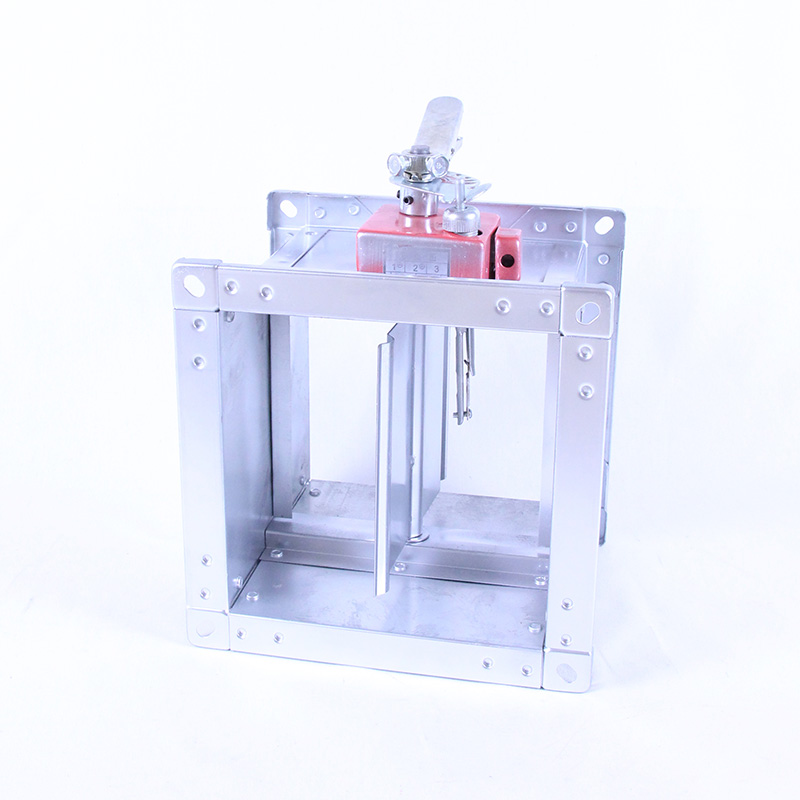
For air systems, the figure to write into the specification is a percentage of rated flow at a stated differential pressure. Wuxi Weishan quotes under 0.5 % for its anti-backflow check valve range. On a 20,000 m³/h air handler that is 100 m³/h — 27.8 L/s — which is small enough to be irrelevant for most dilution ventilation and large enough to matter in a fume hood exhaust or a cleanroom pressure cascade. Convert the percentage into absolute flow before you accept it.
The three sealing families
• Metal-to-metal. Durable, temperature-tolerant, poor tightness. Right for steam and high-temperature duties.
• Elastomer seat. Good tightness at moderate temperature. EPDM to about 120 °C, NBR to about 90 °C, both sensitive to the wrong chemical.
• PTFE / spherical. Chemically broad, used in the spherical-body check valve where the body is stainless and the seal is PTFE. The spherical form allows larger diameters at moderate pressure without a heavy cast body.
Symptom five: the valve will not open at all
This is nearly always installation, not product. Four rules cover it:
1. The flow direction must match the arrow cast on the body. The arrow points downstream, not upstream.
2. Large valves need independent support. A DN300 check valve hanging on two flange bolts will distort its own body under line weight.
3. A lift-type valve must be on a vertical line if it is the vertical pattern, horizontal if horizontal. There is no universal body.
4. Do not bolt a check valve directly to another valve. The wake from the upstream valve's trim arrives at the disc as an unstable velocity profile and the disc hunts.
The fourth rule is the one that gets argued about, because direct connection saves a spool piece and 300 mm of plant room. It also produces the chatter described above, and the argument is usually settled by the first maintenance bill.
Why sizing on peak flow fails
Check valves are routinely sized from the pump's design duty point, which is the peak flow the system will ever see. The valve then spends its life at 40 % of that flow, with the disc hovering near the seat rather than lifted clear. The result is seat erosion, chatter at part load and a valve worn out long before the pump is. Size on the minimum continuous flow and accept a slightly higher pressure drop at peak.
Choosing between the five types
The type decision can be made from three inputs: line size, fluid cleanliness, and how fast the system needs the disc closed.
Lift type. Small diameter, low pressure, clean fluid. Disc rises off a seat on flow and drops back. Cheap and effective, but orientation-specific and prone to chatter at part load.
Swing type. The workhorse for large diameter and low velocity. The disc swings on a hinge out of the flow path, so resistance is low and sealing is good. It needs space and it closes relatively slowly, which is where the water hammer comes from.
Butterfly (wafer) type. A disc rotating about a central shaft, clamped between flanges. Short face-to-face, low resistance, simple construction, and the usual choice where space in the plant room is the binding constraint. It has the least tolerance for debris on the seat.
Diaphragm type. An elastomeric diaphragm flexes to open and closes without metal-to-metal contact. Cushioned closure, good for water hammer, tolerant of slightly dirty fluid, limited by the diaphragm's temperature and chemical range.
Spherical type. A ball-shaped stainless body with a PTFE seat, used at moderate pressure and larger sizes where a cast iron body would be too heavy or too corrosion-prone.
The seat is not a shut-off point
A
check valve is not an isolation valve and should not be asked to be one. Metal-to-metal seats pass a trickle by design, and even an elastomer seat is a flow-control device rather than a shut-off point. Where isolation is needed for maintenance, it belongs on a separate valve upstream. Using the check valve as the isolation point is how a pump gets drained into a plant room.
Maintenance that actually prevents the next failure
A check valve inspection is fifteen minutes if the isolation valves work and two days if they do not. The routine is: isolate, depressurise, remove the bonnet or the wafer, inspect the seat and disc for erosion and embedded debris, check the stem or hinge pin for wear and play, replace the seal, and check the body for corrosion pitting at the low point where condensate collects.
In humid plant rooms, coat the external linkage and the stem with a rust-preventive before reassembly. In steam service, check for wire drawing across the seat, which shows as a fine groove and is the precursor to through-leakage.
Wuxi Weishan manufactures check valves alongside its ductwork and damper range — lift, swing, butterfly, diaphragm and spherical patterns, with stainless bodies and PTFE seals where the duty requires it — so a project can take the anti-backflow device and the duct it protects from one drawing set. The company's own reference list includes metro smoke control and industrial ventilation work where backflow protection is a life-safety item rather than a convenience.
The summary worth keeping is this: a check valve is chosen by symptom, not by catalogue page. Reverse rotation, chatter, hammer and leakage each point at a specific combination of type, size, spring and mounting. Get those four right and the valve will sit in the line for twenty years without anyone remembering it is there.
 +85247166614