Ask three suppliers to quote an angle steel flange for a 1000 × 500 duct and the prices will differ by a factor of two. Almost none of that spread is margin. It comes from four decisions that are made silently — the angle size chosen, the coil direction, the bolt pitch and whether the 90° corner is bent or welded — and each of them moves both the material bill and the labour bill.
This is a walk through those four decisions with the numbers attached, because the flange is usually the single largest fabricated item count in a duct package and nobody cost-models it.
What the part actually is
An angle
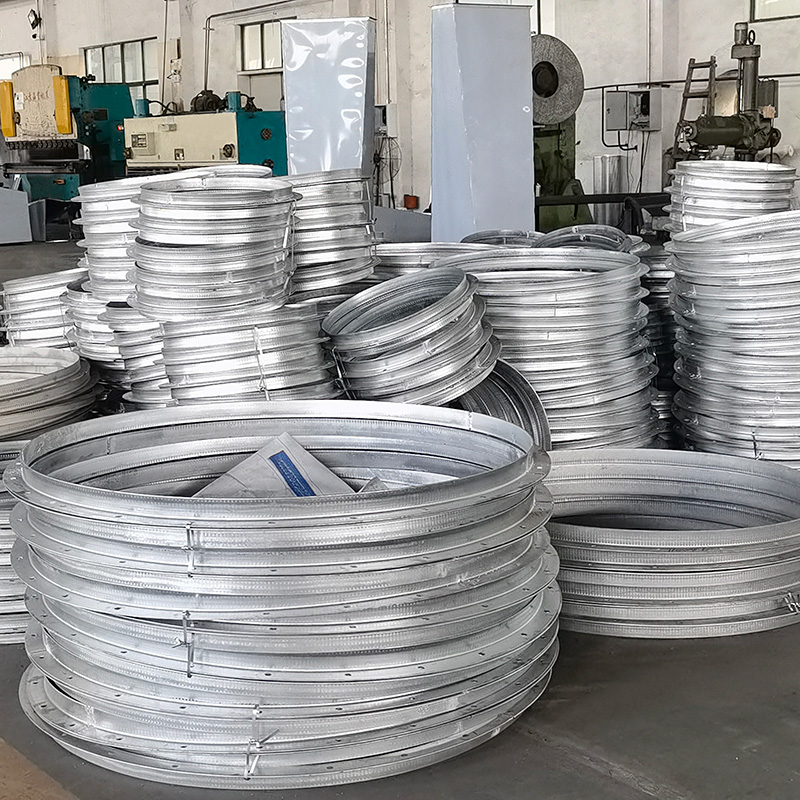
steel flange is a frame made from equal-leg angle, rolled or bent into a rectangle, with the two legs held at exactly 90° to each other. The duct wall is inserted into the throat of the angle and welded or riveted, and the outward-facing leg becomes the mating face that carries the bolts and the gasket.
That "exactly 90°" is the whole engineering content of the part. If the bend opens up, the mating face tilts and the gasket loads unevenly. If the leg wrinkles, the bolt holes no longer line up across a joint. Bending angle without a controlled-radius tool produces both, which is why the forming step, not the material, is where a cheap flange becomes an expensive one.
Decision one: the angle size
The angle size is normally taken from a code table keyed to duct width, and the table is not generous. Under the GB 50243 schedule used across Chinese ductwork, a 400 mm wide duct takes ∠25 × 3, a 1000 mm duct takes ∠30 × 4, and a 2000 mm duct steps to ∠50 × 5.
|
Duct size |
Angle |
Perimeter |
Angle mass |
Bolts at 150 mm pitch |
|
320 × 320 mm |
∠25 × 3 |
1.28 m |
1.42 kg |
10 |
|
400 × 400 mm |
∠25 × 3 |
1.60 m |
1.77 kg |
12 |
|
630 × 400 mm |
∠30 × 4 |
2.06 m |
3.62 kg |
15 |
|
1000 × 500 mm |
∠30 × 4 |
3.00 m |
5.28 kg |
21 |
|
1250 × 500 mm |
∠40 × 4 |
3.50 m |
8.35 kg |
25 |
|
1600 × 500 mm |
∠40 × 4 |
4.20 m |
10.02 kg |
29 |
|
2000 × 800 mm |
∠50 × 5 |
5.60 m |
20.88 kg |
39 |
The mass column is where the surprise sits. Going from a 1250 mm duct to a 2000 mm duct more than doubles the flange mass, because both the perimeter and the section weight increase at the same time. Angle steel runs 1.11 kg/m at ∠25 × 3 and 3.73 kg/m at ∠50 × 5 — a factor of 3.4 on the section alone.
Why the table is a floor, not a target
Upsizing the angle is the standard response to a joint that leaks or a flange that distorts during welding. It works, and it costs. Moving a 1000 × 500 joint from ∠30 × 4 to ∠40 × 4 adds 3.07 kg of steel per flange and about 70 % to the material line. On a project with 400 such joints that is 2.5 tonnes of steel bought to solve a problem that a better bend radius would have prevented.
The right sequence is to fix the forming first and only then consider upsizing.
Decision two: coil direction
There are two ways to orient the angle during forming, and the choice is not cosmetic.
Positive coil rolls the angle with its opening facing outward, away from the duct. The flange's outer leg presents a clean, continuous face to the mating flange, and the duct wall sits in the throat with good access for welding on the inside.
Negative coil rolls the angle with its opening facing inward, toward the duct. This puts the flat outer face against the duct wall, which can simplify the external weld and gives a slightly more compact joint, but the throat is now buried and the inner weld becomes awkward.
Positive coil is the default for most HVAC work because the welder can reach both sides. Negative coil appears where the external face must be flush — architectural exposed ductwork, or where a flange has to sit inside a tight ceiling void.
Which coil direction for exposed ductwork
Exposed ductwork in a plant room or an architectural ceiling changes the answer. Positive coil leaves the angle's open throat facing outward, which collects dust and reads as an unfinished edge. Negative coil turns the flat leg outward and gives a clean line, at the cost of a buried throat and a more difficult inner weld. On visible work the appearance usually wins; on concealed work it almost never does.
Decision three: bolt pitch
Bolt pitch drives cost in a way that is easy to underestimate, because bolts are cheap individually and numerous collectively.
On a 1000 × 500 duct the perimeter is 3.0 m. At a 200 mm pitch that is 16 bolts; at 150 mm it is 21; at 120 mm it is 26; at 100 mm it is 31. Each additional bolt is a hole to drill, a bolt to supply, a washer pair, and about 15 seconds of assembly labour on site.
|
Pitch |
Bolts on 1000 × 500 |
Relative bolt + drilling cost |
|
200 mm |
16 |
1.00 |
|
150 mm |
21 |
1.31 |
|
120 mm |
26 |
1.63 |
|
100 mm |
31 |
1.94 |
Tightening the pitch does buy something: gasket compression becomes more uniform and the joint holds a higher pressure class. But going from 150 mm to 100 mm nearly doubles the bolt cost to gain a pressure class that most HVAC systems never use. Specify the pitch from the pressure class, not from habit.
Decision four: bent corner or welded corner
A rectangle can be formed from four mitred pieces welded at the corners, or from a single length of angle notched and bent at three corners. Bent corners are stronger and faster to assemble, and they eliminate three welds per flange. Welded corners are cheaper on a press brake that cannot handle the notch geometry, and they let a fabricator use offcut lengths.
The practical test is the diagonal. Measure both diagonals of a finished flange; a difference of more than 3 mm across a 1000 mm frame means the corners moved during welding and the joint will fight itself on site.
Bolt grade is the cheap part
Grade 4.8 bolts are adequate for a duct flange carrying a few hundred pascals. Grade 8.8 costs marginally more and buys nothing on a low-pressure joint, but it matters where the flange is also a structural connection — a hanger bracket, a seismic restraint or a support frame. Mixing grades on one project is a reliable way to find out later which joint was assembled from the wrong box.
The full cost picture
Putting the four decisions together gives a cost curve that is far steeper than most estimators assume.
|
Duct size |
Cost index (320 × 320 = 100) |
Material share |
|
320 × 320 mm |
100 |
24 % |
|
400 × 400 mm |
123 |
24 % |
|
630 × 400 mm |
179 |
34 % |
|
1000 × 500 mm |
257 |
35 % |
|
1250 × 500 mm |
339 |
42 % |
|
1600 × 500 mm |
402 |
42 % |
|
2000 × 800 mm |
665 |
53 % |
Two things fall out of that table. First, cost scales roughly with perimeter to the power of 1.7, not linearly — doubling the duct size roughly quintuples the flange cost. Second, the material share climbs from a quarter to over half, which means that on large ducts the only lever that matters is the angle size, while on small ducts the labour and fasteners dominate.
This is the arithmetic behind the well-known complaint that angle steel flanges are expensive on large ductwork. It is not that angle is a bad material. It is that a 2000 mm joint needs 20.9 kg of steel and 39 bolts per flange, and there is no way to make that cheap.
Where angle steel stops being the right answer
Above roughly 1250 mm, three alternatives start to win on total installed cost:
TDF (transverse duct flange) joints. The duct end is rolled into an integral flange with a formed pocket that takes a corner clip. No separate angle, no drilling, no welding at the joint. Material drops dramatically and assembly on site is a push-fit. The limit is pressure class — TDF suits low and medium pressure systems and is not the right choice for high-pressure or smoke exhaust ductwork.
Flat plate flanges. A flat ring cut from sheet, welded to the duct end. Cheaper than angle on small sizes, weaker in bending, and prone to distortion on thin sheet.
Slip-on and welded companion flanges. Common on stainless and process ductwork where a hygienic, crevice-free bore matters more than first cost.
The crossover is not fixed, because it depends on the fabricator's equipment. A shop with a good TDF roll former will beat angle steel from about 630 mm upward. A shop set up for welded stainless work will use angle to 2000 mm without blinking.
What to write in the specification
Four lines prevent most of the arguments:
1. The angle size and the code table it comes from.
2. The coil direction, stated explicitly as positive or negative.
3. The bolt pitch, the bolt size and the grade.
4. The corner detail — bent or welded — and the diagonal tolerance.
Add the gasket material and thickness, because the flange does not seal by itself and a 3 mm EPDM gasket compresses very differently from a 6 mm closed-cell strip.
Wuxi Weishan forms angle steel flanges to the GB/T 9119 dimensional family in both coil directions, in the size range from 320 mm to over 2000 mm, and supplies them as part of a duct package so the flange, the duct end and the bolt pattern are dimensioned on one drawing. The company's ductwork has gone into metro smoke control, pharmaceutical cleanrooms and industrial ventilation across 16 countries, which is the kind of duty mix that exposes a bad flange within the first pressure test rather than the third year.
The summary is short. An angle steel flange is 1.4 kg of steel on a small duct and 21 kg on a large one, and the difference between a cheap flange and an expensive one is almost never the steel — it is the bend, the pitch and the corner.
 +85247166614