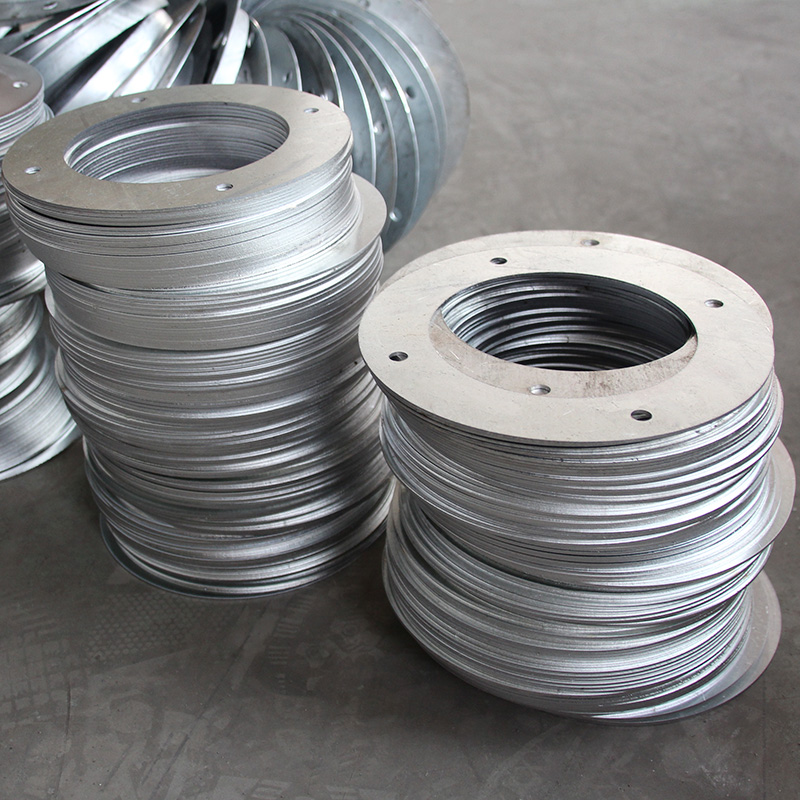
A flat plate flange is the simplest joint in industrial piping and ducting. A flat ring of steel, a hole in the middle, a ring of bolts, a gasket. No hub, no neck, no transition. It is cheap, it is quick to make, and it works perfectly well for the overwhelming majority of water, air and low-pressure service in a building.
Then, somewhere on the way up the pressure scale, it stops working — and it does not stop gradually. The failure is quiet, then sudden. The useful exercise is to walk up that ladder and note where each rung starts to cost more than the next better option.
Rung one: 0.25 to 0.6 MPa — where the flat plate is unbeatable
At the bottom of the range, a
flat plate flange has no competition on installed cost. The ring can be cut from sheet or plate with a plasma table, the bolt holes drilled in one pass, and the weld is a single-sided fillet. There is no machining, no hub to turn, no transition to blend.
The nominal pressure range for plate flanges in general service runs from 0.25 MPa up to 42.0 MPa, which sounds like the flat plate covers everything. It does not — the top of that range belongs to heavy forged plate with full penetration welding, and it is a different product in everything but name.
At 0.25 to 0.6 MPa the governing load is barely a load at all. Take a DN200 joint at 0.6 MPa: the hydrostatic end force trying to push the two halves apart is 18.8 kN, roughly the weight of two tonnes. Four M16 bolts in tension handle that with a comfortable margin, and the plate itself is loaded so lightly that thickness is set by weldability rather than strength.
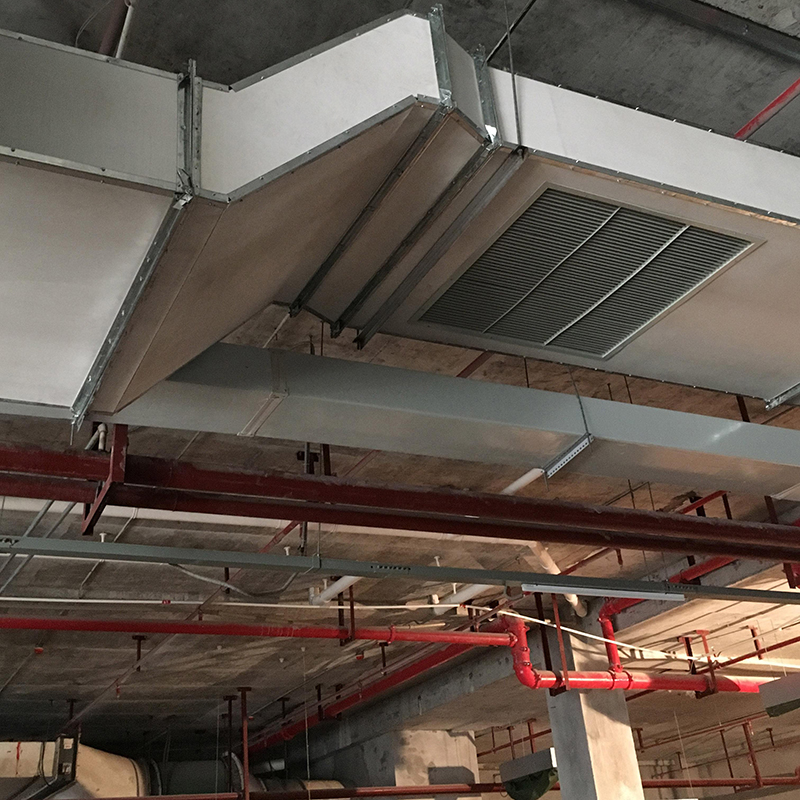
This is the range where ductwork lives. HVAC duct systems operate at a few hundred pascals to a few kilopascals — three orders of magnitude below 0.25 MPa — and the EN 1505 flange family used on European ductwork is designed for exactly that.
Rung two: 1.0 to 1.6 MPa — the plate starts to bend
At 1.6 MPa the picture changes. The end force on a DN200 joint is now 50.3 kN, and on a DN300 joint 113 kN. Those numbers have to be carried by the bolts, and the bolts apply their load to the flange ring at a lever arm measured from the bolt circle to the gasket.
A flat plate has no hub to resist that moment. All the resistance comes from the plate's own bending stiffness, which scales with thickness cubed. So the ring has to get thicker, and it has to get thicker faster than the pressure rises.
|
Pressure |
Relative plate thickness |
|
0.25 MPa |
0.65 |
|
0.60 MPa |
1.00 |
|
1.00 MPa |
1.29 |
|
1.60 MPa |
1.63 |
|
2.50 MPa |
2.04 |
|
4.00 MPa |
2.58 |
Thickness goes with the square root of pressure at constant geometry. Doubling the pressure multiplies the plate thickness by 1.41, and since the ring's mass goes with thickness, the material bill rises by the same factor while the pressure only doubles.
The visible symptom of an under-thickness plate is flange rotation. The outer edge of the ring lifts, the gasket unloads on its outside diameter, and the joint weeps from the outside in. On a joint that has been in service for years this shows as a rust stain fanning out from the bolt holes.
The symptom you can actually see
Flange rotation does not announce itself as a leak. It announces itself as a stain — a fan of oxide spreading outward from the bolt holes on a carbon steel joint, or a white bloom on galvanised work. The stain is the path the weeping took. Finding it means the joint has been passing a small amount of fluid for long enough to corrode, which is usually months rather than days.
Rung three: the cubic law that decides whether it leaks
The reason flange rotation matters so much is that leakage through a gasketed joint is not linear in gap. For flow through a thin annular slit, the rate goes with the cube of the gap height.
|
Gap at the gasket |
Leak rate at 1 bar |
Leak rate at 6 bar |
|
0.05 mm |
0.034 L/s |
0.205 L/s |
|
0.10 mm |
0.273 L/s |
1.64 L/s |
|
0.20 mm |
2.18 L/s |
13.1 L/s |
Double the gap and the leak rate goes up by eight. That is the entire argument for stiff flanges in one table. A joint that is perfectly tight at 0.05 mm of gasket gap is passing two litres a second at 0.2 mm — and 0.2 mm is well within the range of what a rotated flat plate produces under bolt load.
It also explains why re-torquing a weeping flat plate joint so often fails. The bolts are already tight; the plate has simply rotated, and no amount of bolt tension will pull a bent ring flat again.
Why re-torquing does not fix it
The instinct on a weeping joint is to tighten the bolts. On a rotated flat plate this makes the problem worse. The bolts are already carrying the load; adding tension increases the moment that bent the plate in the first place. The gasket at the outside diameter is already unloaded and cannot be re-loaded by pulling harder on a ring that has bowed away from it. The joint has to come apart.
Rung four: 2.5 MPa — the crossover
At 2.5 MPa a flat plate flange is still made, still sold, and still the cheapest thing on the shelf for water supply and HVAC duty. This is the pressure class where its cost advantage is at its clearest, and where most building services work sits.
Above it, the arithmetic reverses. Once the plate has to be thick enough to resist rotation, the mass of the ring approaches the mass of a necked flange, and the necked flange is stiffer per kilogram because the hub sits right where the bending moment is highest. The welding neck also puts the weld away from the highly stressed region, which matters for anything that will be fatigue-loaded or radiographed.
The crossover is not a single number. It depends on diameter, gasket type, bolt size and whether the joint will be thermally cycled. But somewhere between 2.5 and 4 MPa, a competent estimator stops reaching for the flat plate.
The four places the flat plate genuinely loses
Beyond raw pressure, there are duties where a flat plate is the wrong part regardless of the number on the drawing.
Thermal cycling. A flat plate joint that heats and cools repeatedly loses gasket compression a little on every cycle, because there is no elastic element to follow the movement. A necked flange or a bellows-backed joint handles it; a flat plate does not.
High temperature. Above roughly 200 °C the gasket material becomes the limiting item, and the flat plate's poor load distribution makes the gasket work harder. Compressed fibre and graphite gaskets need uniform compression, which a rotating plate does not provide.
Vacuum. A flat plate on vacuum service is loaded in the opposite direction and the gasket has no internal pressure helping it seat. It will hold small vacuum with a soft gasket and will not hold a good vacuum at all.
Hygienic service. A single-sided fillet weld leaves a crevice on the inside of the joint. In pharmaceutical and food duty that crevice is a cleaning problem, and the answer is a sanitary clamp or a fully penetrated flange, not a plate.
Where it is the right answer, and stays the right answer
Three duties keep the flat plate in the specification permanently.
Low-pressure water and HVAC. Below 2.5 MPa in closed-loop heating, chilled water, domestic water and condensate, the flat plate is the value option and nothing beats it. A 1000 × 500 duct flange in 1.0 mm sheet is a few hundred grams of steel and a few minutes of welding.
Chemical auxiliary lines. Where the line is a drain, a vent, a sample point or an instrument connection, the flat plate's simplicity and low cost win outright. The line will never see design pressure.
Temporary closures. A flat plate cut to the bolt pattern makes an instant blind for hydrostatic testing or maintenance isolation. It is not a permanent solution but it is the fastest one available.
The gasket is half the joint
A
flat plate flange with a poor gasket is a worse joint than a thinner plate with a good one. Compressed fibre sheet, spiral wound, PTFE envelope and closed-cell strip each need a different compression to seal, and the plate has to be stiff enough to deliver that compression evenly. Selecting the flange and the gasket separately, as two lines on a bill of materials, is how mismatches get built in.
Material choice
Carbon steel Q235 covers the general case and takes a galvanised or painted finish. Stainless 304 handles most mildly corrosive duty and 316 the chloride-bearing cases. Alloy steel appears where temperature or pressure pushes past what carbon steel will take, and at that point the flange is no longer a flat plate in any meaningful sense.
The gasket matters as much as the plate. A 3 mm compressed fibre sheet and a 6 mm closed-cell strip behave completely differently under the same bolt load, and neither behaves like a spiral wound gasket. Specify the gasket by material, thickness and the compression it needs, not by "gasket included".
The specification lines that matter
Four lines in a specification will keep a flat plate joint out of trouble:
• Nominal pressure and the standard it is taken from — EN 1505 for ductwork, the relevant GB or EN piping standard otherwise.
• Plate thickness, not "to suit". Thickness is the whole structural argument.
• Weld detail: single-sided fillet with the leg size stated, or full penetration where the duty requires it.
• Gasket material, thickness and whether it is to be replaced at every break.
Wuxi Weishan produces plate flanges to the EN 1505 family alongside its angle steel flange range and its ductwork, which lets a project match the joint type to the pressure class across a whole system rather than defaulting to one detail everywhere. The company's ventilation work in metro, pharmaceutical and industrial applications spans the full range from 200 Pa duct joints to low-pressure process connections, and the flange choice differs between them.
The short version: a
flat plate flange is the correct answer below about 2.5 MPa, an acceptable answer to about 4 MPa with a good gasket and a thick plate, and the wrong answer above that. The number that decides it is not the pressure alone — it is the gap, because leakage goes with the cube of the gap and the plate's willingness to stay flat is what sets the gap.
 +85247166614



 Current
location:Home >news
>Industry news
>Flat Plate Flange: Climbing The Pressure Ladder Until It Stops