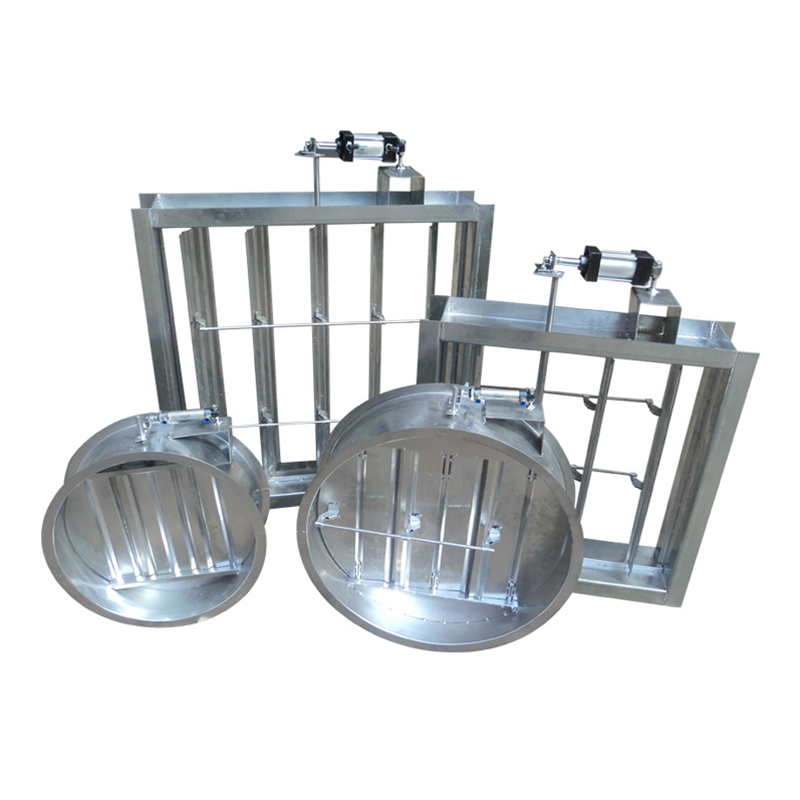
What Is a Damper?
A damper is a movable plate or blade inside a duct that controls airflow by obstructing the cross-section. Dampers are used for:
Isolation: open/close to isolate a duct section for maintenance or shutdown.
Modulation: continuously adjust airflow to maintain temperature, pressure, or airflow.
Balancing: trim airflow at each branch to achieve design distribution.
Fire safety: close automatically on fire detection to prevent fire and smoke spread.
Smoke control: open/close to control smoke movement during a fire.
The Wuxi Weishan damper product line covers all damper types.
What Are the Main Damper Types?
|
Damper Type |
Actuation |
Best For |
Limitations |
|
Manual damper |
Hand-operated |
Balancing, isolation, low-frequency operation |
No remote control, no automation |
|
Electric damper |
Electric motor |
Modulation, BMS integration |
Requires power, control wiring |
|
Pneumatic damper |
Compressed air |
Modulation, fast response, hazardous area |
Requires compressed air |
|
Fire damper |
Fusible link or actuator |
Life safety, fire/smoke isolation |
One-time use, requires replacement |
|
Smoke damper |
Electric or pneumatic |
Smoke management |
Requires detection system |
|
Backdraft damper |
Gravity / spring |
Reverse flow prevention |
Limited control
|
Each damper type is suited to a different control strategy and safety requirement.
When Is a Manual Damper the Right Choice?
Manual dampers are the right choice when:
The damper is operated infrequently: balancing, isolation for maintenance.
No remote control is needed: the operator can access the damper directly.
The system has no BMS: the damper is set once and left.
Cost is a constraint: manual dampers are the least expensive.
Common applications:
Branch balancing dampers (set once, then locked).
Isolation dampers for equipment maintenance.
Volume dampers at diffusers.
The Wuxi Weishan manual damper product line includes single-blade and multi-blade configurations.
When Is an Electric Damper the Right Choice?
Electric dampers are the right choice when:
Remote control is required: BMS integration, automated control.
Modulation is needed: VAV boxes, temperature control.
Fast response is needed: < 30 seconds open/close.
Compressed air is not available: standard electric infrastructure.
Common applications:
VAV terminal units.
Zone control dampers.
Outdoor air dampers with actuator.
Exhaust dampers with actuator.
The Wuxi Weishan electric damper product line covers 24V and 230V actuators with on/off, floating, or proportional control.
When Is a Pneumatic Damper the Right Choice?
Pneumatic dampers are the right choice when:
Fast response is critical: < 5 seconds full stroke.
Hazardous area: no electric spark risk (refineries, chemical plants, grain handling).
Compressed air is readily available: industrial plant with pneumatic infrastructure.
Modulation is needed: continuous control.
Common applications:
Process control dampers (refineries, chemical plants).
High-cycle dampers (> 100 cycles per day).
Hazardous area dampers (explosion-proof environments).
The Wuxi Weishan pneumatic damper product line includes pneumatic actuators for industrial applications.
When Is a Fire Damper Required?
Fire dampers are required by building codes (NFPA 90A, NFPA 90B, IBC, EN 1366) at:
Fire-rated wall penetrations: where a duct passes through a fire-rated wall or floor.
Fire-rated floor penetrations: where a duct passes through a fire-rated floor.
Where required by code: specific occupancies and construction types.
Fire dampers close automatically when the temperature at the damper exceeds the fusible link rating (typically 165°F / 74°C or 212°F / 100°C) or when activated by a fire alarm signal.
Fire dampers are life-safety devices. They must be listed by UL, CE, or equivalent, and must be installed per the manufacturer's instructions and the local code.
The Wuxi Weishan fire damper product line is UL-listed and CE-marked for fire-rated wall and floor penetrations.
What Are the Leakage Classes for Dampers?
Damper leakage is classified per AMCA 500-D and similar standards:
|
Class |
Leakage Rate (cfm/ft² @ 1 in. w.c.) |
Best For |
|
Class I |
< 4 |
Low-pressure commercial |
|
Class II |
< 8 |
Low-pressure commercial |
|
Class III |
< 16 |
Medium-pressure commercial |
|
Class IV |
< 40 |
High-pressure industrial |
For low-leakage applications (VAV terminals, isolation dampers), Class I or II is required. For high-pressure industrial service, Class III or IV is required.
What Are the Blade Configurations?
Damper blade configurations:
|
Configuration |
Leakage |
Pressure Drop |
Cost |
Best For |
|
Single blade |
High |
Low |
Low |
Low-pressure, large ducts |
|
Multi-blade (parallel) |
Low |
Medium |
Medium |
Medium-pressure, isolation |
|
Multi-blade (opposed) |
Lowest |
Medium |
Medium-high |
Low-leakage, modulation |
|
Multi-blade (in-line) |
Low |
Medium |
Medium |
Modulation |
Multi-blade opposed blade dampers provide the lowest leakage and are used for VAV and isolation. Single blade dampers are used for large low-pressure ducts where leakage is acceptable.
What Are the Materials of Construction?
Common damper materials:
|
Component |
Material |
Notes |
|
Frame |
Galvanized steel, stainless steel, extruded aluminum |
Standard is galvanized |
|
Blades |
Galvanized steel, stainless steel, aluminum |
Standard is galvanized |
|
Seals |
EPDM, silicone, neoprene, foam |
EPDM most common |
|
Bearings |
Bronze, stainless steel, nylon |
Bronze for high-cycle |
|
Linkage |
Steel, stainless steel |
Standard is steel |
|
Actuator |
Electric or pneumatic |
Per specification |
For corrosive environments (coastal, chemical), stainless steel construction with EPDM seals is recommended.
How Are Dampers Sized?
Damper sizing is based on the duct size and the airflow:
Determine the duct size: width × height (rectangular) or diameter (round).
Determine the airflow: CFM or m³/h through the damper.
Calculate the face velocity: CFM / duct area (fpm).
Check the pressure drop: per the manufacturer's data at the design airflow.
Verify the leakage class: per the manufacturer's data at the design pressure.
For VAV dampers, the face velocity should be 1,500–3,000 fpm for proper control. For isolation dampers, the face velocity can be higher (3,000–5,000 fpm).
What Are the Common Operating Issues?
Common operating issues in dampers:
|
Issue |
Cause |
Prevention |
|
High leakage |
Worn seals, blade misalignment |
Replace seals, realign blades |
|
Stuck damper |
Corrosion, debris, linkage failure |
Inspect and lubricate linkage |
|
Actuator failure |
Electrical fault, mechanical wear |
Inspect and test actuator |
|
Noise |
High velocity, blade vibration |
Limit velocity, add silencer |
|
Vibration |
Loose linkage, worn bearings |
Tighten linkage, replace bearings |
|
Failure to close (fire damper) |
Fusible link failure, actuator failure |
Test annually, replace fusible link |
|
Condensation |
Cold air, humid ambient |
Insulate duct, add vapor barrier
|
Each issue is preventable with discipline. Periodic inspection and testing are recommended for fire dampers (annual per NFPA 80).
How Are Fire Dampers Tested?
Fire damper testing requirements:
Initial installation: visual inspection to verify installation per the manufacturer's instructions.
Operational test: cycle the damper (for motorized dampers) to verify open/close operation.
Fusible link test: replace the fusible link if it shows signs of damage or aging.
Annual inspection: visual inspection and operational test per NFPA 80.
Drop test: for gravity-actuated dampers, verify the damper drops to the closed position when released.
Documentation: maintain a record of inspections, tests, and replacements.
For UL-listed fire dampers, the test procedure is specified in the UL listing and the manufacturer's installation instructions.
What Are the Code Requirements?
Major code requirements for dampers:
NFPA 90A: Installation of air conditioning and ventilating systems. Specifies fire damper requirements for fire-rated wall and floor penetrations.
NFPA 90B: Installation of warm air heating and air conditioning systems.
NFPA 80: Standard for fire doors and other opening protectives. Specifies fire damper testing.
IBC (International Building Code): requires fire dampers at fire-rated wall and floor penetrations.
EN 1366-2: European standard for fire damper testing.
UL 555: Standard for fire dampers.
CE marking: required for European projects.
For each project, the local code must be consulted for specific damper requirements.
What Is the Future of Damper Technology?
Trends in damper technology:
Smart actuators: actuators with built-in position feedback and diagnostics.
IoT integration: dampers connected to building management systems with real-time monitoring.
Self-testing fire dampers: fire dampers that automatically cycle and report status.
Improved seals: lower-leakage seals for energy-efficient buildings.
Composite materials: lighter, corrosion-resistant materials for special applications.
For a damper manufacturer, the trend toward smart actuators and IoT integration is creating new opportunities for value-added products.
Conclusion
HVAC dampers control, isolate, or modulate airflow in duct systems. The principal types — manual, electric, pneumatic, fire — each have different control strategies and safety requirements. Wuxi Weishan produces the full range: manual damper, electric damper, pneumatic damper, fire damper, plus the broader damper product line. The selection depends on the control function, the actuation, the leakage class, the fire rating, and the pressure class.
Frequently Asked Questions
What is the difference between a damper and a valve?
A damper controls airflow in a duct; a valve controls flow in a pipe. Dampers are flat plates that obstruct the duct; valves are typically round with a disc or ball.
What is the difference between a fire damper and a smoke damper?
A fire damper closes automatically on fire detection to prevent fire spread. A smoke damper opens or closes to control smoke movement. Fire dampers are required by code; smoke dampers are part of smoke management systems.
What is the leakage class of a fire damper?
Fire dampers are typically Class II or III leakage. Low-leakage fire dampers (Class I) are available for energy-efficient buildings.
How often should fire dampers be tested?
Fire dampers should be inspected and tested annually per NFPA 80. Some jurisdictions require more frequent testing (e.g., semi-annually in hospitals).
What is the actuation voltage for electric dampers?
Standard voltages are 24V AC/DC (low voltage, for BMS) and 230V AC (line voltage, for direct connection). Pneumatic dampers use 20–100 psi air pressure.
What is the typical actuator runtime?
Typical runtime is 30–90 seconds for standard electric actuators. Fast actuators (5–15 seconds) are available for special applications. Pneumatic actuators are faster (1–5 seconds).
What is a fusible link?
A fusible link is a temperature-sensitive device that holds the fire damper in the open position. When the temperature exceeds the link rating (typically 165°F or 212°F), the link melts and the damper closes.
Can a fire damper be motorized?
Yes, motorized fire dampers combine a fusible link with an electric actuator. They close on either fire detection (signal) or fusible link activation.
What is the difference between opposed blade and parallel blade dampers?
Opposed blade dampers have blades that rotate in opposite directions; they provide lower leakage and better modulation. Parallel blade dampers have blades that rotate in the same direction; they are used for two-position control.
What is the typical pressure drop for a damper?
Typical pressure drop is 0.05–0.15 in. w.c. for an open damper at the design airflow. Higher pressure drop indicates a more closed damper.
What is the standard damper width?
Standard damper width is the duct width minus the actuator clearance. For multi-blade dampers, the blade width is typically 6–8 inches.
What is the future of damper technology?
The future is toward smart actuators, IoT integration, self-testing fire dampers, improved seals, and composite materials.
 +85247166614



 Current
location:Home >news
>Industry news
>HVAC Dampers: Manual, Electric, Pneumatic, And Fire Damper Selection Guide
Current
location:Home >news
>Industry news
>HVAC Dampers: Manual, Electric, Pneumatic, And Fire Damper Selection Guide