Square Duct: The Geometry, Worked Through
Release time:2026-12-07 Visits:1
A
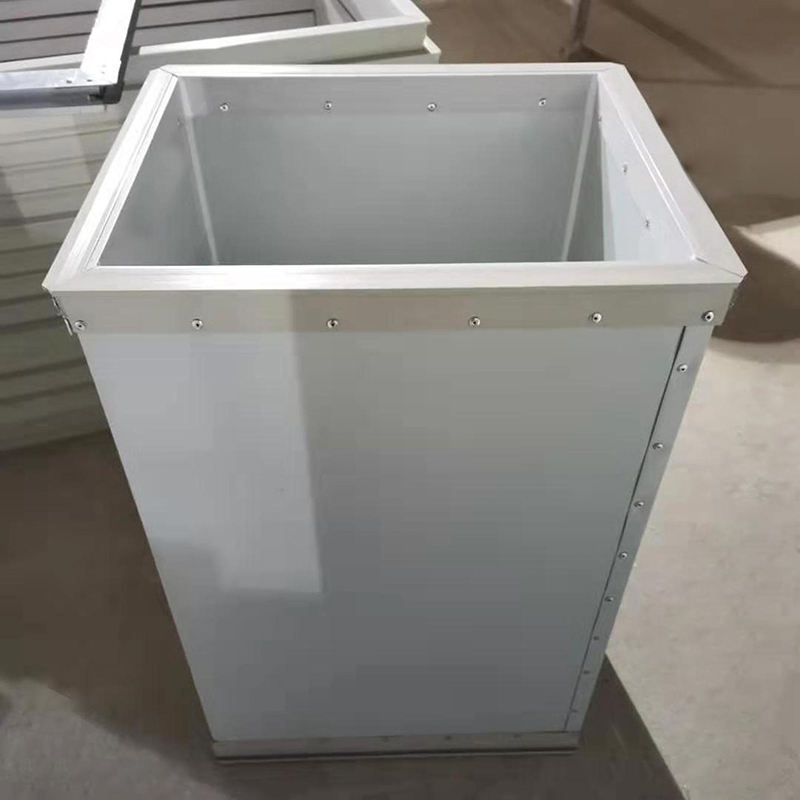
square duct is a rectangular duct with its two dimensions made equal. That one-line definition hides the reason the form exists, because a square section is never the cheapest way to move air and it is never the lightest. It wins on a different axis entirely — it is the easiest shape to build, to fit and to take a branch off, and on short runs those three things outweigh everything else.
Working through the geometry makes clear where that trade sits.
The one formula that governs every duct shape
Duct sizing for pressure loss uses the equivalent diameter, the round duct that would produce the same friction loss per metre as the shape in question. For a rectangular section with sides a and b in millimetres:
De = 1.30 × (a·b)^0.625 ÷ (a + b)^0.25
For a square, a = b, so the expression collapses to something simpler and the equivalent diameter becomes a fixed fraction of the side.
|
Side |
Area |
Equivalent diameter |
Round duct of same area |
Perimeter penalty |
|
200 × 200 mm |
0.040 m² |
219 mm |
226 mm |
+12.8 % |
|
315 × 315 mm |
0.099 m² |
344 mm |
355 mm |
+12.8 % |
|
400 × 400 mm |
0.160 m² |
437 mm |
451 mm |
+12.8 % |
|
500 × 500 mm |
0.250 m² |
547 mm |
564 mm |
+12.8 % |
|
630 × 630 mm |
0.397 m² |
689 mm |
711 mm |
+12.8 % |
|
800 × 800 mm |
0.640 m² |
875 mm |
903 mm |
+12.8 % |
|
1000 × 1000 mm |
1.000 m² |
1093 mm |
1128 mm |
+12.8 % |
Two constants fall out of that table, and they hold at every size. The equivalent diameter of a square duct is 96.8 % of the diameter of the round duct with the same cross-sectional area. The perimeter is 12.8 % longer than that same round duct.
Those two numbers are the entire cost of choosing square over round, and they never change.
What the 12.8 % actually buys and costs
The perimeter penalty is a material penalty. A duct is made from sheet, and sheet is bought by area, so a square duct of a given cross-section uses 12.8 % more steel than the round alternative. On 200 metres of 500 × 500 duct in 0.75 mm galvanised sheet that is roughly 45 kg of extra steel — not a rounding error, not a catastrophe.
The equivalent-diameter penalty is a fan penalty, and it is smaller than most people assume. Running the friction calculation at the same velocity in a 500 mm square and a 564 mm round gives about 4 % more pressure loss per metre in the square. Four percent.
So the honest summary is: a square duct costs about 13 % more in steel and about 4 % more in fan energy than the best round alternative of the same capacity. Everything else is a detail about installation.
Where the penalty is actually paid
The 12.8 % shows up in three places, and only one of them is the material invoice. It appears as extra sheet on the coil, extra weight on the hanger schedule, and extra surface on the insulation. On a large project the third is often the largest, because insulation is priced by area and a square duct has 12.8 % more of it than the round alternative at the same capacity.
A worked example at a realistic duty
Take 2000 m³/h through a 500 × 500 duct.
Cross-section 0.25 m², so velocity is 2000 ÷ 3600 ÷ 0.25 = 2.22 m/s. That is low for a main run and perfectly normal for a branch or a low-velocity system.
Equivalent diameter 0.547 m, Reynolds number about 81,000, friction factor 0.020 against a galvanised surface roughness of 0.15 mm. Friction loss works out at 0.109 Pa/m.
Over 30 metres that is 3.3 Pa. Over 50 metres, 5.4 Pa.
Those numbers explain why square duct is so often the right answer on distribution runs: at these velocities the duct friction is a rounding error next to the fittings, the diffusers and the terminal unit. Optimising the duct shape to save 4 % of 5 Pa is not a productive use of anyone's afternoon.
The same flow in smaller squares shows the other side of the coin. At 315 × 315 the velocity rises to 5.60 m/s and the loss to 1.07 Pa/m — ten times the loss of the 500 mm duct, for the same air. Duct sizing is a velocity decision far more than a shape decision.
Reading the number correctly
The equivalent diameter is not a physical dimension and cannot be measured on site. It is a device for using round-duct friction charts on a rectangular section. Two consequences follow: the figure only holds for turbulent flow, which is true of every HVAC duct, and it does not account for fittings. A square duct with six elbows loses far more pressure than the straight-run calculation suggests, and the elbows, not the section shape, are where the design effort belongs.
The flat-face problem, and why square is easier than rectangular
Every duct wall is a plate loaded by pressure, and a plate's bending stress goes with the square of its span-to-thickness ratio. Double the unsupported width at constant thickness and the stress quadruples.
This is where square sections have an advantage that is not obvious from the numbers. In a square duct both faces are the same width, so both need the same treatment — one bracing schedule covers the whole perimeter. In a rectangular duct the narrow faces are fine and the wide faces need attention, which means tie rods, internal braces or a heavier gauge on two walls only, and a fabrication drawing that has to keep track of which wall is which.
The practical limit for an unbraced galvanised square duct is around 800 to 1000 mm on a side at medium pressure. Past that, either the gauge goes up or the faces get tied. At 1250 mm square in 1.0 mm sheet, the flat face will oil-can visibly under fan pressure and will drum audibly on start-up.
Why the joint detail is what makes square practical
The reason square duct survives commercially is the TDF joint — the transverse duct flange. The duct end is rolled into an integral flange with a formed pocket, and adjacent sections are joined with a corner clip and a gasket, with no separate angle, no drilling and no welding at the joint.
On a round duct the equivalent is a slip joint or a rolled bead, both of which are fast. But a round duct cannot take a branch at an arbitrary position without a saddle or a tee fitting, and it cannot be rectangular-adapted at a diffuser without a transition. A square duct can do both, in the shop, with a plasma table and a folder.
That is the real argument. Square duct is not chosen because it is efficient. It is chosen because a square section is the shape that lets a rectangular diffuser, a rectangular fire damper, a rectangular volume control damper and a rectangular access panel all bolt on without a transition piece. The 12.8 % material penalty buys a system with fewer parts.
The bracing clause
Above roughly 800 mm square at medium pressure, an unbraced flat face will drum and oil-can. The usual fix is an internal tie rod across the duct, which is cheap, effective and completely unacceptable on hygienic ductwork because it cannot be cleaned. The alternative is external bracing or a heavier gauge, and which one is chosen has to be settled at the drawing stage. A tie rod added after fabrication leaves a hole that has to be sealed.
Where square is the wrong call
Three situations where the geometry works against you:
Long straight mains. A 100-metre main run in square section wastes 12.8 % of the steel for the whole length. Round
spiral duct is cheaper to buy, cheaper to insulate, and faster to hang.
High-velocity dust transport. Abrasive dust wears the corners of a square duct preferentially, and the four internal corners are dead zones where material settles during shutdown. Round is better on both counts.
Tight ceiling voids. A square section needs its full height. A rectangular section of the same area can be flattened to fit, at a material cost that is still lower than lowering the ceiling.
Sizing and specification notes
Three lines cover most of what a square duct specification needs.
State the size and the gauge together, because they are not independent. A 500 mm square at low pressure takes 0.6 mm; at medium pressure 0.75 mm; the code tables give the pairing and deviating from them is a false economy.
State the joint type. TDF is standard for galvanised low and medium pressure work; welded flange or angle steel flange for stainless, high pressure and smoke exhaust.
State the bracing rule above the threshold, including whether internal tie rods are acceptable. On a pharmaceutical or food duct an internal tie rod is a cleaning nightmare and the answer is external bracing or a heavier gauge, and that decision has to be made before the duct is fabricated, not after.
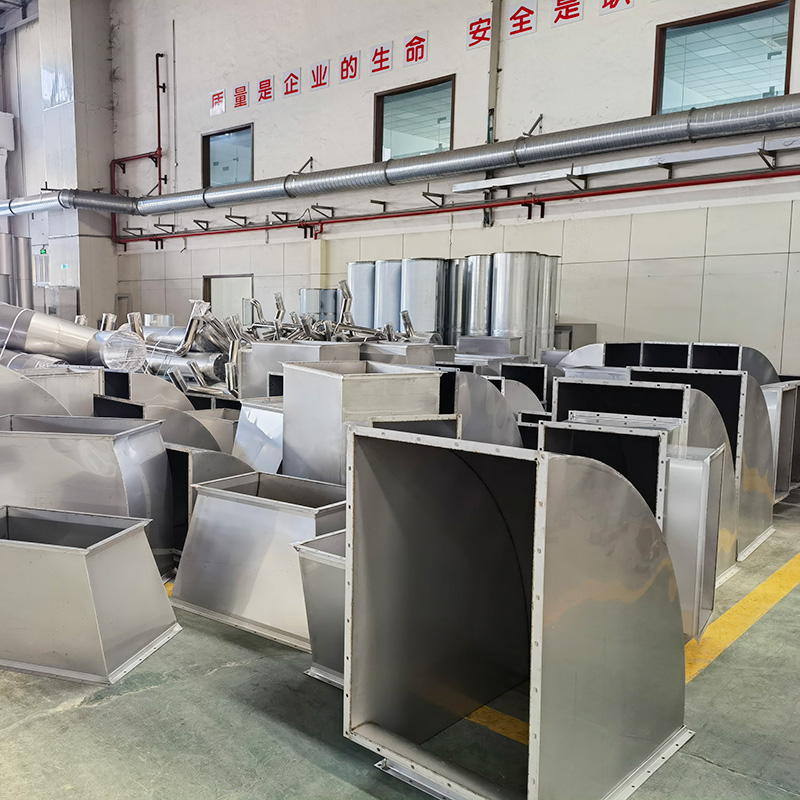
Wuxi Weishan produces square and rectangular duct in galvanised SPCC, 304 and 316L stainless and Q235B carbon steel, with TDF joints on the light-gauge range and welded construction for the heavier duties, in a 10,000 m² facility with laser cutting and CNC folding under one roof. The company also supplies the fire dampers, volume dampers and access doors that fit those square openings, which is the practical advantage of the shape described above.
The one-line version:
square duct pays 12.8 % more for its steel and 4 % more for its fan energy, and in exchange it removes transitions, fittings and site labour from every diffuser, damper and access panel in the system. On a short distribution run that trade is obviously correct. On a 100-metre main it is obviously wrong. Most buildings contain both, which is why most buildings use both.
 +85247166614