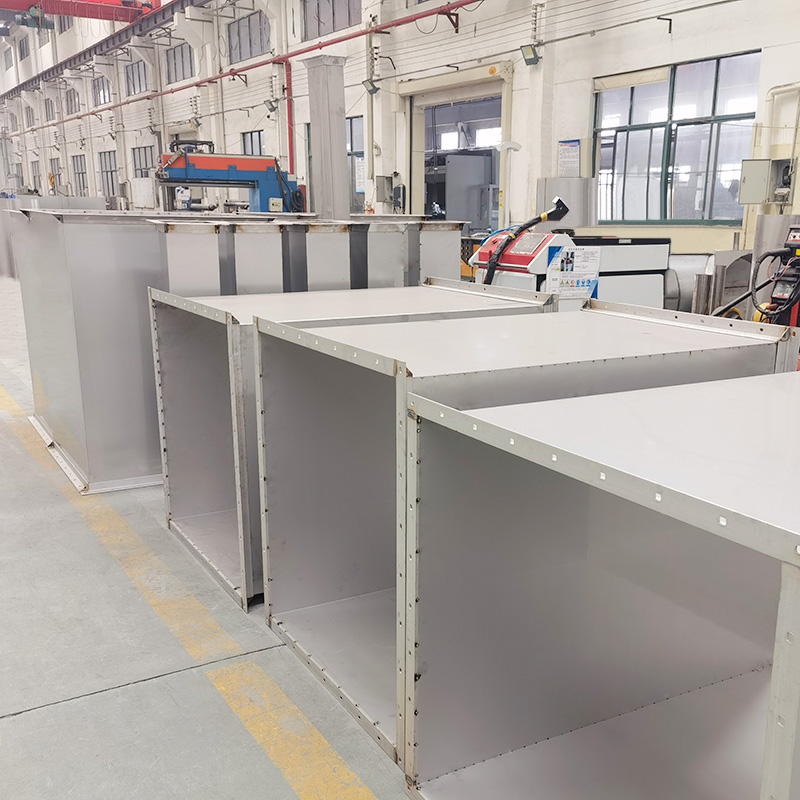
Rectangular duct gets argued about more than any other component in an air system. The arguments usually rest on three beliefs that get repeated until they sound like engineering: that a high aspect ratio wrecks the pressure loss, that rectangular is inherently inefficient compared with round, and that the aspect ratio should never exceed 4:1.
Two of those are close to right for the wrong reason. One is close to wrong for the right reason. Running the arithmetic makes the difference clear, and it changes which number you should be optimising.
Belief one: high aspect ratio ruins the pressure loss
It does not. It barely touches it.
Take a fixed cross-sectional area of 0.50 m² and a fixed velocity of 12 m/s, and vary only the aspect ratio. The round duct of the same area is the reference.
|
Aspect ratio |
Section at 0.50 m² |
Equivalent diameter |
Friction vs round |
|
Round |
Ø798 mm |
798 mm |
baseline |
|
1 : 1 |
707 × 707 mm |
773 mm |
+4 % |
|
2 : 1 |
1000 × 500 mm |
762 mm |
+6 % |
|
3 : 1 |
1225 × 408 mm |
746 mm |
+8 % |
|
4 : 1 |
1414 × 354 mm |
731 mm |
+11 % |
Going from a perfect square to a 4:1 section adds 11 % to the friction loss per metre. At a typical 1.6 Pa/m that is 0.18 Pa/m. Over 40 metres it is 7 Pa.
Seven pascals is less than a single poor elbow. It is less than the difference between two brands of diffuser. If the aspect ratio is being driven by a ceiling void that is 400 mm deep, taking 4:1 instead of 2:1 costs about 2 Pa per 40 metres and saves 200 mm of building height. That is not a difficult decision, and yet the 4:1 rule gets applied as though it were a code requirement.
Where the friction argument does have teeth is at high velocity. At 18 m/s in a small duct the absolute loss per metre is several times larger, so an 11 % penalty on 12 Pa/m is 1.3 Pa/m, which is real money in fan power over a long run. The rule should be tied to velocity, not to a universal ratio.
Where the rule does bite
The 4:1 default earns its place at high velocity. At 18 m/s in a small duct the absolute loss per metre is several times the figure at 12 m/s, so an 11 % penalty becomes 1.3 Pa/m rather than 0.18 Pa/m. On a long, fast run that is real fan power. Tie the aspect ratio limit to the velocity in the run rather than applying one number across a whole system.
Belief two: rectangular is inefficient compared with round
True, but the inefficiency is not where people look for it.
The friction penalty is 4 to 11 %, as above. The material penalty is much bigger, and it is the one that shows up on the invoice.
|
Aspect ratio |
Perimeter at 0.50 m² |
vs round |
|
Round |
2.507 m |
baseline |
|
1 : 1 |
2.828 m |
+12.8 % |
|
2 : 1 |
3.000 m |
+19.7 % |
|
3 : 1 |
3.266 m |
+30.3 % |
|
4 : 1 |
3.536 m |
+41.0 % |
A 4:1
rectangular duct uses 41 % more sheet metal than the round duct that carries the same air at the same velocity. That is a permanent, per-metre, per-kilogram cost that appears in the material order, the freight, the hanger schedule and the insulation bill.
So the honest comparison is: rectangular duct costs 41 % more in steel and 11 % more in fan energy at 4:1, against a square duct's 12.8 % and 4 %. The steel is the dominant term, and it is the term nobody quotes when they cite the 4:1 rule.
What that means for the decision
If the choice is between a 2:1 rectangular section and a 4:1 rectangular section, and both fit the void, take 2:1 — the 10 % saving in steel is worth more than the 5 % saving in fan energy, and it will also be easier to brace.
If the choice is between a 4:1 rectangular section and dropping the ceiling by 200 mm, take the 4:1 section and stop worrying about 11 %.
Belief three: 4:1 is a hard limit
The 4:1 rule is a good default and a poor law. It comes from a combination of three practical limits that happen to converge around that ratio:
Bracing. The wide face of a rectangular duct is a plate in bending, and its stress goes with the square of the span-to-thickness ratio. Doubling the width at constant gauge quadruples the stress, so a 1414 mm wide face needs either a heavier gauge or tie rods, while a 707 mm face does not. The 4:1 limit is roughly where bracing becomes unavoidable on standard gauges.
Manufacture. Above 4:1 the cross-brakes, the corner seams and the flange stiffness all get awkward, and the duct stops being a straightforward fold-up job.
Fitting geometry. A very flat duct is hard to take a round branch off, hard to fit a damper into, and hard to get a cleaning brush through.
None of those is a pressure-loss argument. All three are real, and all three can be solved with money. What cannot be solved is the material bill, which is why the ratio should be driven by the void and then checked against bracing cost.
Where the weight goes
A
rectangular duct's mass per metre is the perimeter times the gauge times steel density, and the numbers get large quickly on big sections.
|
Section |
Gauge |
Mass per metre |
Hanger load at 3 m span |
|
630 × 320 mm |
0.75 mm |
11.2 kg/m |
33.5 kg |
|
1000 × 500 mm |
0.75 mm |
17.7 kg/m |
53.0 kg |
|
1000 × 500 mm |
1.00 mm |
23.6 kg/m |
70.7 kg |
|
2000 × 500 mm |
1.00 mm |
39.3 kg/m |
117.8 kg |
|
2000 × 800 mm |
1.20 mm |
52.8 kg/m |
131.9 kg (at 2.5 m) |
A 2000 × 800 duct at 1.2 mm weighs 52.8 kg per metre before insulation. At a 2.5 m hanger spacing each support carries 132 kg, and that is a different class of fixing from the 33 kg drop rod used on a 630 × 320 branch. The hanger schedule, the anchor type and the structural interface all change at that point, and they change because of the section size, not because of anything to do with airflow.
This is the cost that never makes it into the duct-versus-round comparison: rectangular duct needs more hangers, heavier anchors and more coordination with the structural engineer, and the gap widens with aspect ratio.
Hangers are part of the duct cost
A hanger schedule is priced per support, and the number of supports scales with the section's mass and stiffness. A 2000 × 800 duct at 1.2 mm needs a heavier drop rod, a heavier anchor and often a structural fixing that a 630 × 320 branch does not. Comparing rectangular and round on sheet metal alone understates the penalty, because the support cost moves in the same direction and is rarely counted.
Where rectangular is not a compromise at all
There are duties where rectangular is the correct engineering answer and round is the compromise.
Deep voids and plenum ceilings. The available height is fixed by the building. A rectangular section uses it; a round duct of the same capacity needs more of it.
Large volume at low velocity. At 4 m/s and 40,000 m³/h, the round duct is over 1.8 m in diameter. A rectangular section at 2:1 fits a plant room that a 1.8 m circle does not.
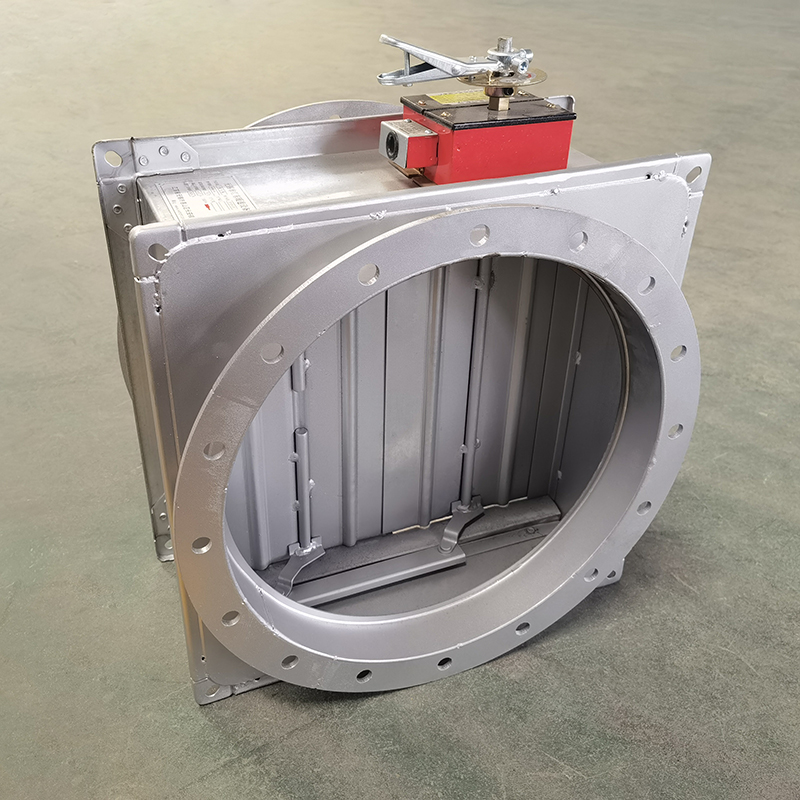
Equipment interfaces. AHU coils, filters, dampers, fire dampers, sound attenuators and diffuser plenums are almost all rectangular. Every one of those connections is a transition if the duct is round.
Fabrication from flat sheet. Rectangular duct can be cut and folded from flat sheet on a plasma table and a folder, with no spiral former, no decoiler and no lock-forming roll. For a fabricator without spiral equipment, rectangular is the only option.
Specification notes that prevent rework
Three lines matter more than the rest.
Specify the gauge against the size and pressure class together, from the code table, rather than leaving it to the fabricator. The common failure is a 1250 mm wide duct built in 0.75 mm because that is what was on the floor, oil-canning under test and then being braced retrospectively.
Specify the bracing rule by width, and say whether internal tie rods are permitted. On hygienic ductwork they are not, and the alternative is external bracing or a heavier gauge — a decision that has to exist before fabrication.
Specify the joint type per system. TDF for low and medium pressure galvanised work; angle steel or welded flange for high pressure, stainless and smoke exhaust.
Wuxi Weishan fabricates
rectangular duct in galvanised SPCC, 304 and 316L stainless and Q235B carbon steel, with TDF joints on light gauge and welded construction with angle steel or plate flanges on the heavier duties, sized from 320 mm upward. Because the flange, the damper and the access door come from the same drawing set, the aspect ratio decision can be made once and carried through the whole assembly instead of being re-litigated at every component interface.
The summary worth keeping: aspect ratio is a material decision, not an aerodynamic one. It moves steel cost by up to 41 % and fan energy by up to 11 %, and those two numbers are not the same size. Optimise the sheet, accept the pascals, and keep the bracing rule in view.
 +85247166614



 Current
location:Home >news
>Industry news
>Rectangular Duct: Three Beliefs, And What The Numbers Say