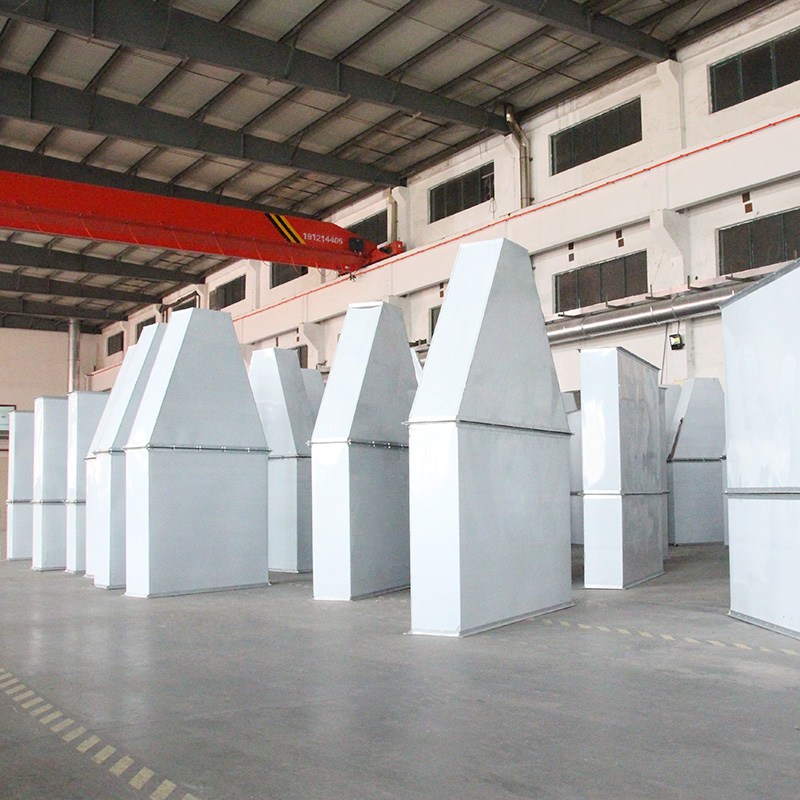
Almost every ventilation system in the world is built from a galvanized sheet metal duct, and almost nobody reads the coating specification. The drawing says "galvanised" and the fabricator buys whatever coil is on the rack. That works fine in a dry ceiling void and fails in three years in a coastal plant room, and the difference is a single number that nobody wrote down.
Walking down a galvanized sheet metal duct specification one line at a time is the quickest way to see where that number belongs.
The steel under the zinc is usually SPCC — cold-rolled commercial quality sheet — or DX51D in the European designation. It is mild, formable, and it has no corrosion resistance of its own. Everything the duct does to resist rust comes from the coating.
Gauge selection follows the code table and the pressure class, not preference. In the common GB 50243 schedule a 320 mm wide duct takes 0.5 mm, a 500 mm duct 0.6 mm, a 1000 mm duct 0.75 mm, and a 2000 mm duct 1.0 to 1.2 mm. Deviating downward to save steel is the single most common cause of oil-canning and drumming on start-up.
For a 1000 × 500 duct in 0.75 mm Z275, the perimeter is 3.0 m and the mass is 18.5 kg per metre — 53 kg on a 3-metre hanger span once you add the flange.
Now the part that changes decisions. Zinc corrodes at a rate set by its environment, and the spread between environments is more than an order of magnitude.
Two conclusions fall straight out. In a dry indoor ceiling void, Z120 is generous — the duct will outlive the building. In a coastal or industrial plant room, Z275 is not a premium, it is the minimum, and even then the duct needs a paint system on top.
This is why specifying "galvanised" without a coating mass is not a specification. The same word covers a duct that lasts sixty years and a duct that lasts one.
The paint question
Galvanised steel takes paint badly when the surface is fresh, because the zinc forms a passive layer that paint will not key to. The standard preparation is a sweep blast, a T-wash or an etch primer, followed by a compatible topcoat. Painting over mill-finish galvanised sheet without preparation produces a coating that fails in sheets within a season — and takes the zinc with it in the disbonded areas.
What the standard actually tests
Coating mass is verified by stripping the zinc from a known area of sheet and weighing it, which is why the specification is expressed in grams per square metre rather than micrometres. The thickness figure is a conversion, useful for corrosion calculations but not what the mill certificate reports. When a supplier quotes a coating class, ask for the test method and the certificate, because a triple-spot average and a single-spot minimum are different claims.
Line three: the cut edge
Every cut, every notch and every drilled hole exposes bare steel. Zinc protects steel sacrificially, so a small exposed edge is protected by the surrounding coating dissolving preferentially — but the protection extends only a short distance, and it consumes coating as it works.
In a dry indoor application this is a non-issue. In a wet or coastal one it is the reason a duct fails along its seams rather than in the middle of its panels. The remedies are to specify a coating on cut edges, to use a heavier coating overall so there is more zinc to spend, or to move to a material that does not depend on a coating at all.
Line four: the seam
A galvanized
sheet metal duct is joined along its length either by a lock seam — the sheet edges folded and interlocked — or by welding. The choice is not stylistic.
Lock seam. No heat, no coating damage, fast, and the standard for light-gauge HVAC work. The limitation is strength and airtightness: a lock seam is mechanically interlocked, not fused, and it will pass a small amount of air. On a low-pressure system that is acceptable; on a medium or high-pressure system it is the leak you spend a day finding.
Welded seam. Strong and airtight, and the right choice for high pressure, for stainless, and for anything that will be tested to a tight leakage class. On galvanised sheet it brings a specific problem: welding through zinc produces zinc oxide fume, which is a respiratory hazard and a cause of weld porosity.
The practical answer is to remove the coating from the weld zone before welding and reinstate it afterwards with a zinc-rich compound. On a 30 mm wide seam in Z275 material that is about 8 grams of zinc removed per metre of weld, and the fume extraction has to be designed for it rather than improvised.
The comparison in one line each: a lock seam is moderately airtight with no coating damage and suits low pressure light gauge; a welded seam with the coating stripped and reinstated is highly airtight and suits medium and high pressure; welding through the coating is not recommended at all; and a TDF joint at the duct ends gives high airtightness with a gasket and no coating damage, which is why it dominates low and medium pressure work.
Flange and joint coatings are separate items
The duct body and the flange are often different materials with different coatings. A galvanised duct with a painted angle steel flange has two corrosion systems meeting at a weld, and the weld itself has neither. On a galvanized sheet metal duct in a corrosive environment, the flange, the weld and the fixing are where the coating story breaks down first, and they are rarely specified at all.
Line five: what happens between the factory and the ceiling
Fresh galvanised sheet stored in damp conditions develops white rust — zinc hydroxide and zinc carbonate forming a bulky white deposit on the surface. It is not a cosmetic issue. White rust consumes coating, and a panel with a heavy bloom has less zinc left than its specification claims.
The prevention is unglamorous: store under cover, keep the stack off the ground, allow air circulation between sheets, and do not let condensation form on cold metal in a warm humid space. On site, the same rules apply to installed ductwork before the ceiling closes — a duct that sits for three months in a wet riser with water pooling in the bottom will have white rust along its low point and pitting underneath it.
The construction sequence matters here. Duct installed and sealed early in the programme will be exposed for longer, and the coating specification should account for the exposure rather than assume the building will be dry.
Line six: where galvanised stops being appropriate
Four duties where a galvanized
sheet metal duct is the wrong material regardless of coating mass:
Chloride-bearing air. Swimming pools, coastal intakes, some process exhaust. Zinc is attacked by chlorides and no coating mass fixes it. Stainless 316L is the answer.
Condensing service. Kitchen exhaust, some process extract. Water running on zinc continuously will consume the coating locally. Stainless or a coated carbon steel with a drainage detail.
Hygienic duty. Pharmaceutical and food ducts need a cleanable, non-shedding bore. Galvanised sheet has a seam and a coating that can flake; stainless with welded seams is the standard.
Smoke exhaust. A galvanised duct can be used under external fire protection, but the rating belongs to the assembly, not the duct, and the coating is irrelevant to the fire performance.
What to write in the specification
Six lines turn "galvanised" into a real specification:
• Substrate designation and gauge, tied to the pressure class.
• Coating mass in g/m², both faces, and the standard it is tested to.
• Seam type, and the coating reinstatement method at welded seams.
• Cut edge treatment, or a statement that none is required because of the environment.
• Storage and handling requirements, including white rust prevention.
• Any paint system, with its surface preparation.
Wuxi Weishan produces galvanized sheet metal duct in SPCC from 0.5 mm upward, with lock-seam construction on light gauge and welded construction with coating reinstatement on the heavier and higher-pressure duties, alongside stainless 304/316L and carbon steel Q235B ranges for the duties where zinc is the wrong answer. The company's environmental engineering work — pulse dust removal, VOCs treatment, industrial ventilation across 16 countries — has taken its ductwork into enough coastal, chemical and high-humidity sites to make the coating conversation a standard part of the specification rather than an afterthought.
The short version: on a galvanized sheet metal duct, the gauge decides whether it is stiff enough and the coating mass decides whether it is still there in ten years. One of those two numbers is always on the drawing. The other one should be.
 +85247166614